
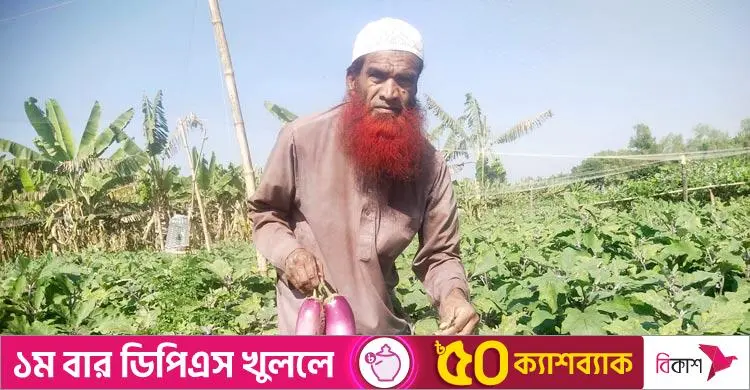
Farmers in several northern districts are growing poison-free vegetables using environment-friendly methods, without chemical fertiliser or pesticide. Such fields can be seen in parts of Bogura as well as Rangpur, Nilphamari, Dinajpur and Panchagarh. The farmers describe it as a new farming movement. In their words, they will not produce food that brings danger. Their lives have changed, and demand for their vegetables in the market has grown.
In Kamarpara and Jointapur villages of Chupinagar union in Bogura's Shajahanpur upazila, farmers have brought about what amounts to a revolution in poison-free vegetable growing. They have put chemical fertiliser and pesticide aside and farm with herbal methods and vermicompost. Their effort is being praised from the field to the market.
Farmers who make their own inputs
On the morning of 18 December, farmer Abdul Mannan (58) was working beside his tomato field, scattering a kind of organic fertiliser on the soil. "I used to use chemicals. The yield was good, but the soil became hard and lost its life. Now I use earthworm compost and herbal remedies. The soil's fertility has come back, and the quality of the crop has improved," he said. On one side of the field, bottles of a natural pesticide made from neem leaves and pitraj hung from branches. Sprayed on the field, it keeps insects away without harming the plants.
In Kamarpara, almost every house has cement rings beside it in which earthworms, cow dung and straw are mixed to make vermicompost. Farmer Abdul Majid (55), standing by the ring next to his house, said: "We make earthworm compost using cow dung and some organic materials. When this compost goes on the land, the yield is much better."
Another woman farmer, Monowara Begum (38), said: "We make this fertiliser ourselves. It not only cuts costs but also improves the quality of the land. Land that used to give 100 kg of crop now gives 120 kg."
Young farmer Kamrul Hasan Shovon (28) showed how herbal pesticide is made. "An extract of plants such as neem leaves, bishkatali and thankuni, sprayed on vegetable fields, keeps pests away. The plants stay healthy and yield more," he said, adding that Kamarpara village is famous for chilli growing.
What the numbers show
Giving the example of chilli on 10 decimals of land, he said that growing it the conventional way, from ploughing through chemical fertiliser, pesticide and irrigation to marketing, costs Tk 6,500. The land yields 48–50 maunds. Even sold at Tk 300 a maund, the chillies fetch Tk 15,000, and after costs the profit is Tk 11,500, by his account.
Grown organically, the same land costs a third as much. Cow dung is applied when the land is prepared, then 15–20 kg of vermicompost (a local fertiliser made from earthworms and dung) before irrigation. For pests the farmers use a herbal remedy: an extract of neem leaves, bishkatali, pitraj, thankuni, dhutura and bherenda, of which just 50 grams is mixed in each litre of water and sprayed. They say no pests remain on the crop, the plants live longer, the yield is much higher and the produce looks glossy and is poison-free. By this method, growing 10 decimals costs only Tk 2,000 and yields 55–60 maunds. Sold at the same Tk 300 a maund, the profit after costs is Tk 16,000. Because buyers prefer poison-free vegetables, selling is no problem, and the village's produce is now in demand in nearby markets.
Wholesaler Salam Saudagar (50) said: "I buy vegetables from this village regularly. They sell at a good price in Dhaka's markets. Buyers are looking for poison-free goods, so a slightly higher price is no problem. Vegetables grown with chemical fertiliser often rotted before reaching Dhaka. Poison-free vegetables last longer, which is why buyers like them."
Moslem Uddin, a salaried worker buying vegetables at the nearby RDA market, said: "I buy poison-free vegetables to protect my own and my family's health. They are free of harmful chemicals, so we can eat them without worry. For health-conscious city people like us, these vegetables are now very attractive."
Farmer Shukur Ali (60) said: "We used to have to borrow heavily each season, and chemicals cost a lot. Now we make our own fertiliser and pesticide. With lower costs, profits are higher. My two sons are studying. That was not possible before."
Women in Kamarpara are not confined to household work. Woman farmer Monira Khatun (42) said: "We work in the fields ourselves and also grow vegetables in the yard. What we earn from selling poison-free vegetables pays for the household."
Support for the farmers
A private organisation called Gramin Unnayan Prokalpo helps the farmers produce safe vegetables. Its executive director, Abdullah, said: "We are training farmers in how to make vermicompost and use herbal pesticides. Their initiative is becoming an example for the whole country." He called for a separate marketing system to bring these vegetables within reach of ordinary buyers, and for support from the agriculture officials concerned.
Motlubur Rahman, deputy director of the Department of Agricultural Extension (DAE) in Bogura, said: "Poison-free farming benefits not only the farmer; buyers are getting healthy food too. We have taken steps to spread this method everywhere, so that both farmers and consumers benefit."
How it began
The journey began around 2010. Kamarpara farmer Saidur Rahman's eyesight was damaged by spraying pesticide. His accident was a lesson that made the whole village aware. Interest in poison-free farming then grew in Kamarpara and neighbouring villages, and farmers decided to grow vegetables using only herbal inputs, without pesticide or chemical fertiliser.
Rostam Ali, a field coordinator ("crop doctor") of Bangladesh Agricultural University, helped them with information. At first the initiative was limited to Kamarpara and Jointabari. Since then, nearby villages including Bri-Kushtia, Phulkot, Bilkeshpata, Bihigram, Dahikandi, Barapathar, Chupinagar, Bohail, Duskula, Mostail, Khalishakandi, Durgapur, Shibpur, Ramnagar, Joanpur, Radhanagar, Garidah and Sonaidighi have been changed by poison-free farming. Local farmers are inspiring one another and now advise each other voluntarily.
Rangpur, Dinajpur and Panchagarh
Farmers in Pirganj, Mithapukur and Kaunia upazilas of Rangpur are also growing poison-free vegetables after training from Rangpur's agricultural university. Farmer Mahbubur Rahman said: "We used to use chemical fertiliser, but now we use organic fertiliser and take care of the plants. Farming this new way gives much better quality, and the environment is not polluted." He said the agriculture department was also supporting them, which helped their farming.
In Hakimpur, Biral and Nawabganj areas of Dinajpur, farmers grow vegetables without pesticide or chemical fertiliser, using vermicompost, cow dung and natural materials to raise soil fertility, and yields are rising. Hakimpur farmer Selim Uddin said: "With natural methods the land stays healthier and the crops are better."
In parts of Panchagarh, farmers have used biofertiliser, which is environment-friendly and maintains soil fertility. Local farmer Jamal Uddin said: "We grow vegetables with some natural materials. Costs are low and yields are good." He said the method is becoming popular among other farmers and its use is increasing day by day.
Source: Jagonews24. First published in Bengali on The Agro News.
Comments
(0)