
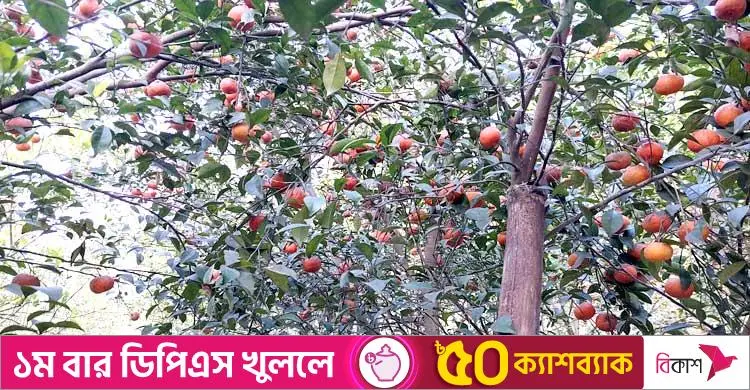
Orange farming is growing in 16 districts of the country's north. Thanks to the weather and soil quality, China orange, Darjeeling malta and mandarin orange have become profitable in the region. Farmers' hard work and help from the agriculture department are changing the local economy.
Md Abdul Aziz, a farmer in Gobardhanpur village of Bogura, started growing China oranges in 2019. His orchard on two bigha now has 200 fruiting trees. Alongside China, Darjeeling and mandarin oranges, he also grows red grapes, Thai grapes and local grapes. He has sold about Tk 4 lakh worth of fruit so far.
"I became interested in orange farming after watching YouTube, and started with encouragement from my children," Abdul Aziz said. "There is good demand in the market now, so I am getting good prices."
Several people in the Gobardhanpur area have started growing China oranges on a small scale. Some are also getting good results from trial plantings of lemon and malta.
From Panchagarh to Kurigram
Panchagarh in the north is already known for tea, but orange farming has now brought big changes. Farmers in Tetulia and Boda upazilas have started growing oranges in hilly areas. They say yields are good because of the hilly land and the use of natural organic fertiliser.
Abdul Kader, a farmer in Tetulia, said: "Alongside tea, orange farming has opened a new horizon for us. By using natural resources properly here, we can gain more."
Several farmers in Mithapukur upazila of Rangpur and Chirirbandar upazila of Dinajpur are growing China and Darjeeling malta on a small scale. Orange farming could expand greatly in the region with government help. Farmers say demand for oranges is high, and buyers trust the fruit more because it is free of poison.
The Department of Agricultural Extension (DAE) in Rangpur said plans are being made to raise yields further by training farmers and supplying necessary inputs.
Mandarin oranges are being grown on a trial basis in Saghata upazila of Gaibandha and Phulbari upazila of Kurigram. The DAE says interest among local farmers is rising because yields have been good.
Farmer Md Rafiqul Islam said: "Because the mandarin yield has met expectations, I plan to grow it on more land next year."
Technology, storage and marketing
Better technology is making orange farming easier and more rewarding. Drip irrigation and modern irrigation systems have become very popular with farmers. Local agriculture offices are giving technical support by training farmers and supplying equipment.
One of the biggest challenges for farmers is the lack of enough cold storage and processing centres for harvested oranges. The authorities concerned are taking steps to make processed products, and there is scope to expand the market by producing juice, jam, jelly and other goods.
Marketing is also making progress. Farmers are selling fruit through online platforms and directly to wholesalers. Buyers' trust has grown because the fruit is poison-free and grown organically.
Faridur Rahman, sub-assistant agriculture officer at the DAE in Bogura, said: "The environment in the north is very suitable for orange farming. We are advising farmers to use organic fertiliser, which makes the fruit sweet and poison-free."
The DAE in Panchagarh and Dinajpur said farmers will get more help through new technology and supplies of improved seedlings.
Costs, returns and the outlook
To raise profits, the agriculture department has taken steps to distribute improved seedlings, train farmers in the use of organic fertiliser and supply drip irrigation technology. There are also plans to set up processing centres locally, which would widen farmers' opportunities to sell their fruit.
Farmers in the north say orange farming can earn more profit at relatively low cost. With an outlay of about Tk 1 lakh, a return of three to four times is possible within two years.
Farmer Md Anwar Hossain said: "By growing companion crops such as lemon and ginger alongside oranges, my income has grown a lot."
Agriculture experts believe that planned cultivation and expansion of orchards in the 16 northern districts could reduce the need to import oranges and strengthen the local economy.
If training, seedling distribution and orange processing centres are provided with government backing, the region will move ahead faster. The success of northern farmers is inspiring farmers in other regions, and with more government support the north could become a new hub of orange production.
Source: Jagonews24. First published in Bengali on The Agro News.

Comments
(0)