
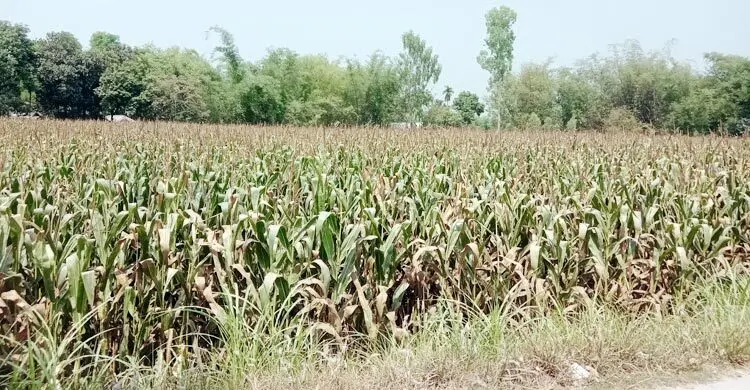
Nilphamari is burning in a prolonged drought. Crops in the fields are losing their colour in the excessive heat, and the ongoing heatwave has left the land short of water and brought on various diseases and pests. Farmers are struggling to protect their crops even with extra irrigation, and fear widespread losses in rice, peanut, chilli, maize, banana and vegetables.
According to agriculture officials, rice grains risk turning chaff (empty) when the temperature rises above 35 degrees Celsius. In Nilphamari, maximum and minimum temperatures are ranging between 40 and 20 degrees Celsius.
Experts say a long drought could threaten crop production. Alongside the financial losses, growing crops in adverse weather has now become a major challenge for farmers.
According to the district agriculture department, boro rice has been grown on 81,857 hectares in Nilphamari this season, peanut on 1,020 hectares, maize on 28,323 hectares and banana on 172 hectares, along with various vegetables.
Farmers' worries
Maidul Islam, a farmer from Chawra in Sadar, told Jago News: "The rice is flowering now. The sky is like this: harsh sun in the morning, less in the afternoon. The rice is being damaged by the heat. And the way the sky looks, nobody can say what will happen even if a storm and rain come."
Anowarul Islam, a peanut grower from Chikonmati in Domar, told Jago News that the peanut plants in his field are wilting in the intense heat. The soil where he grows gold seems to have dried up and become lifeless. He planted the crop with money borrowed from a moneylender, but it is being ruined before his eyes by the drought.
"There is no moisture in the soil. There is no rain either. So the peanut kernels are getting smaller. When I irrigate with the machine, the water doesn't last even five days. The sun dries everything up," Anowarul Islam said.
Nabijul Islam Nabin, a farmer from Palashbari union in the upazila, told Jago News: "This year fog ruined most of the seedbeds. Later I bought seedlings at a high price and planted rice. Now it seems the rice that has come out will turn to chaff in the intense heat. God knows how I will feed my family."
Hamidul Islam, a farmer from Khalishachapani in Dimla, told Jago News: "I planted maize on 10 bighas this time. I thought the yield would be good. But because of the drought the maize yield is very low. There won't be much profit."
Dr SM Abu Bakar Saiful Islam, deputy director of the Department of Agricultural Extension (DAE) in Nilphamari, told Jago News that various DAE officials are advising farmers so that their crops are not damaged by the extreme heat.
Source: Jagonews24. First published in Bengali on The Agro News.
Comments
(0)