
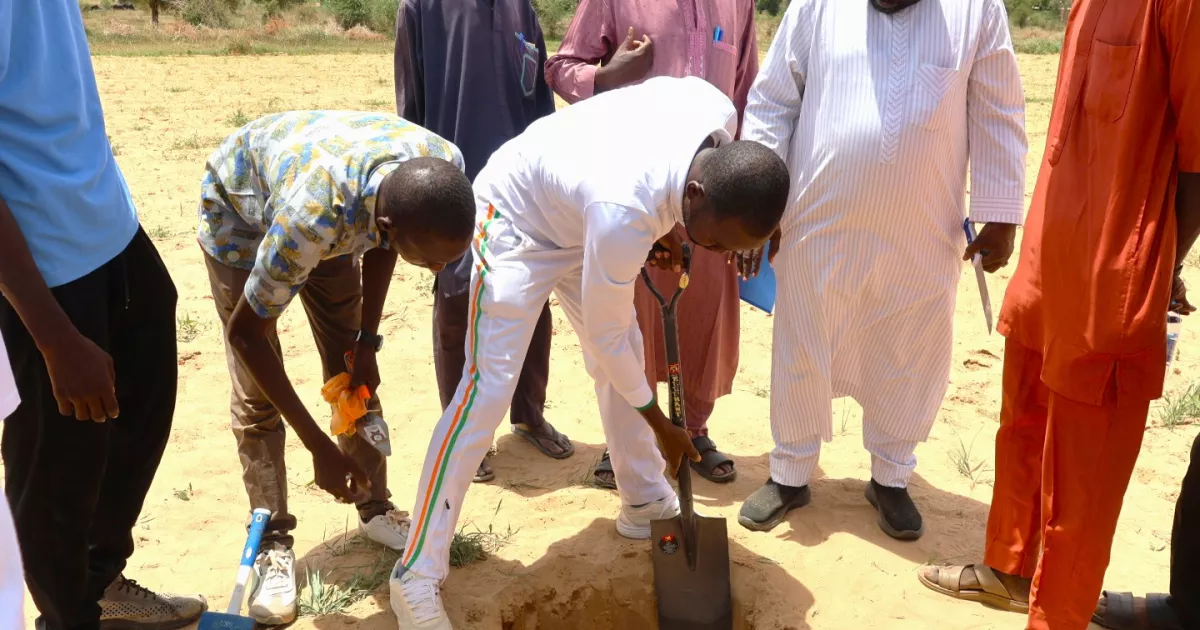
Twenty members of field survey teams in the Republic of Niger have been trained to carry out a major soil sampling campaign that will produce baseline data on soil fertility for the country's farming areas. The three-day course, held in Maradi from 7 to 9 July 2026, was run by IITA-CGIAR through the Soil Values Program.
Participants included team leaders, surveyors and technical staff from the partner institutions implementing the programme. Prof. Jibrin M. Jibrin facilitated the technical sessions, while Dr Maman Garba, IITA Scientist for Soil Values in Niger, coordinated the training and provided French interpretation throughout so that the field procedures were understood by all.
The sessions covered the scientific principles of representative soil sampling; the hierarchical sampling framework of primary, secondary and tertiary sampling units; site verification and sample collection; labelling, packaging, handling and quality assurance; and field safety and community engagement. Participants also learned two digital tools, ODK Collect for electronic data capture and MAPS.ME for navigation to sampling points.
"The most valuable aspect was integrating digital technologies with biophysical soil sampling," said Issiaka Maman Bizo, a Research Assistant at ICRISAT Niger. "This approach will help us collect reliable data for evidence-based decision-making on soil fertility management in Niger."
After the training, the teams were deployed to the Korama and Gulbi watersheds to begin sampling. The data will characterise the soil fertility constraints of the two areas and inform targeted interventions, from fertiliser recommendations to soil management practices, across Niger's part of the Sahel.
Standardised, georeferenced soil data of this kind is what allows fertiliser and soil-management advice to be matched to a particular field rather than a whole region. The IITA story was contributed by Sarah Sallau.
Source: CGIAR
Comments
(0)