
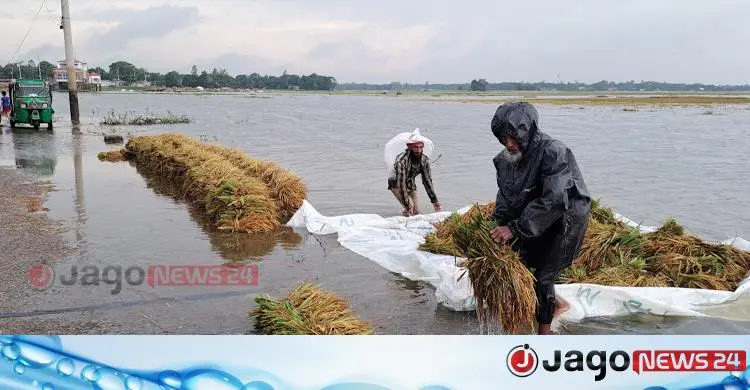
In Netrokona's haor region, farmers seem to be in a fight against nature. Continuous rain and hill runoff from upstream are raising water in the haors and rivers rapidly. Ripe paddy is going under water, while the fear is growing that cut crops will rot because they cannot be dried. Thousands of farmers are at a loss as they try to save their crops.
The district Water Development Board said the Kangsa river at Jhanjail is already flowing 95 centimetres above the danger level. With heavy rain forecast for the next few days, it is feared the situation could get worse.
Officials of the Khaliajuri upazila administration said about 58 per cent of the paddy in the haor has been cut so far, but the paddy on the remaining half of the land is still in the field and depends entirely on the weather.
Labour shortage and waterlogged fields
Farmers are at their wits' end with heavy rain, hill runoff and the fear of lightning, and on top of this come a labour shortage and limited machinery. In many areas, waterlogging means combine harvesters cannot be used.
Manik Sarkar, a farmer in Gaglajur in Mohanganj upazila, said: "Two days ago there was ripe paddy in the field. It rained at night. In the morning I came and found everything under water. Out of seven bighas I have been able to bring in only one."
Kuddus Mia, a farmer in Khaliajuri, said: "Fearing a flood, I have cut even half-ripe paddy. Whatever I get is better than having it go under."
Many farmers have cut paddy for threshing but cannot dry it in the continuous rain, so it too is at risk of rotting. In some places water has reached paddy kept on the threshing yards. Shahin Mia, a farmer in Krishnapur village, said he woke in the morning to find the paddy on his threshing yard washed away. "I don't know what to do now," he said.
Embankments at risk
The haors' crop protection embankments are now at serious risk, and embankments in various haors of Mohanganj upazila have weakened. Upazila nirbahi officer Nadir Hossain Shamim said all the project implementation committees (PICs) have been ordered to guard the embankments, and preparations have been made to drop geo-bags quickly if needed.
The Meteorological Department said rainfall above normal may occur in the north-east and upstream over the next few days. Heavy rain is also likely in Cherrapunji in India, which could bring fresh runoff and complicate the situation further.
Md Sakhawat Hossain, executive engineer of the Water Development Board, said it is now very risky to leave paddy that is 80 per cent ripe in the field, and cutting it quickly is the safest course.
The haor farmers' livelihood for the whole year depends on the Boro crop. If it is lost, repaying loans, running the household and even getting food could become hard. Jalil Mia, a farmer in Panchhat village, said: "Everything is going under before my eyes. I can't understand how I'll repay my loans or support my family."
Sakhawat Hossain, executive engineer of the district Water Development Board, said the Dhanu river at the Khaliajuri point is now 85 centimetres below the danger level and all the embankments are intact. But water will rise further from today, which could create a flood situation and put the embankments under threat. "We are staying in the area with the upazila administration. We are fully prepared to protect the crops and the embankments," he said.
Targets and the administration's response
Aminul Islam, deputy director of the district Department of Agricultural Extension (DAE), said Boro paddy was grown on 185,547 hectares in the district, with a target of 1,321,732 tonnes of paddy. Of this, the target for 41,065 hectares in the haor area is 292,590 tonnes.
Deputy commissioner Khandaker Mushfiqur Rahman said water in the Dhanu river has risen somewhat, but the haor is still safe. So that farmers can harvest without disruption, members of the embankment PIC committees, local public representatives and farmers have been asked to stay alert alongside the Water Development Board.
He said the UNOs are in the field and are being advised round the clock. Geo-bags have been kept ready wherever they need to be dropped. If the water rises, the risk will grow, and everyone must stay alert, he said.
Source: Jagonews24. First published in Bengali on The Agro News.


Comments
(0)