
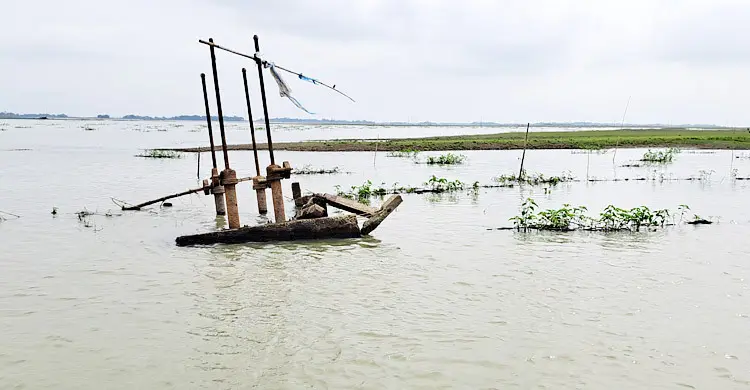
Water is still brimming in all of Netrokona's haors. Farmers along the haors are worried about when the water will recede and when Boro cultivation can begin. They cannot even prepare seedbeds for Boro. If Boro is planted late, the haor crop will face the threat of early floods.
Sluice gates out of order
The district Water Development Board says there are 402 hydraulic sluice gates for draining the 134 large and small haors of Netrokona. Of these, 327 are working and 75 are out of order. But although they are in order on paper, most of them are now out of order, so water is draining from the haors very slowly. In addition, a sudden flood in the month of Ashwin has left the haors full of water.
Researchers say development in the haors does not take account of their physical geography. Unplanned embankments and the loss of navigability of the rivers threaten the haor environment. As a result, the haors' freshwater fish are declining on the one hand, and on the other the year's only crop is repeatedly lost to early floods.
Every year there is a risk of hill runoff in the haor areas between March and April, when the haor paddy starts to ripen. To protect the Boro crop on about 41,000 hectares in the haor region, the government spends crores of taka each year building crop protection embankments. But the embankments break in the hill runoff and the year's only Boro crop goes under water.
Seedbeds 15 days behind
The sluice gates of large crop haors such as Kirtankhala, Dingapota and Charhaijda in Netrokona are also out of order. In the Boro season, seedbed preparation begins in the first week of Agrahayan. Seedbeds are made on high ground beside the haor, known locally as kanda. But this year seedbed work is about 15 days behind, so Boro planting will also be 15 days late. Paddy planted late ripens late, and the runoff water from upstream may arrive before the paddy is ripe.
Shafiqul Islam Talukdar and Mohsin Mia, farmers of Puranhati village in Khaliajuri Sadar, said the Kirtankhola embankment of Kirtankhola haor has two sluice gates, one of which is broken and the other in somewhat better shape. "On one side there is the worry about the crop protection embankment, on the other the worry about the sluice gates. Even when we grow the year's only crop on borrowed money, an early flood takes it all."
Kuddus Mia and Abdur Razzak, farmers of Jagannathpur village in the same upazila, said: "Because of the Ashwin flood the haor water is not going down. We can't prepare Boro seedbeds. If the seedbeds don't emerge, cultivation will be delayed, and if cultivation is delayed, the risk of losing the crop to floods rises."
According to the agricultural extension office, paddy yields in the haor are 5 to 6 tonnes a hectare. Farmers in Madan, Mohanganj and Khaliajuri upazilas of the haor region have about 41,000 hectares of land, with a target of producing about 2.5 lakh tonnes of Boro paddy. If the haor water is slow to recede, cultivation is delayed and the crop is exposed to the risk of early floods.
Officials' view
Saying that most of the sluice gates need repair, Netrokona Water Development Board executive engineer Sarwar Jahan said: "Three years ago Tk 25 crore was sought to repair these sluice gates, which would now take more than Tk 34 crore. The sluice gates will be repaired if we get the allocation. This year Tk 90 crore was sought for the haor crop protection embankments and we received Tk 15 crore. Because of the recent Ashwin flood there will be some problems at the start of Boro cultivation. But the water also falls naturally and evaporates."
Md Nuruzzaman, deputy director of the Department of Agricultural Extension (DAE), said: "The Boro seedbeds have emerged. Seedbeds are usually on high ground. The haor water will take a little longer to recede, but I hope Boro will be cultivated at the right time."
Source: Jagonews24. First published in Bengali on The Agro News.
Comments
(0)