
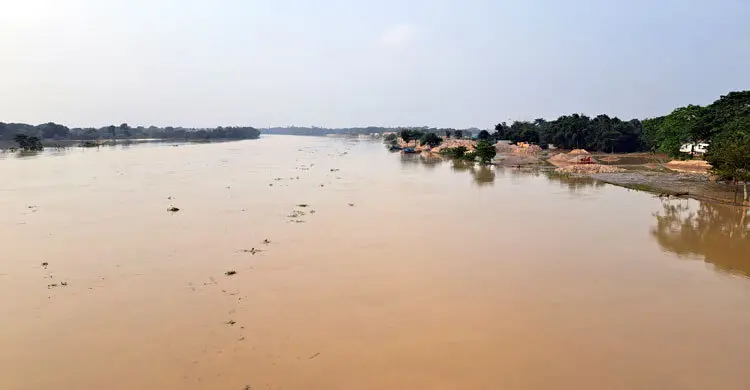
Flood water has started to recede in Netrokona, but the crisis is not over. Many of those returning home from shelters or relatives' houses have found their homes wrecked, and their paddy and rice spoilt by water. As a result, these people are struggling for food.
With most rural roads in the district still under water, it is hard to get around in search of work. About 25,000 hectares of aman crop are under water, 232 educational institutions remain closed, and around a lakh people are still marooned. All in all, flood victims are going through hardship.
Rivers falling
Md Sarwar Jahan, executive engineer at the Netrokona Water Development Board office, said water in all rivers, including the Kangsha, Someshwari, Dhanu and Ubdakhali, had been falling fast since Wednesday afternoon. But the Ubdakhali is still flowing 5 cm above the danger level at the Kalmakanda point, where the danger level is 6.55 metres. Other rivers are below the danger level, and the water is expected to drain quickly through the Dhanu into the Meghna, he said.
Continuous heavy rain and hill runoff caused a flash flood on 6 October in Kalmakanda, Durgapur, Purbadhala, Barhatta and Sadar upazilas of Netrokona. More than a lakh people in 131 villages were marooned, and aman paddy on about 27,000 hectares was submerged. Although the water began to fall from Wednesday afternoon, there is still water on various roads and in schools and homes. Some 232 educational institutions, including 212 government primary schools, were closed because of the water. With about 350 km of paved and unpaved roads under water, links with all unions have not been restored.
Roads and bridges damaged
According to the Local Government Engineering Department (LGED) Netrokona office, of the 5,953 km of roads under LGED in the district, 1,638 km are bitumen roads, and the rest are CC, RCC, megatom, carpeting and earthen roads. Most of the roads from which flood water has drained cannot be used, as the current has broken them in places. Small and large concrete bridges, box culverts and approach roads have also collapsed in the flood at various spots. With road links cut, people are suffering badly.
Saidur Rahman, chairman of Lengura union parishad in Kalmakanda, said people's hardship was not easing even though the flood water had gone down. Many people's homes have been broken, and they cannot repair them for lack of money. Large numbers of people are crowding in for relief, and roads have been badly damaged as well as homes, he said.
Mostafizur Rahman, assistant commissioner (land) in charge of the Durgapur upazila nirbahi officer's duties, said many villages in Gaokandia, Kullagara and Kakoigara unions were still under water. Aman fields have been badly damaged in villages including Sreepur, Bil Kakrakanda, Daulatpur, Gojalia, Rambari and Shantipur, he said.
Crop and fish losses
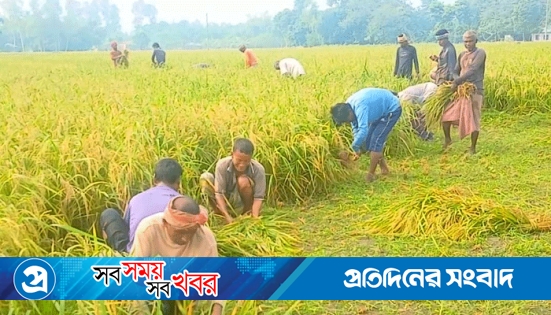
Md Nuruzzaman, deputy director of the district Department of Agricultural Extension (DAE), said aman is grown on 1 lakh 35 thousand 900 hectares in the district's 10 upazilas. He said crops on 24,667 hectares were damaged by the flash flood, and vegetables on 177 hectares were destroyed.
District fisheries officer Md Shahjahan Kabir said 723.43 tonnes of fish and fry from 1,480 ponds and farms had been washed away in the flood, a loss of about Tk 8.24 crore.
Deputy commissioner Banani Biswas said Tk 4 lakh, 3,000 packets of dry food and 80 tonnes of rice had been distributed in Netrokona so far, and allocations were being increased according to need.
Source: Jagonews24. First published in Bengali on The Agro News.
Comments
(0)