
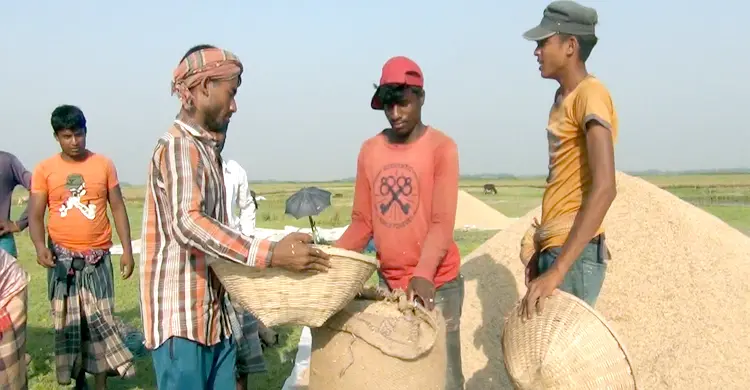
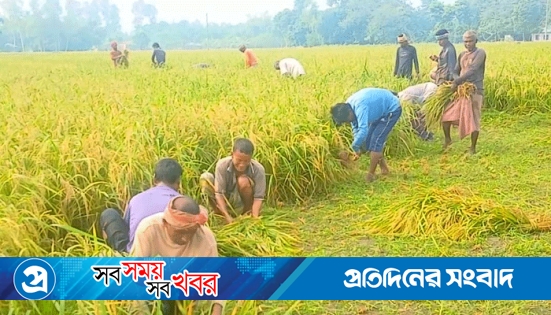
Farmers across Netrokona, including in the haor areas, have had a bumper Boro harvest this season but are not getting a fair price for it. They say the sale price of their crop does not cover production costs, and rising prices of fertiliser, diesel and electricity are pushing them into losses. Even the government's price of Tk 30 a kg for paddy, they say, will not cover their costs. Many are being forced to sell paddy cheaply at local markets.
At Bausi bazar in Barhatta upazila, coarse paddy was selling at Tk 950–1,050 a maund.
Farmers' accounts
Masum Mia, a farmer in the area, said: "Farming doesn't add up. Selling a maund of paddy, I can't even buy a kilo of beef. Guests have come to the house and I don't know what to do. Prices of everything are so high! How will I get through the year? How will I pay for my children's education? I see darkness before my eyes."
Shafiq Mia, a farmer from Dudhkora village in the same upazila, had come to sell paddy at the local Fakirer Bazar. "There is no profit in farming any more," he said. "Oil is dearer, electricity is dearer, everything is dearer. The fertiliser and diesel needed to grow a crop cost more too. Selling paddy doesn't cover production costs. It cost me about Tk 1,150 to grow a maund of paddy. At market it sells for Tk 950. The government is paying Tk 1,200, but we can't sell paddy to the warehouse. There's too much hassle."
Mohsin Mia, a farmer from Piranhati village in Khaliajuri Sadar, said many farmers are forced to sell despite low prices because they need money for daily household costs. Many farm on borrowed money and have to sell paddy cheaply to repay lenders on time.
Keshab Ranjan Sarkar, former president of the district Krishak League, said: "Bypassing the government's purchase decision, mill owners buy paddy cheaply and, in collusion with warehouse officials, sell it at the government price. That is why farmers don't get the government price and suffer losses. Because of debt, they are forced to sell paddy cheaply at markets."
The government began buying on 7 May, and purchases began in the district town on 15 May; in some upazilas they have not yet started. Farmers forced by debt to sell before then are getting much lower prices from local traders and making losses. Most farmers are selling paddy cheaply to middlemen.
Area, output and procurement
According to the district Department of Agricultural Extension (DAE), this year's Boro target in Netrokona was 184,470 hectares, and 184,735 hectares were planted, 265 hectares above target. The expected Boro paddy production target for the district is 1,184,563 tonnes.
In the haor alone, Boro was grown on 40,970 hectares, with a production target of 267,535 tonnes of paddy, worth about Tk 749 crore 9 lakh 80 thousand at current market prices.
According to the district food controller's office, the government will buy the following at the fixed price: Sadar, 1,735 tonnes of paddy and 28,077 tonnes of rice; Barhatta, 1,193 tonnes of paddy and 5,676 tonnes of rice; Purbadhala, 1,848 tonnes of paddy and 14,547 tonnes of rice; Mohanganj, 1,338 tonnes of paddy and 4,379 tonnes of rice; Kendua, 1,666 tonnes of paddy and 4,280 tonnes of rice; Durgapur, 1,522 tonnes of paddy and 154 tonnes of rice; Madan, 1,476 tonnes of paddy and 102 tonnes of rice; Atpara, 986 tonnes of paddy and 1,077 tonnes of rice; Kalmakanda, 1,705 tonnes of paddy and 49 tonnes of rice; and Khaliajuri, 1,708 tonnes of paddy and 77 tonnes of rice. In total, the office says 15,177 tonnes of paddy and 61,218 tonnes of rice will be bought in the district at the government price.
District food officer Moyetasemur Rahman said the Boro season target is to procure 15,177 tonnes of paddy at Tk 30 a kg and 61,218 tonnes of rice at Tk 44 a kg. The procurement drive has begun to ensure farmers get a fair price, and work is under way so farmers can easily supply paddy to warehouses without harassment.
Netrokona deputy commissioner Anjana Khan Majlish said paddy purchases began in the district on 15 May. Farmers who register under the set rules can sell paddy at the government price.
Source: Jagonews24. First published in Bengali on The Agro News.
Comments
(0)