
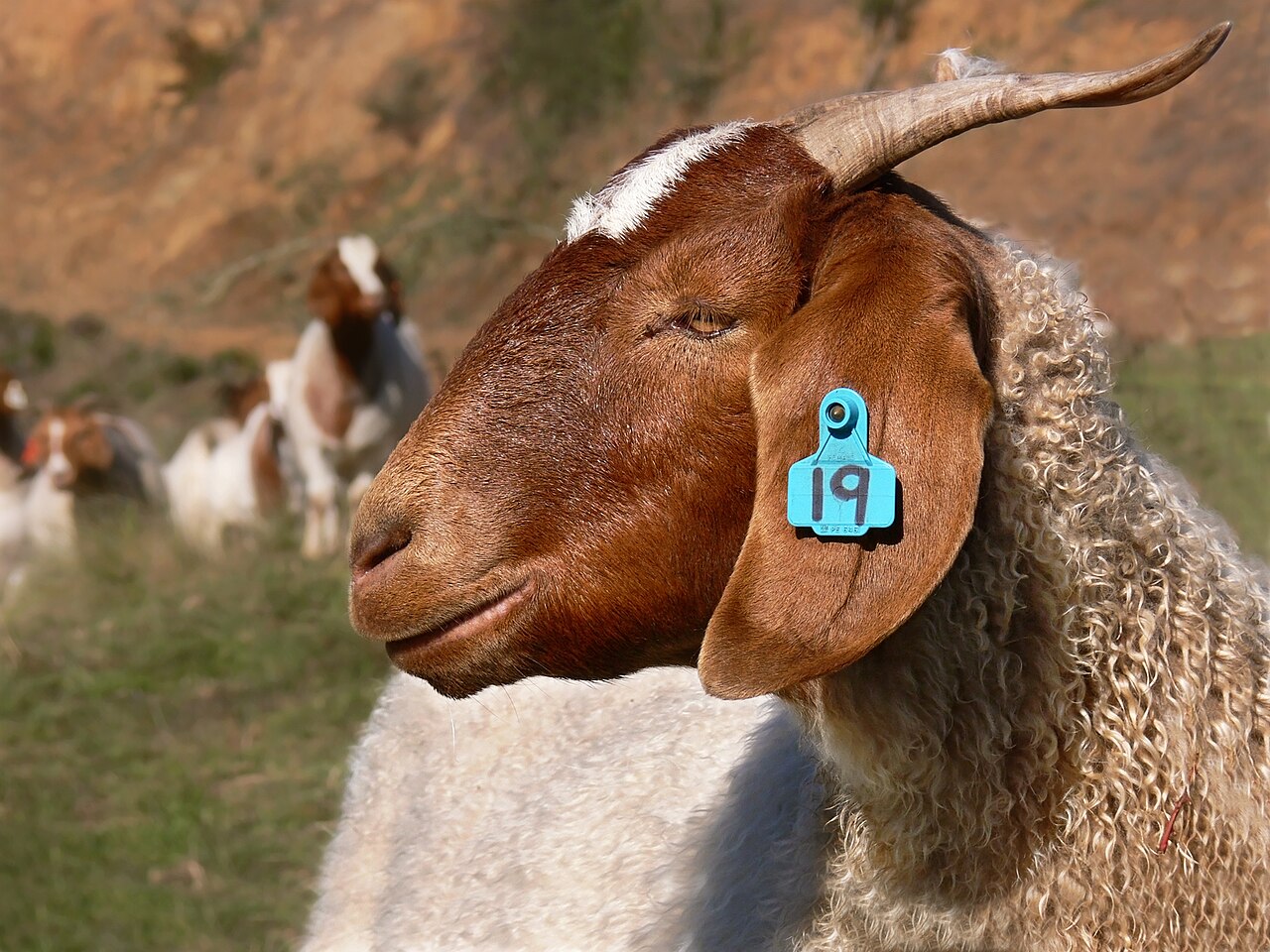
One of the oldest active Boer goat studs in the world, founded in 1925, is still breeding on the arid Noorsveld of South Africa's Eastern Cape, Farmer's Weekly reported. Father and son Sakkie and Nicky Nell, the sixth and seventh generations, run 450 goats under extensive conditions dominated by sweet noors (Euphorbia coerulescens), a spiny succulent that sheep and goats eat in droughts.
The family switched to Boer goats in 1933, after fourth-generation farmer Louis Nell lost 700 Angora goats in a shed during a severe cold spell; he later helped found the South African Boer Goat Breeders' Association in 1959. The breed has proved itself in hard times, Sakkie said: the area averages 250mm of rain a year but received 50mm in 2018 and 65mm in 2019, during a drought that lasted from 2014 until early 2026, and the goats came through it relatively unscathed.
Selection follows the breeders' association standards, with ewes chosen for length, depth and above all mothering ability, since they must kid and raise young under stress. The Nells are strict on udders: no more than two teats, one on each side, and they use only rams with two teats. Outside rams, from studs such as Lucas Burger and Nico Botha, serve for one breeding cycle only, after which only rams carrying half Nell genetics are used.
The goats are not pampered. Their diet is about 60% browse and 40% grazing, which raises the farm's carrying capacity, and the stocking rate is 2ha per small livestock unit. In droughts the noors plants are slashed in half so goats can reach them, and only in extreme dry spells is a protein or energy lick given. The land is split into camps of 120ha to 300ha, each with two watering points set far apart to avoid overgrazing and trampling.
Two mating seasons, from November for April-May kidding and from March-April for August-September kidding, ease management. Kids weigh 4-5kg at birth (3-3.5kg for triplets), the kidding rate averages 180% and weaning 160%, and ewes first mate at 14 months and can produce for up to 10 years; 20% of older ewes are replaced each year.
The stud sells mainly at its own production sales, to commercial and stud breeders. Its top prices so far are R70,000 for a ewe and R50,000 for a ram, and a Nell ewe was world champion at the 2006 Boer Goat World Show.
Reporting by Annelie Coleman for Farmer's Weekly.
Photo: Benjamint444 / Wikimedia Commons (CC BY-SA 3.0)
Source: Farmers Weekly South Africa

Comments
(0)