
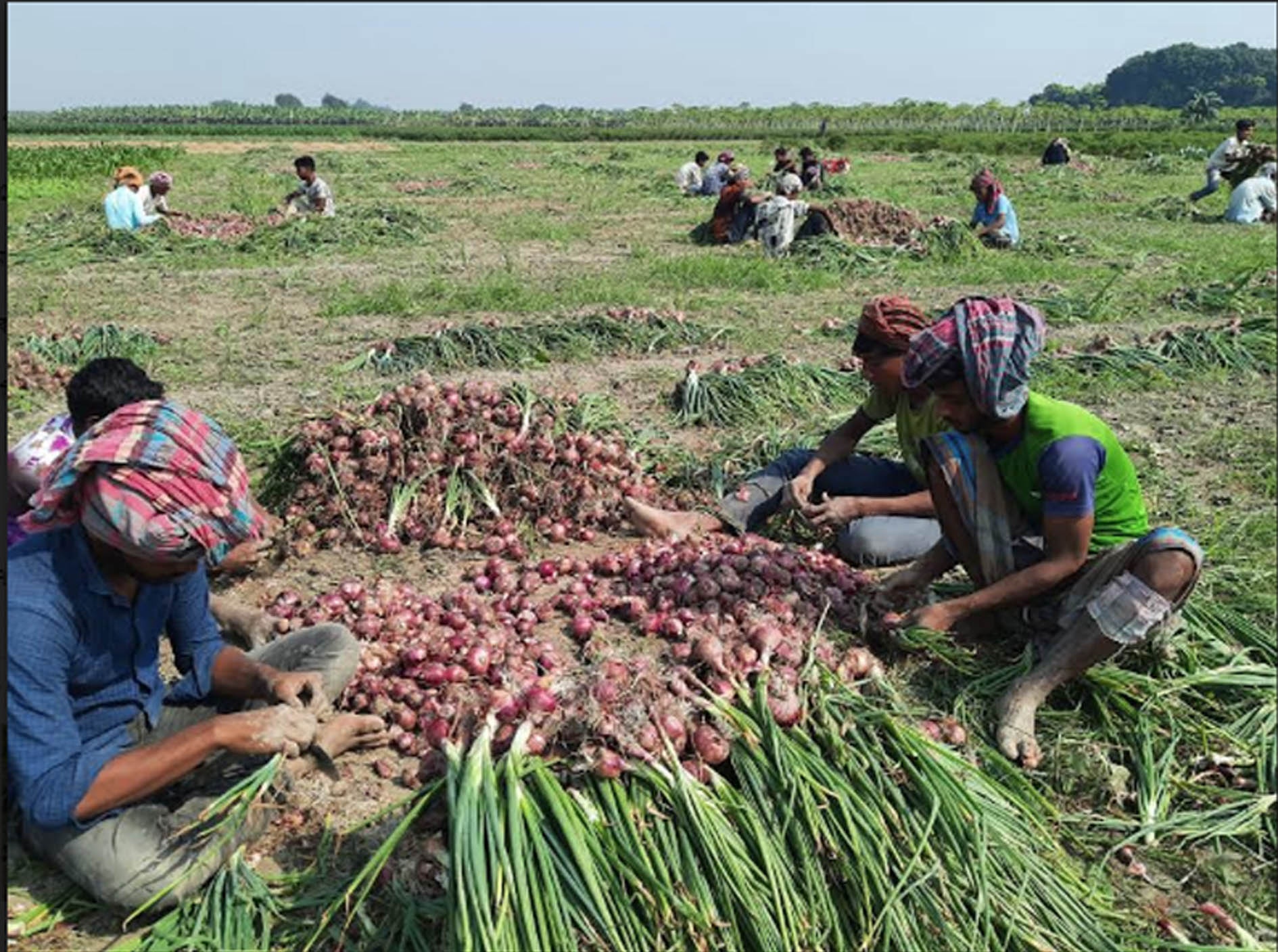
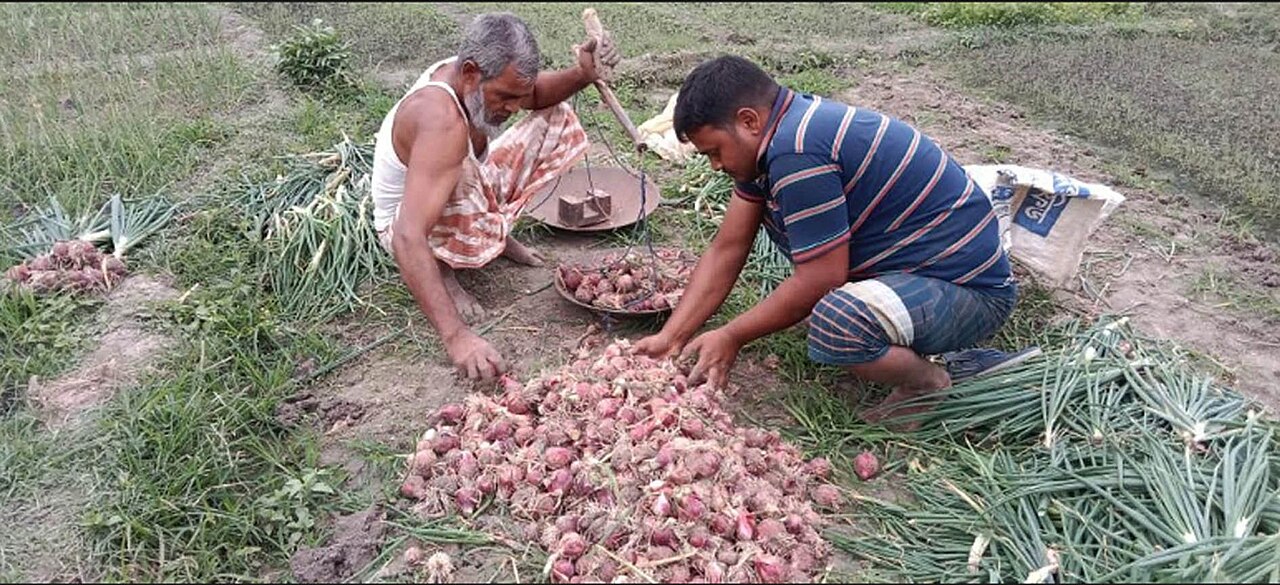
Onion farmers in Natore were selling their crop for less than it cost to grow in early April 2026, at the height of the harvest. Growers and traders at Naldanga haat, the district's largest onion market, told Jagonews24 in a report published on 5 April 2026 that prices did not cover what they had spent on seed, fertiliser, pesticide, labour and leased land. Farmers and traders named onions imported from India, arriving on the market together with the local crop, as the main reason for the fall.
Farmers said rain shortly before the harvest had cut yields in the area that season, while higher prices of fertiliser, seed, pesticide and labour had raised their costs. By their account, growing the Laila or bulb-planted (kanda) type of onion cost Tk 15,000 to Tk 20,000 a bigha, and growing the various local varieties cost Tk 40,000 to Tk 50,000 a bigha. At the prices then on offer, they said, they could not recover that money.
Prices and costs at Naldanga haat
At Naldanga haat, the Jagonews24 correspondent found onions of different kinds selling at Tk 800 to Tk 1,000 a maund, depending on size. The maund is the traditional unit in which Bangladesh's onion markets trade; The Daily Star described it in February 2026 as about 37 kilograms.
Md Saidul Islam, a farmer from Madhabpur village in Naldanga, told the reporter at the haat that he was selling onions at Tk 600 to Tk 700 a maund and was not getting even half of his cost.
Bimal Kumar, an onion seller at the market, gave his own figures. He said he had leased one bigha of land for Tk 40,000 and bought seed at Tk 3,000 a maund, and that dearer fertiliser and pesticide had pushed his cost above Tk 50,000 a bigha. His yield, he said, was 50 to 60 maunds a bigha, and after paying for transport he could not recover what he had spent.
Storage, rot and imports: what traders and officials said
Rana Ahmed and Zahurul Islam, onion wholesalers (aratdars) at Naldanga haat, said Naldanga upazila alone produces 54,000 tonnes of onions a year. Other districts, they said, have storage facilities for onions, but Natore has none, and part of the crop rots when farmers keep it by traditional methods at home. As a result, they said, even when prices rise later in the year, the growers who produced the onions do not get that price and are left with the loss.
The two traders said the fall in prices had come because onions imported from India during the harvest season had reached the market at the same time as the domestic crop. That is their explanation; the import figures that government agencies had published up to early April 2026 are set out below.
Md Sabuj Ali, the Naldanga upazila agriculture officer, agreed that farmers were getting less than their costs. He said the agriculture department was advising farmers on how to store their onions and was distributing some fans among them to prevent rotting.
Habibul Islam Khan, deputy director of the Department of Agricultural Extension (DAE) in Natore, said bulb-planted and seedling onions had been grown on 7,304 hectares in the district that season, against a production target of 133,505 tonnes. Rain before the harvest, he said, had reduced production somewhat.
Naldanga, its haat and the Halti Beel
Naldanga was a union of Natore Sadar upazila until 2013. Following a decision of the national committee on administrative reorganisation on 27 May 2013, the Local Government Division issued a notification on 7 July 2013 creating Naldanga upazila from Naldanga municipality and five unions: Bipra Belgharia, Brahmapur, Khajura, Madhnagar and Piprul. The 2022 census counted 135,318 people in the upazila. The town lies on the north bank of the Baranai river, with Atrai upazila of Naogaon to the north, Natore Sadar to the south, Singra to the east and Puthia and Bagmara of Rajshahi to the west.
The haat that gave the town its name was set up by local people on the bank of the Baranai in 1947. It sits twice a week, on Saturdays and Tuesdays, and from the start traders came from other parts of the country to buy onions, potatoes, betel leaf and vegetables there; Naldanga railway station opened beside it on 1 August 1962. In March 2020 Prothom Alo described the onion market, 17 kilometres north-west of Natore town, as one where outside wholesalers bought from the aratdars and sent the onions to Dhaka, Rangpur, Dinajpur and at least ten districts in all. A representative of the local truck booking office then put the trade at 150 to 200 tonnes of onions on each haat day.
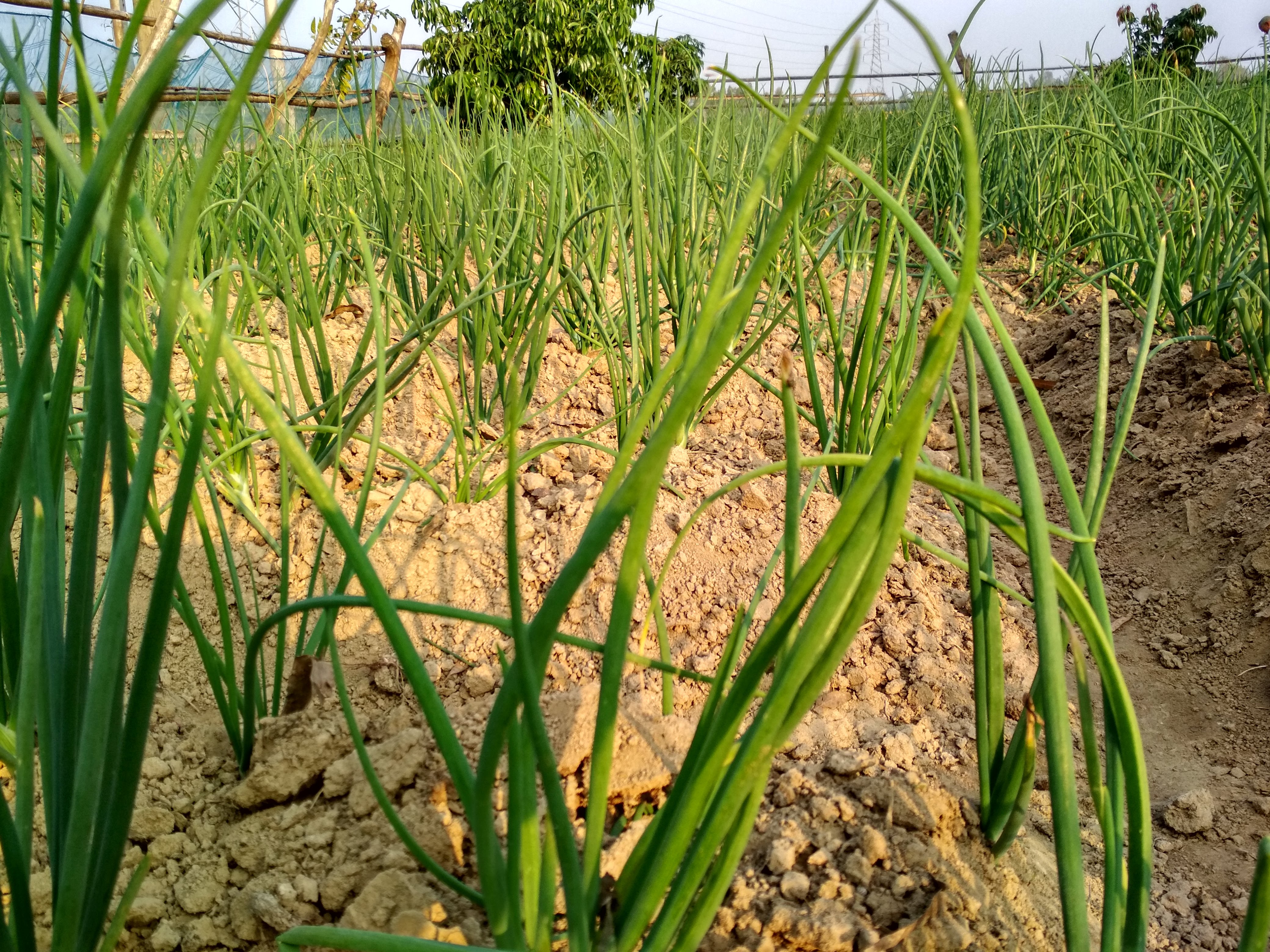
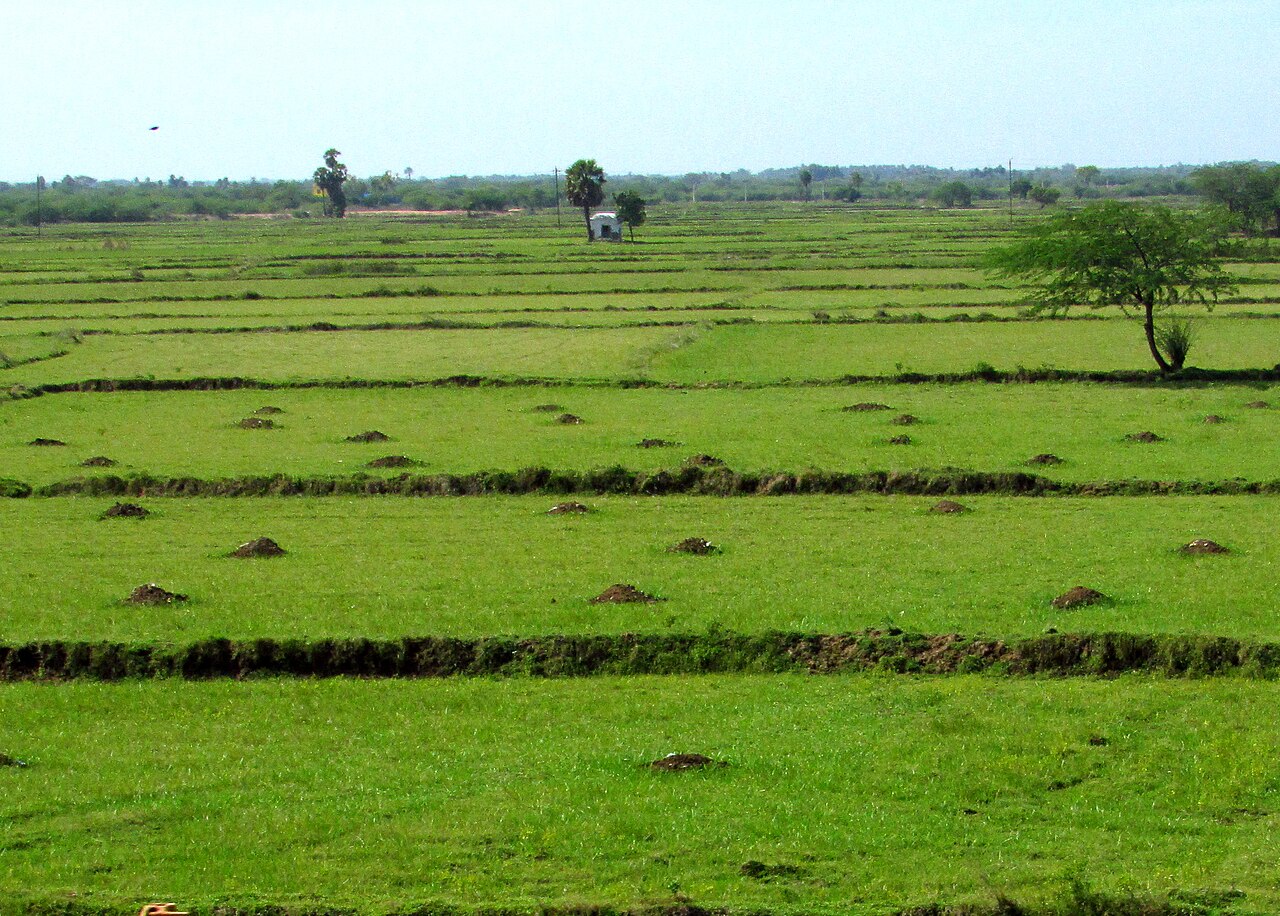
Much of Naldanga's farmland lies in the Halti Beel, a wetland about 10 kilometres north of Natore town that takes in parts of the Piprul, Khajura, Madhnagar and Brahmapur unions. From Baishakh to Kartik, roughly April to November, the beel stands under five to eight feet of water and is known as a breeding ground for native fish; it is linked to the Atrai river, and the part that holds water in winter has been declared a fish sanctuary. In the dry season the same land is cropped, and in February 2025 Ajker Patrika found farmers in the Sonapatil area of the beel lifting bulb onions, with women workers cutting, sorting and drying them before they were bagged for the haat.
Natore district itself covers 1,721.84 square kilometres of Rajshahi division, according to Banglapedia. Its rivers include the Padma, the Baral and the Baranai, and the Chalan Beel is its best-known wetland. It became a district in 1984, and Banglapedia's census-based profile lists agriculture as the main source of income, at 70.59 per cent.
Bulb onions, seedling onions and seed
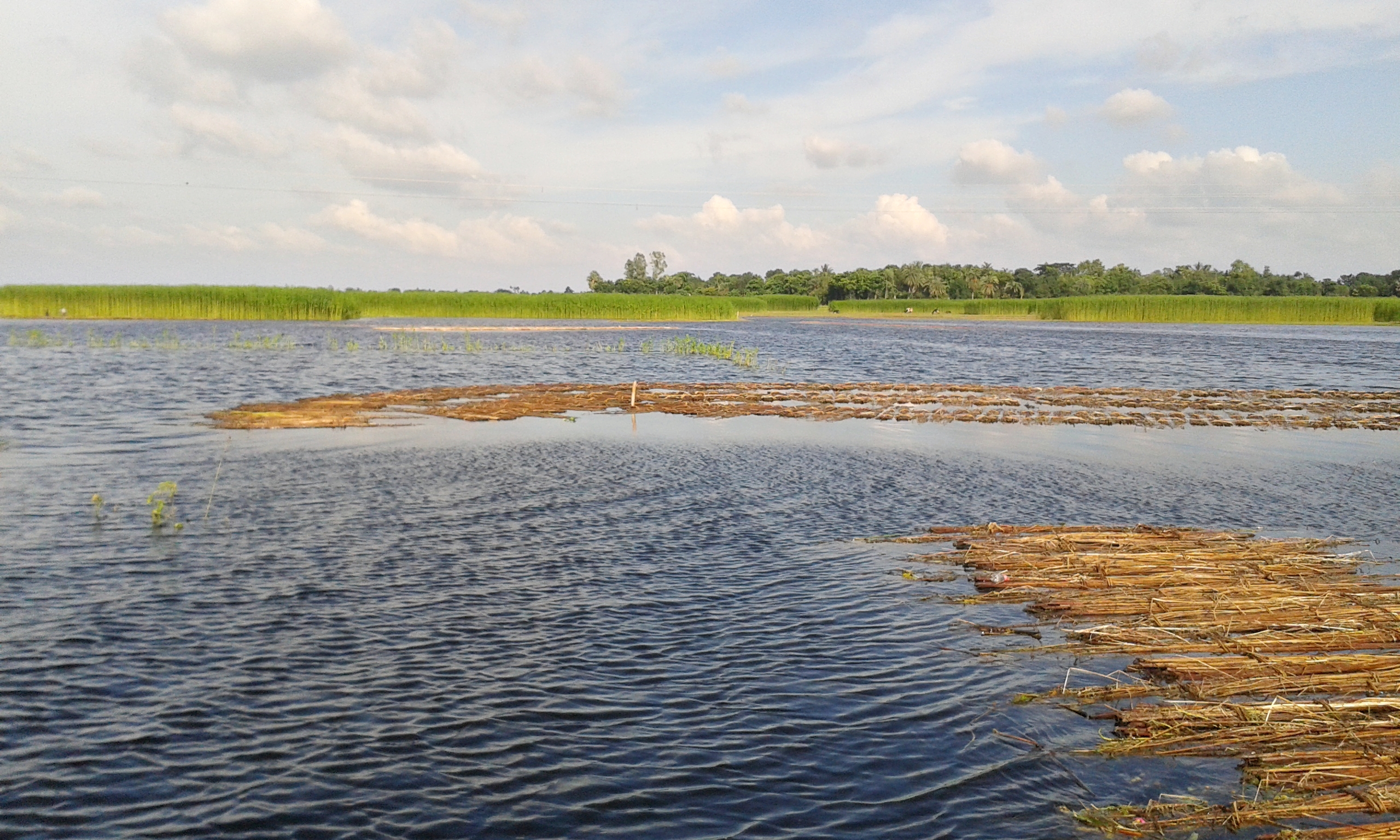
The DAE recognises two ways of growing onions in Bangladesh, The Business Standard's Bangla edition reported on 7 March 2026. In the murikata method, small bulbs are planted in October and November and the crop is lifted from late December to March. In the hali method, seedlings are transplanted in December and January and the bulbs are harvested in March and April. The bulb-planted (kanda) onions and the seedling (chara) onions in the DAE deputy director's Natore figures are these two crops.
The early murikata crop does not keep. In 2020 the then Naldanga upazila agriculture officer explained to Prothom Alo that the flower stalk of this onion is cut early to be eaten as a vegetable, which leaves a knob at the top of the bulb, so it cannot be stored for long and farmers lift and sell it quickly for fear of rot. In March 2026 farmers told Bangla Tribune that murikata onions begin to rot if they are not sold within two to four days of lifting. Traders at Naldanga said in 2020 that the later seedling onions are easier to store and reach the market more gradually.
The onion itself is Allium cepa, a bulbous herb whose edible bulb is made of food-storage leaves, according to Banglapedia. It grows on all types of soil; Banglapedia gives December or the first week of January as the best time to transplant it in Bangladesh, and names Taherpuri and Faridpuri as two important local varieties, alongside BARI Piaj-1 from the Bangladesh Agricultural Research Institute. In March 2026 Jugantor reported good yields of the Taherpuri and Nasik N-53 varieties in neighbouring Rajshahi.
Naldanga also grows onion seed. Rupali Bangladesh reported on 24 February 2026 that onion seed crops in the upazila had expanded by 78 hectares that season, according to upazila agriculture officer Md Sabuj Ali, after seed had sold at Tk 5,500 to Tk 7,000 a kilogram the year before. Farmers in Haridakhalshi village called the seed 'black gold' and said hail in Baishakh was the greatest risk to the crop. Planting material for the bulb crop is also costly: in February 2025 Natore farmers told Ajker Patrika they had paid Tk 8,000 to Tk 10,000 a maund for seed bulbs that season and used eight to ten maunds a bigha.
Earlier complaints from Naldanga
The complaint in April 2026 was not new. In February 2025 Ajker Patrika reported that onions had been planted on 500 hectares more than the target in Natore Sadar and Naldanga upazilas that season, and that farmers who had leased land at double the usual rent and bought costly seed were unable to recover their costs when prices fell at the start of the harvest. New bulb onions were then selling at Naldanga haat at Tk 1,000 to Tk 1,200 a maund.
Farmers in the Halti Beel told that paper their total cost had reached Tk 120,000 to Tk 130,000 a bigha against a yield of 70 to 80 maunds. One of them, Sajdar Rahman, said he had spent Tk 130,000 on a bigha, harvested 80 maunds and sold them for Tk 96,000. According to the upazila agriculture department, bulb onions covered 1,270 hectares in Naldanga that season, 540 hectares more than the year before, with a production target of 26,911 tonnes.
Then, too, wholesaler Zahurul Islam and aratdar Bulbul at Naldanga haat blamed continuing imports from India for the fall in prices, and farmers asked for imports to be stopped for at least two months during the harvest. Mizanur Rahman, the Department of Agricultural Marketing (DAM) officer in Natore, said the onions then reaching the market could not be stored, so farmers were releasing them all at once; he said his office was monitoring prices daily and that a project to build storage had been taken up so that farmers could keep their onions.
A season of low prices across the onion districts
Natore was one of many districts where growers said they were losing money in the 2025-26 season. On 25 February 2026 The Daily Star reported that wholesale prices at Pushpopara haat in Pabna had fallen from Tk 1,600 a maund before Ramadan to Tk 1,100 to Tk 1,200 as early-harvested onions and imports increased supply. The DAE in Pabna, the largest producing district, reported 54,335 hectares under onion with a target of 8.45 lakh tonnes. A trader in Sujanagar upazila said cultivation costs had risen above Tk 50,000 a bigha and that prices needed to stay between Tk 1,500 and Tk 1,800 a maund for farmers to profit; farmers and traders there urged the government to halt imports.
On 7 March 2026 The Business Standard's Bangla edition reported farmers selling at Tk 700 to Tk 1,100 a maund against production costs they put at Tk 1,400 to Tk 1,600 a maund. Agriculture officials attributed the fall to oversupply after wide planting and a bumper crop. In Faridpur, onion had been planted on about 54,000 hectares against a target of about 48,000, and the DAE deputy director there advised farmers to store onions for a few months instead of selling at once. The additional director of the DAE's Bogura region said farmers had lost money on potatoes and onions for two years running.
The Daily Sangram reported on 11 March 2026 from the Chalan Beel area, which takes in parts of Sirajganj, Natore and Pabna, that murikata onions had reached the market in the last week of December 2025 at about Tk 3,500 a maund, fallen to Tk 1,300 to Tk 1,400, recovered to Tk 1,800 to Tk 2,000 until mid-February, and then slid to Tk 800 to Tk 1,000, with small onions at Tk 500 to Tk 600.
On 17 March 2026 The Business Standard reported, citing the DAE, that onion had been grown on about 302,000 hectares nationally against a target of 286,000 hectares, with production forecast at about 4.3 million tonnes, while the Department of Agricultural Marketing put farm-gate onion prices at Tk 20 to Tk 25 a kilogram against costs of Tk 38 to Tk 40.
Late in March the slump deepened in Rajshahi. Jugantor reported on 28 March 2026 that a fuel crisis had left outside traders without trucks, and onions in markets at Bagmara, Puthia and Durgapur were selling at only Tk 150 to Tk 200 a maund. The DAE told the paper that seven districts, Rajshahi, Pabna, Kushtia, Jhenaidah, Magura, Faridpur and Rajbari, grow half of the country's onions, on 1.92 lakh hectares that season with a target of 19.88 lakh tonnes.
Imports from India in the 2025-26 season
Imports had resumed on 7 December 2025 after a three-month halt, as onion prices rose in the domestic market, the Dhaka Tribune reported. By 5 January 2026, The Daily Star reported, the government had approved imports of 73,050 tonnes since 7 December and more than 52,000 tonnes had arrived, all from India according to the DAE's plant quarantine wing, which issues the phytosanitary certificates importers need. National Board of Revenue data showed 62,987 tonnes worth Tk 240.11 crore imported in the first six months of fiscal 2025-26, of which 49,873 tonnes came in December alone.
In early January the government stopped issuing new import permits for onions from India, citing the interest of domestic farmers; the Dhaka Tribune reported on 6 January 2026 that imports under permits already issued would be allowed until 30 January. On 25 February 2026 Boni Amin Khan, head of the DAE's quarantine wing, told The Daily Star that 87,838 tonnes of onion imports had been approved for fiscal 2025-26, of which 86,278 tonnes had arrived, and that with prices stable and supply sufficient there was no need to import more; further imports would be considered only if prices rose sharply.
The reports read for this story do not show whether Indian onions were still reaching Natore's markets in early April 2026; the link between imports and the fall in prices at Naldanga is the explanation the traders and farmers gave.
Production, demand and losses after harvest
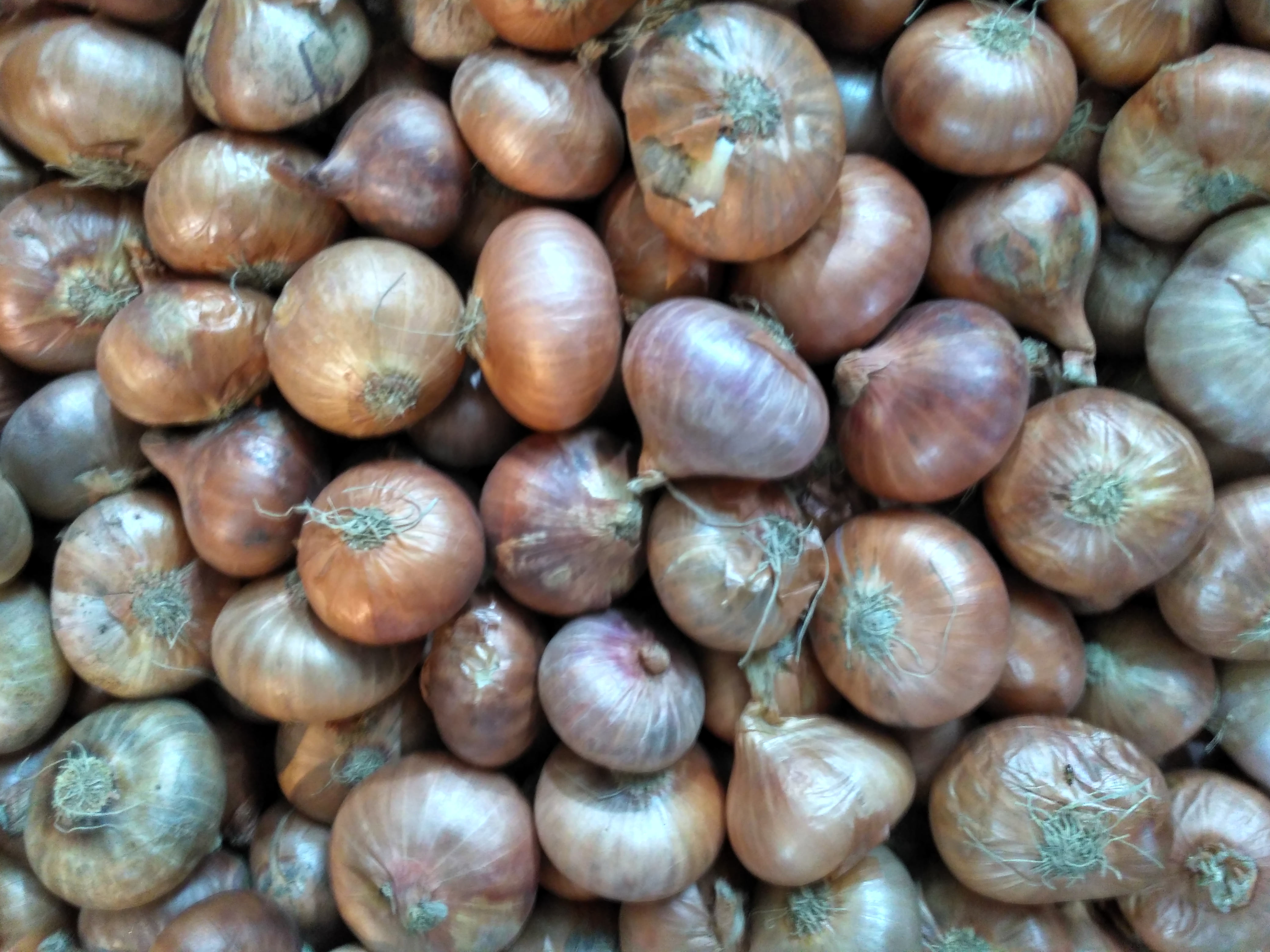
Government agencies gave differing figures for how much onion Bangladesh grows and needs. The DAE estimated the previous season's harvest at more than 39 lakh tonnes, enough to meet domestic demand, but projected that 6 to 7 lakh tonnes of imports would still be needed to make up for losses after harvest, The Daily Star reported in January 2026. In March 2026 Bangla Tribune cited the agriculture ministry as putting production in fiscal 2024-25 at about 32,21,431 tonnes, a rise of 10.42 per cent, and the DAM as putting fiscal 2023-24 output at 37.9 lakh tonnes; the commerce ministry put annual demand at about 35.5 lakh tonnes, met in part by imports of 5.5 lakh to 5.78 lakh tonnes a year.
Every source agrees that a large share of the crop is lost after harvest. In July 2024 the DAM's senior marketing officer in Faridpur told Prothom Alo that 25 to 30 per cent of the onions produced go to waste, so that of about 35 lakh tonnes grown only some 22 lakh tonnes survive, leaving a shortfall of six to seven lakh tonnes a year even though output exceeds demand. Bangla Tribune's March 2026 report put losses from lack of storage at 30 to 40 per cent. That report named Natore with Naogaon, Bogura, Sirajganj and Joypurhat as onion-growing districts of the north, with Pabna, Rajbari and Faridpur as the main producers.
Model houses, air-flow machines and fans
One government response to these losses has been low-cost storage on the farm. Prothom Alo described the DAM's onion 'model houses' in Faridpur in July 2024: built from bamboo, wood, coloured tin sheets and reinforced concrete pillars, each house measured 25 feet by 15 feet, stood on 15 pillars, held three tiers of racks with space for air beneath, and used six electric fans at the back to push hot air out. Each held 300 maunds and kept onions for six to nine months, cost Tk 4.5 lakh, and served five farmers; 65 were planned for Saltha and Nagarkanda upazilas in 2022-23.
Bonik Barta reported on 25 July 2024 that 285 such houses in seven districts, Kushtia, Jhenaidah, Magura, Faridpur, Rajbari, Rajshahi and Pabna, each with room for 250 to 300 maunds, then held about 10,000 tonnes of onions. Natore was not among the seven districts named.
In April 2025 Samakal reported that the agriculture ministry had decided to install 4,000 air-flow machines in onion-growing areas. In this method, onions are heaped on a perforated mat laid over a raised brick floor, and an electric fan inside a vertical cylinder in the middle of the room draws air down and pushes it through the heap; the paper said onions can be kept this way for eight months of the year. A farmer in Faridpur Sadar told Samakal that his machine, costing Tk 15,000 to Tk 16,000, stored about 300 maunds for an electricity bill of Tk 500 to Tk 600 a month.
On 31 March 2026, five days before the Natore report, Agriculture Minister Mohammad Amin Ur Rashid told parliament that the government had introduced a new low-power storage method that could keep onions for up to three months, that it had so far been given to 68 farmers, and that the ministry was discussing how to expand it, The Business Standard reported. It was against this background that Naldanga's upazila agriculture officer said in April that fans were being handed out to farmers there to keep stored onions from rotting.
Photo: Press Information Department / Wikimedia Commons (public domain)
Sources: Jagonews24, The Daily Star, The Business Standard, Dhaka Tribune, Bangla Tribune, The Daily Sangram, Jugantor, Ajker Patrika, Prothom Alo, Bonik Barta, Samakal, Rupali Bangladesh, Banglapedia, Wikipedia
Comments
(0)