
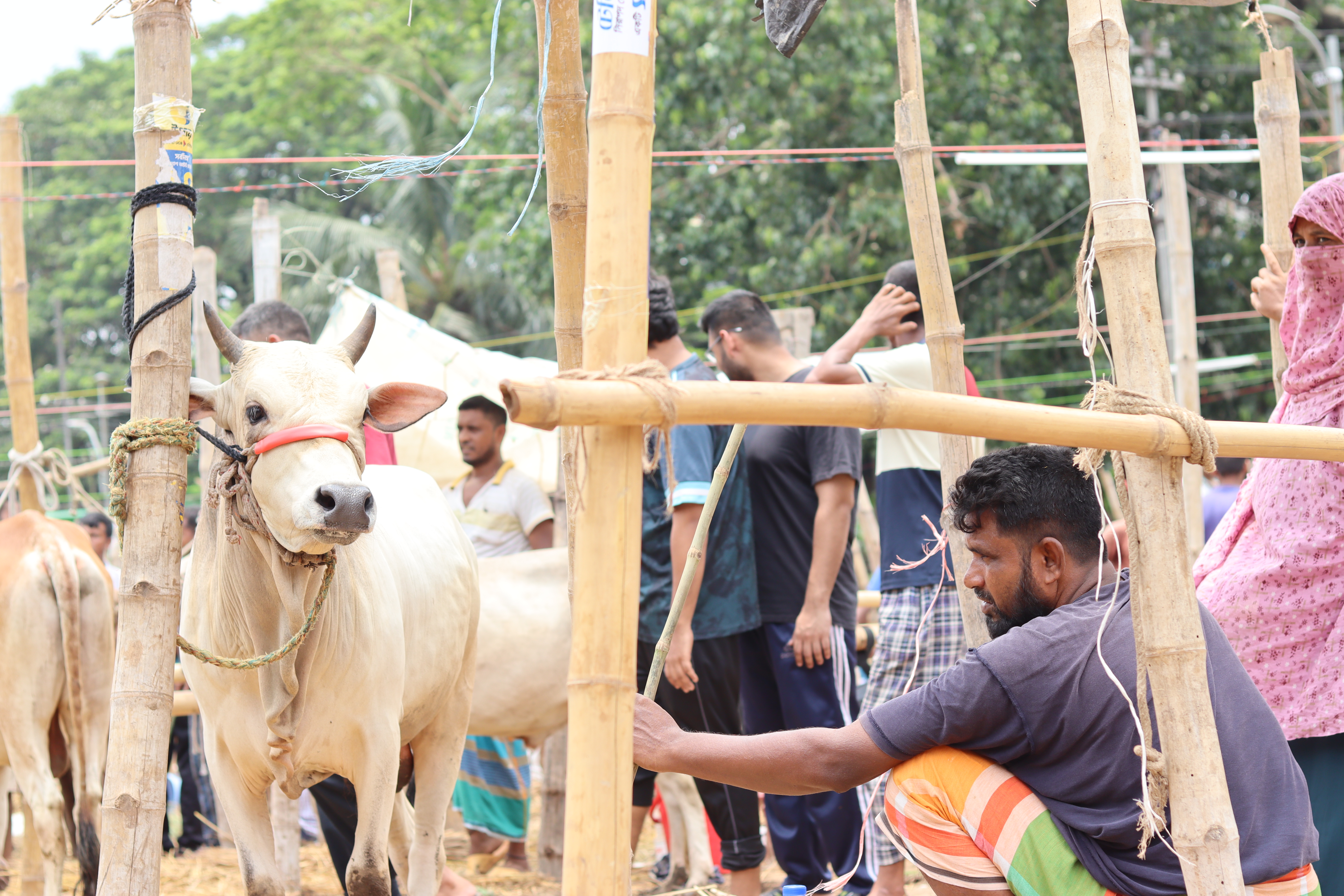
A cattle market in Karimpur union of Narsingdi Sadar upazila, where sellers pay no levy on the animals they sell, drew large crowds of buyers and sellers on Wednesday 27 May 2026, as the country prepared for Eid-ul-Azha, which was to be celebrated in Bangladesh on 28 May. The temporary market, held every year on the Karimpur football ground, was packed with cattle, buffaloes and goats, Jagonews24's Narsingdi district correspondent reported that afternoon.
The market is one of the best known and most traditional in the district. Its defining feature is that sellers do not pay hasil or khajna, the levy normally collected on each animal sold at a Bangladeshi cattle market. Without that extra cost sellers can sell more easily, and buyers get a chance to buy animals at relatively lower prices. In 2026 the market was organised by the Karimpur Probashi Oikya Forum, a forum of Karimpur people living abroad, with the help of local students.
The organisers said they had kept the market free of levies by paying the government lease of about Tk 80,000 themselves. Small, medium and large cattle, buffaloes and goats of various breeds had been brought in for sale.
A crowded day on the Karimpur ground
People involved in running the market said more animals had arrived than in other years, and that special arrangements had been made for the safety of buyers and sellers. Those arrangements, described below, included banking services, a locker system for keeping cash safe and machines for detecting counterfeit notes.
Sakib Mia, who had come to buy a cow, said he lived in the Mohishasura area. "There is a market in our area too, but I still came to this Karimpur market. Animals of all sizes are always available here. I have liked a cow and we are bargaining. And the biggest thing is that you don't have to pay any toll when you buy a cow," he said.
Another buyer, Mainuddin, said he had never seen so many cattle and buffaloes at any other market in Narsingdi. "I have never seen so many animals before. But prices seem a bit high. The weather isn't good either, so it is hard to walk around and look. There is hardly room to put your feet," he said.
Seller Sona Mia said he brought cattle to the market every year and sales were usually good. "This time I brought four cows, and two have been sold. Bargaining is going on for the other two. I hope they will be sold," he said.
The Jagonews24 report did not give the prices at which animals changed hands at Karimpur. The only remark on price came from Mainuddin, who felt prices were somewhat high. Reports from elsewhere in the country in the days before 27 May described the same pressure on cost. In a Bangla Tribune report carried by the Dhaka Tribune on 22 May 2026, farmers said feed, labour, electricity and transport costs had risen. Adil Hossain, owner of Adil Dairy Farm, said a medium-sized cow that previously sold for slightly above Tk 100,000 might now reach nearly Tk 150,000, while a farmer in Dhaka said demand for small cattle was strong and larger cattle were selling at comparatively lower prices.
Eight years without a levy
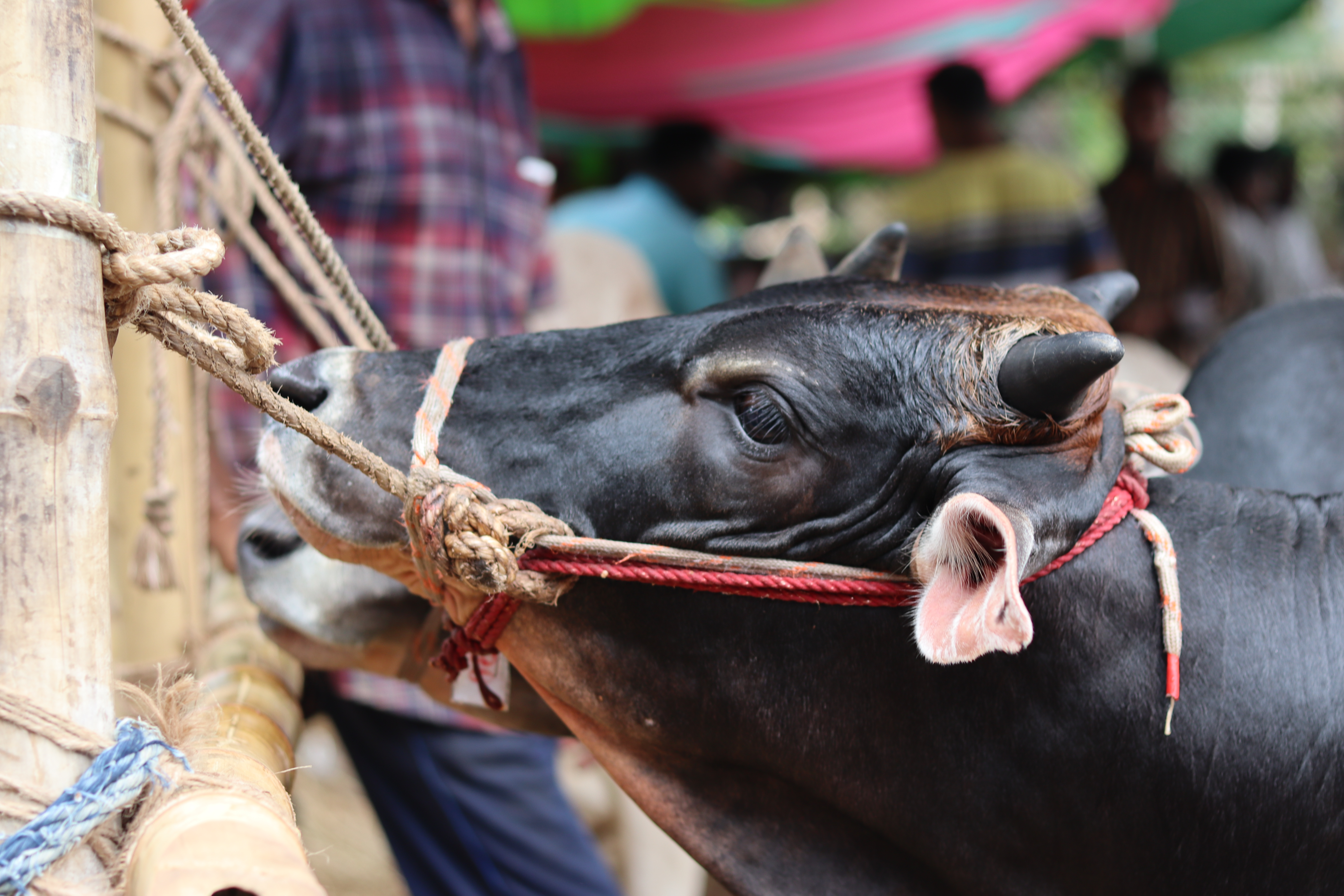
Sakil Mahmud of the Karimpur Probashi Oikya Forum said a toll-free cattle market was held at Karimpur every year. "This market is for everyone. The initiative was taken with the convenience of buyers and sellers in mind. Law and order is good, and various facilities, including counterfeit note detection machines, have been provided," he said.
Monirul Islam Monir, member secretary of the Karimpur union unit of the BNP, said the market had been kept completely free of levies for the past eight years. According to him, the Probashi Oikya Forum paid the government lease every year and ran the market. He said there were banking facilities, lockers for keeping money and counterfeit note detection at the market, and that accommodation had been arranged for people who came with animals from far away.
"So far 2,000 animals have been bought and sold, and we hope 3,000 will be sold. Many more animals have come this year than in other years," he said. These figures are the organisers' own estimates as quoted in the report; no official count for the market was published.
What hasil is and why a levy-free market matters
Most Bangladeshi cattle markets are leased out for the season. The lessee, known as the ijaradar, pays for the lease and earns the money back by collecting hasil on each animal sold. A Prothom Alo report on Chattogram's cattle markets, published on the afternoon of 27 May 2026, set out how this works in a large city. The city corporation leases out the markets, and the Department of Livestock Services (DLS) estimates the demand for sacrificial animals. The lessees' main income, the paper reported, is hasil, which they collect at 5 percent of the price of each animal sold.
According to the figures in the same report, Chattogram City Corporation earned Tk 13.19 crore that year by leasing out three permanent and seven temporary markets. On top of the lease, lessees pay value added tax and income tax at a rate of 25 percent to the government, and spend Tk 1 crore to Tk 1.5 crore on managing the markets. The report said cattle in the city's markets ranged from animals worth Tk 50,000 to 60,000 to animals worth Tk 8 lakh to 10 lakh, that medium-sized cattle were in the greatest demand, and that Chattogram district livestock officer Md Alamgir put the average price of a cow sold in the city's markets at about Tk 1 lakh.
Against that background, the Karimpur arrangement turns the usual model around. Instead of a lessee recovering the lease from the people who trade there, the organisers said they paid the lease of about Tk 80,000 themselves, so that sellers paid nothing on their sales and, as buyer Sakib Mia put it, buyers paid no toll either.
The government had also drawn a line between market sales and other channels. At a press conference on 3 May 2026, Fisheries and Livestock Minister Mohammad Aminur Rashid said buyers would not have to pay hasil for animals bought online, and that hasil would apply only to animals bought directly at a cattle market, BSS reported.
Lockers, banking and counterfeit-note checks
Cattle markets before Eid-ul-Azha handle large amounts of cash. At Karimpur the organisers said they had laid on banking services, lockers where buyers and sellers could keep money safely, and special machines for detecting counterfeit notes.
Such checks were part of a national plan that year. On 10 May 2026 the Currency Management Department of Bangladesh Bank sent the managing directors of all scheduled banks a letter with ten instructions on preventing the circulation of counterfeit notes at sacrificial animal markets, Desh Rupantor reported the same day. The main points were:
- Banks assigned to the markets approved by the Dhaka North and Dhaka South city corporations were to provide free note-checking for traders and buyers, using counterfeit detection machines operated by experienced cash officers, without a break from the day each market opened until the night before Eid.
- In districts outside Dhaka that have a Bangladesh Bank office, banks' regional offices and main branches were to support similar arrangements at the approved markets of the city corporation or municipality, led by the Bangladesh Bank office.
- In districts without a Bangladesh Bank office, the chest branches of Sonali Bank PLC were given the task of sharing out this duty among banks for the approved markets of city corporations, municipalities and thana or upazila areas, and the banks' district and upazila branches were to provide the service accordingly.
- Booths were to offer cash counting with note-counting machines and display a banner with the bank's name and the words 'counterfeit note detection booth'.
- Banks could contact the city corporation, the municipality, the upazila nirbahi officer, the market's lessee and, where needed, the police, BGB, RAB and Ansar for help and security, and were to act under a 2007 circular whenever a counterfeit note was found.
- Branches were to show a video on the security features of banknotes on their customer TV monitors throughout banking hours on every working day until Eid, and each bank was to report on what it had done within 30 working days after Eid.
Digital payment was spreading alongside these checks. Prothom Alo reported on 20 May 2026 that, under a joint initiative of Bangladesh Bank and the DLS, farmers in several districts had been brought under 'smart' market services with digital booths, where buyers and sellers could pay by card or through mobile financial services. Temporary camps of commercial banks, with counterfeit detection machines, ATM booths and digital banking, were being set up at 30 markets in five metropolitan cities including Dhaka. The paper said cashless services at cattle markets began in 2022 at six markets in Dhaka with six banks, and that in 2025 fourteen banks took part at nineteen markets in Dhaka and Chattogram, with cashless transactions of more than Tk 200 crore that year.
Narsingdi Sadar and Karimpur
Narsingdi district is in Dhaka division. According to Banglapedia, the national encyclopedia of Bangladesh, the district covers 1,150.14 square kilometres and is bounded by Kishoreganj to the north, Narayanganj and Brahmanbaria to the south, Brahmanbaria and Kishoreganj to the east and Gazipur to the west. Its main rivers are the Meghna, the Old Brahmaputra, the Arial Khan and the Shitalakshya. Narsingdi was a subdivision of greater Dhaka district and became a district in 1984; it has six upazilas. The 2011 census counted 2,224,944 people in the district, and agriculture (42.73 percent) and commerce (17.84 percent) were the main sources of household income.
Narsingdi Sadar, the upazila in which Karimpur lies, covers 213.43 square kilometres, has the Meghna as its main river, and had 707,525 people at the 2011 census, Banglapedia says. Narsingdi thana was formed in 1930 and the town became a municipality in 1972. Agriculture was the main source of income for 55.47 percent of households and commerce for 12.74 percent. The main crops are paddy, wheat, mustard, jute, potato, garlic and vegetables. The upazila has 27 hats and bazars, and Banglapedia names Karimpur Bazar among the most noted of them, along with Madhabdi Hat and Shekherchar Bazar. The same entry lists 25 dairy farms, 511 poultry farms, 225 fisheries and one veterinary hospital in the upazila.
Cattle, buffaloes and goats in the market
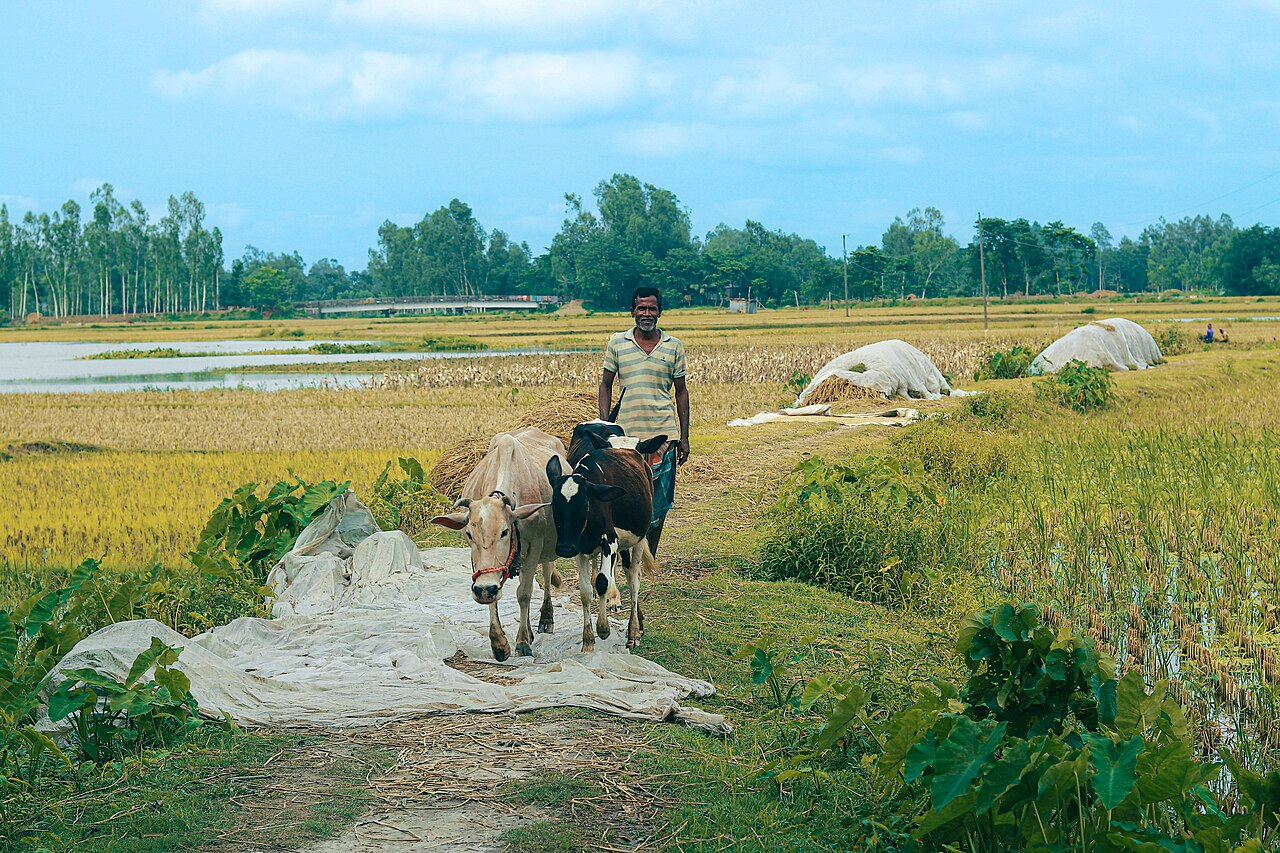
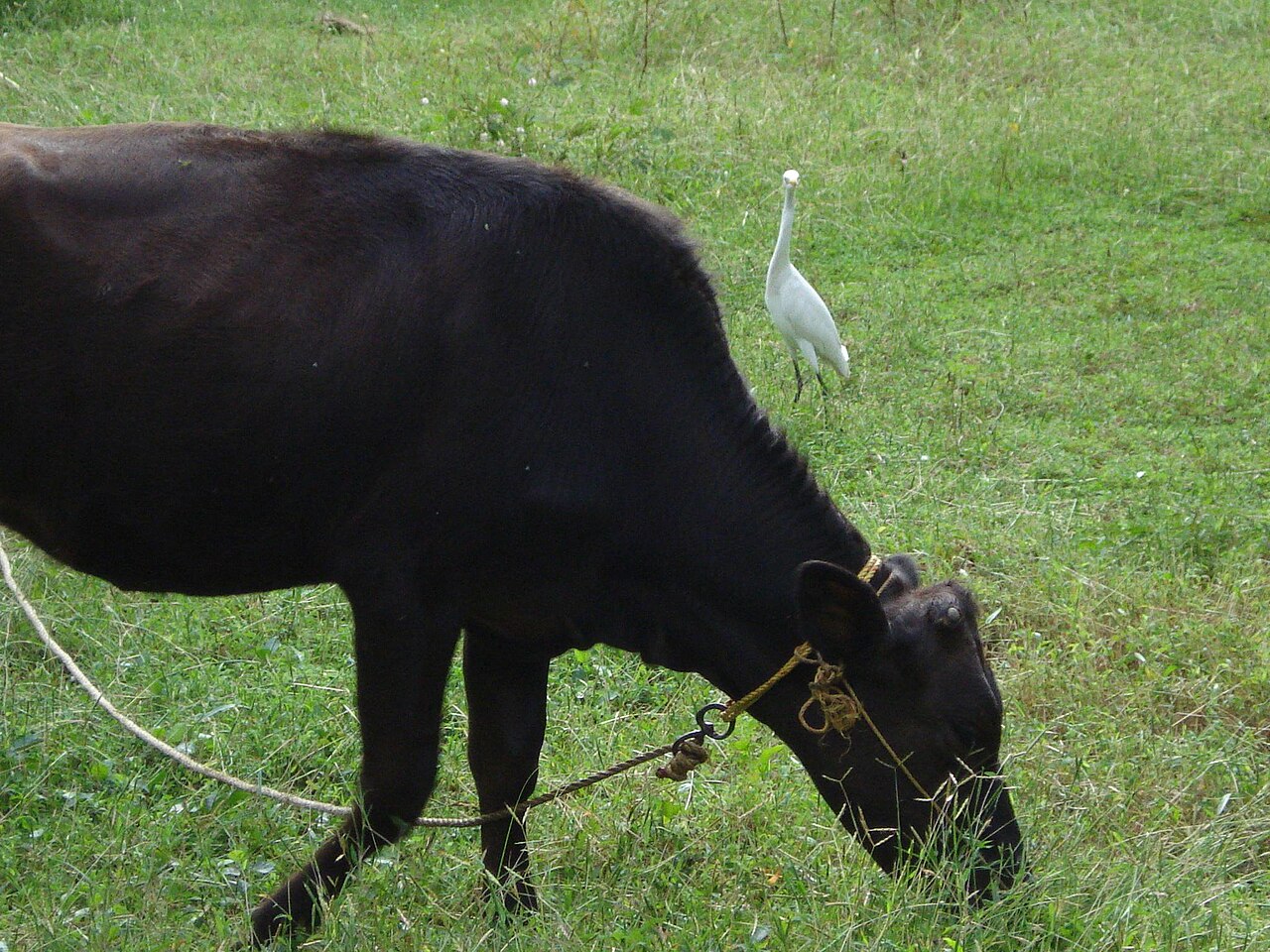
Cattle were the main attraction at Karimpur, as at other sacrificial markets. Banglapedia's entry on cattle says most of Bangladesh's cattle are non-descript indigenous zebu, the humped Bos indicus type, kept for several purposes at once: milk, meat, draught power, and dung for manure and fuel. No specific cattle breed has yet been established in the country, but long natural selection has produced some improved indigenous varieties: Pabna cattle, Red Chittagong, Munshiganj cattle and North Bengal Grey. Exotic breeds such as Holstein-Friesian, Jersey and Sahiwal have been crossed with local cattle to raise production. The entry notes that Bangladesh has a seasonal demand for beef cattle during Eid-ul-Azha, when people generally prefer to sacrifice healthy animals, and that some farmers fatten young bull calves for this market, for example with the urea-molasses straw feeding developed by the Bangladesh Livestock Research Institute (BLRI).
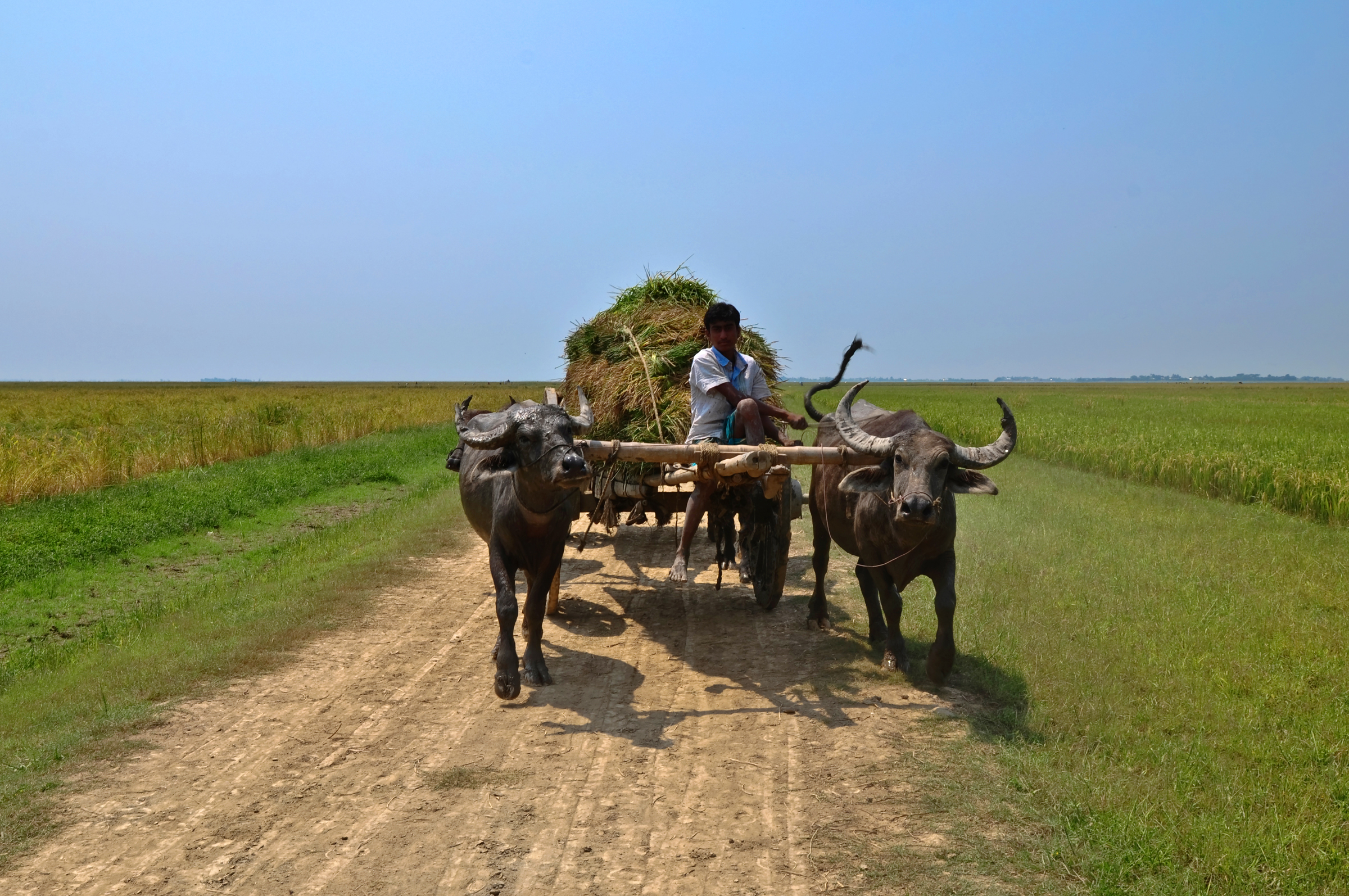
Buffaloes, which the Karimpur organisers also listed, are the domestic water buffalo, Bubalus bubalis. Banglapedia says Bangladesh has no important buffalo breed of its own, and that buffaloes are seen mainly as draught animals for ploughing and pulling carts in districts such as Chittagong, Noakhali, Rajshahi, Rangpur, Dinajpur and Bogra. The shortage of green grass is the main limit on raising them, since one animal needs at least 30 kilograms of grass a day.
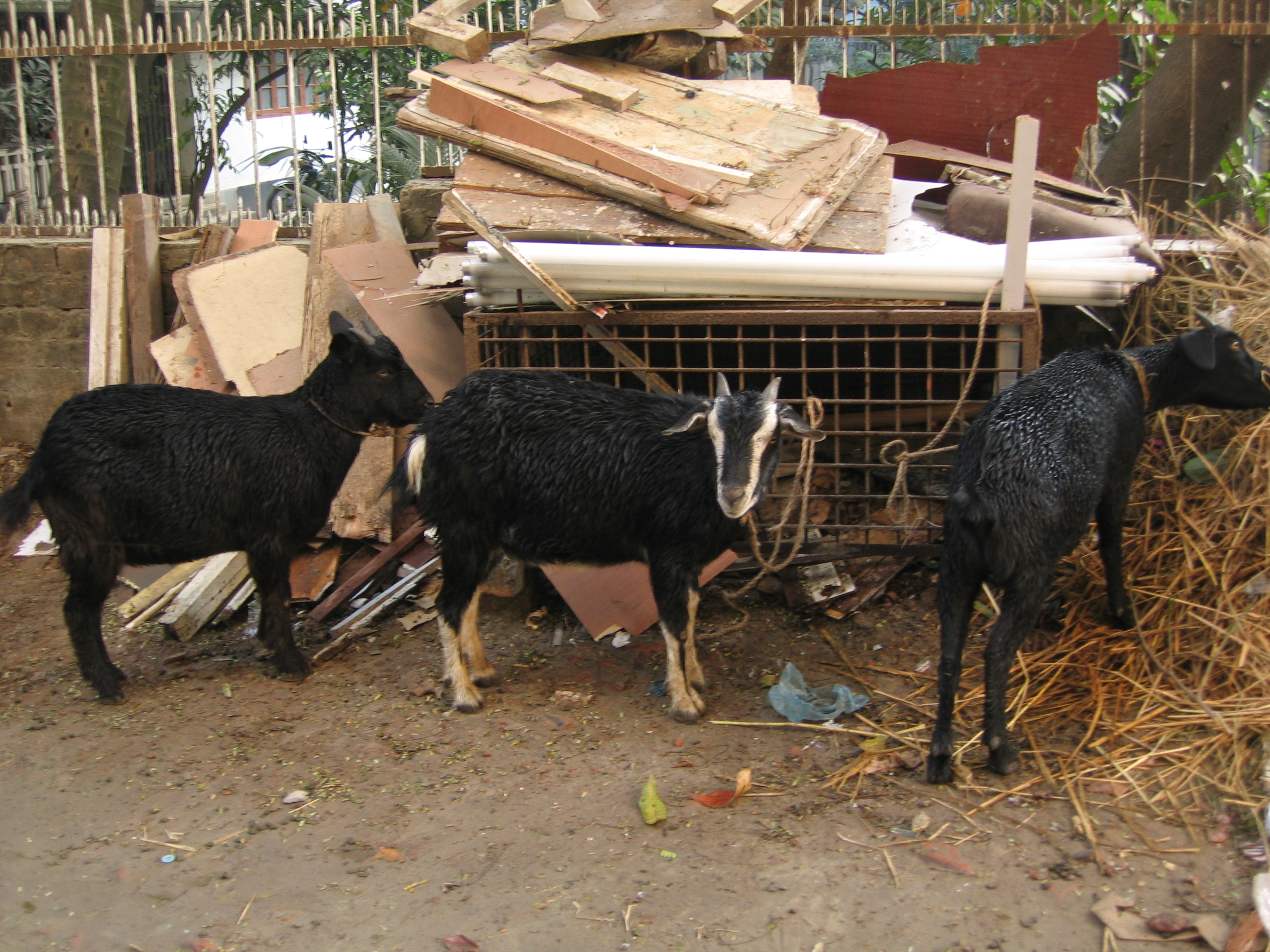
Goats are the smaller sacrificial animal. According to Banglapedia, the Black Bengal goat makes up more than 90 percent of the country's goats, and the rest are mainly Jamunapari goats and their crosses. More than 90 percent of goats are kept by rural people, often by women and children, grazing on fallow land, field ridges, roadsides and embankments with little or no extra feed. The breed matures early: does first give birth at about 12 months and can kid twice a year or three times in two years. An adult buck weighs 16 to 18 kilograms and a doe 12 to 14 kilograms; the meat is known for its tenderness and the skin for its quality.
Sacrificial animals in 2026: the national count
The crowds at Karimpur came in a year when the government said the country had more than enough animals for the festival. At a press conference at the secretariat on 3 May 2026, Fisheries and Livestock Minister Mohammad Aminur Rashid, citing DLS data, said 1,23,33,840 animals suitable for sacrifice were available against a projected demand of 10,106,334, leaving around 22,27,506 animals likely to be surplus, the Dhaka Tribune reported. The available animals comprised 56,95,878 cattle and buffaloes, 66,32,307 goats and sheep, and 5,655 animals of other species such as camels and dumba (fat-tailed sheep).
The minister compared this with the previous year. During Eid-ul-Azha 2025 the total availability had been 1,24,47,337 animals, and while a surplus of more than 20,68,000 was estimated at first, the actual figures showed that 91,36,734 animals were sacrificed, leaving a surplus of around 33.10 lakh.
A Dhaka Tribune report of 22 May 2026, based on government data, set these figures in a longer run. In 2023 about 12.5 million animals were produced and around 10 million sacrificed; in 2024 production stood at 12.1 million with about 9.5 million sacrificed; and in 2025, against 12.4 million animals, around 9 million were sacrificed. While production had risen steadily, the report said, demand had remained relatively stable.
The same report said supply was uneven across regions. According to the DLS, Dhaka's demand stood at 2,158,869 animals against an availability of 1,443,942, and Chittagong also faced a shortage of about 50,000, while Rajshahi, Rangpur, Khulna and Mymensingh divisions had large surpluses, Rajshahi alone about 1.9 million more animals than its demand. A large part of the livestock in the capital's markets was therefore expected to come from the north. DLS Deputy Director (Farms) Md Shariful Haque said there was no livestock shortage that year. Niloy Hossain, senior vice president of the Bangladesh Dairy Farmers Association, said demand for large cattle had declined and that rising feed and transport costs had increased the risks for large-scale farmers.
Government preparations and the role of the DLS
The government's plans for the 2026 markets were set out at the same 3 May press conference, BSS reported. The minister said more than 3,600 cattle markets would be set up across the country, including 27 in Dhaka city, 16 of them under Dhaka North City Corporation and 11 under Dhaka South City Corporation, and that in Dhaka the markets would be allowed only at designated places, not on roadsides where they would disrupt traffic. No sacrificial animals would be imported that year, and the leasing of border hats remained suspended, as in the previous year. He said expert veterinary teams under the supervision of the DLS would be engaged at every animal market across the country to provide emergency treatment for sick animals. The Dhaka Tribune reported on 22 May that twenty veterinary medical teams would be deployed at the capital's 27 markets.
The minister also said that the import of cattle-fattening injections or any steroid was completely disallowed, and that, since some traders might still collect such drugs to fatten animals for the festival, the DLS would destroy them in drives across the country. He said the government had taken strict measures against extortion at the markets and from vehicles carrying animals by road and waterway, and that law enforcement agencies had been instructed accordingly. He said he hoped prices would remain within people's means.
On 14 May 2026, speaking at the Bangladesh Livestock Research Institute in Savar, the minister said there was no shortage of sacrificial animals and that the sacrifice would be performed with animals reared by local farmers, the Dhaka Tribune reported. Law enforcement agencies had been told to prevent the illegal entry of livestock across the border, and people in border areas had been warned against smuggling animals into the country. He said work was under way to make cattle rearing cheaper and to increase the production of improved grass varieties.
Photo: Wasiul Bahar / Wikimedia Commons (CC BY-SA 4.0)
Sources: Jagonews24 (27 May 2026), Prothom Alo (20 May and 27 May 2026), Desh Rupantor (10 May 2026), BSS (3 May 2026), Dhaka Tribune (3 May, 14 May and 22 May 2026), Banglapedia (Narsingdi District, Narsingdi Sadar Upazila, Cattle, Buffalo, Goat)
Comments
(0)