
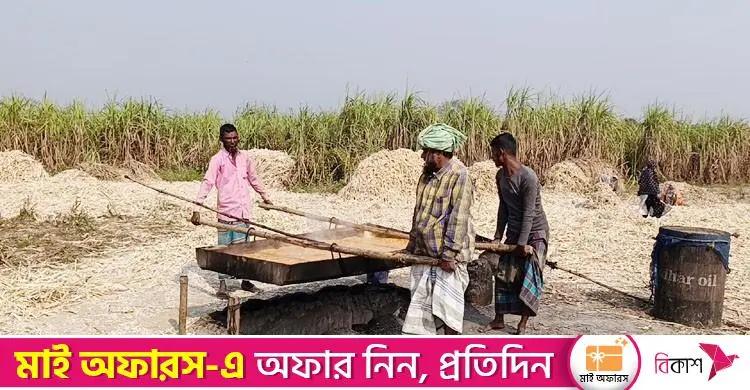
Sugarcane farming is showing fresh promise in Narayanganj. Boro Binairchar and Chhoto Binairchar in Araihazar were once famous for cane jaggery, but the tradition had been fading over time. In the past few years, however, residents have returned to their ancestral occupation and, though on less land than before, have started growing sugarcane again.
They grow the cane and boil the juice in the fields to make traditional, wholesome cane jaggery, which is supplied to different parts of the country. Farmers are seeing profits as a result. Besides Araihazar, sugarcane is also being grown in various parts of Rupganj.
Farmers said sugarcane is grown in the Gopondi, Monohordi, Fazurkandi, Boro Binairchar and Chhoto Binairchar areas of Araihazar, and in the Jangir, Daudpur, Bholab and Hatabo areas of Rupganj. It is their ancestral occupation: their grandfathers and fathers grew cane before them.
Costs and returns
For several years the farming stopped for lack of improved seed, modern technology and skilled workers, but it has now resumed. From planting the cane to making the jaggery, it costs Tk 3,500 to produce a maund of jaggery, which sells for Tk 8,000 a maund. Farmers say they are now seeing success.
Sugarcane farmer Shahidullah said: "I have grown sugarcane on 45 decimals of land this year. At one time the best cane jaggery in Bangladesh was made in Araihazar upazila. This is our traditional occupation. We have been growing it since our forefathers' time."
Abdur Rahim, a student at Safar Ali College in Araihazar, helps his father alongside his studies. "Sugarcane farming pays well. Every year we are busy at this time. Jaggery goes from here to different parts of the country," he said.
Voicing concern, Abdul Momen said: "At least around Tk 1.5 crore worth of jaggery is produced here every year. But sugarcane farming also costs a lot. Perhaps one day there will be no sugarcane farming, because this is the age of industrialisation. Farmland is shrinking day by day. The land will fill up with houses and factories."
Farmer Abdul Halim said: "My father grew sugarcane before me, and my grandfather before him. That is how I learned to grow cane and make jaggery. We are profiting from it. High-quality jaggery is made here, with no chance of adulteration. People come from different parts of the country to buy it."
What officials say
Rupganj Upazila Agriculture Officer Afroza Sultana said: "Producing sugarcane costs Tk 50,000-60,000 per bigha, and it sells for Tk 1 lakh to Tk 1.25 lakh. Farmers also profit if they use mixed cropping, growing other vegetables alongside the cane."
Araihazar Upazila Agriculture Officer Md Rasel Mia said: "Sugarcane is doing well in Araihazar. Farmers grow the Mishrimala variety, which is good for production. We are trying to get them to grow even better-quality cane, but that is being hampered by jackals. Sugarcane farming had declined at one point; now it is starting to rise again. This year it has been grown on 120 acres."
AJM Ahsan Shahid Sarkar, deputy director of the Department of Agricultural Extension (DAE) in Narayanganj, said: "Sugarcane farming is up this year compared with other years. It has been grown on 136 hectares this year, and the area has grown from last year. Most sugarcane in Narayanganj is grown in Rupganj and Araihazar upazilas."
Source: Jagonews24. First published in Bengali on The Agro News.
Comments
(0)