
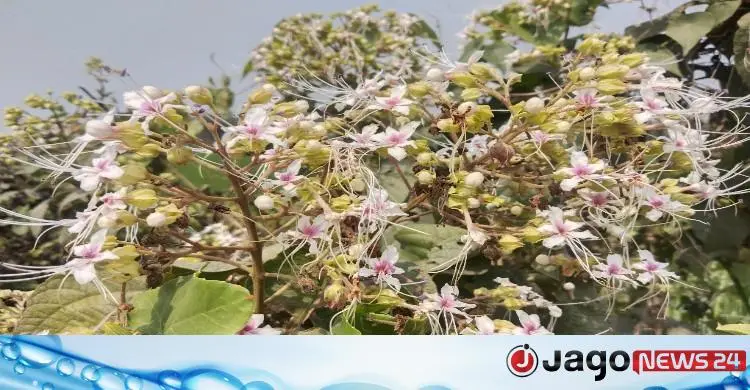
The bhant flower is a very familiar wild shrub of rural Bengal. It grows naturally and untended along winding village paths, roadsides and every nook and corner. Now bhant flowers are spreading their beauty along the roads of Narail, their pure white blooms delighting any flower lover.
Bhant plants spring up naturally along both sides of roads and winding village paths across Narail. Though this familiar flower is seen all the time, many people feel their spirits lift when they look at its white blooms. In different regions it is called bhaita, ghetu, bhat, bonjui or ghontakorno, but in Narail it is best known as bhant or bhanti. Because it blooms in the month of Chaitra, it is also called the Chaiter phul.
Where the flowers bloom
The road through the Chandpur-Bogura beel in Banshgram union of Narail, both sides of the Lohagara-Mithapur main road and both sides of the Kalia-Narail-Magura main road are so thick with bhant flowers that nature seems dressed in splendour. Passers-by and visitors are also charmed by the bhant blooms in the gardens scattered across the district.
With the arrival of spring, the pure white bhant blooms to adorn nature alongside the palash and shimul. Countless sweet-scented bhant flowers can be seen especially by abandoned fields, forests, roads and ponds. Many flowers open together, and bees collect nectar from them. The scientific name of the bhant is Clerodendrum viscosum, and its English name is given as the hill glory bower flower. It is native to the Indian subcontinent, Bangladesh and Myanmar.
Becoming rarer
But the flower is disappearing as time goes by and is now quite rare. It has declined in the villages and is hardly seen in towns. Still, flower lovers who look will not be disappointed: keep your eyes open this Falgun and Chaitra and you will find it. The main stem of the self-sown bhant stands upright, usually 2 to 4 metres tall. The leaves are 4 to 7 inches long, somewhat betel-leaf shaped and rough. Flowers appear at the tips of the branches. The petals are white with a touch of purple. It flowers from spring to summer and has a sweet fragrance that is especially strong at night. Bees collect nectar from the flowers once they open.
The bhant or ghetu is a native wild flowering shrub. It blooms untended in village fields or by the roadside. Though the plant is known as bhant, it has different names in different places and communities; many also call it bonjui. The plant also has medicinal properties.
Nannu Mohuri, a resident of Duttapara village in Aoria union of Sadar upazila, said: "When I was a child, lots of bhant flowers could be seen in our area in this season. You still see them, but not like before, far fewer. They are as lovely to look at as their scent is pleasant."
Shanta Khan of Tularampur union in Narail Sadar upazila said: "Once this flower could be seen almost everywhere in the villages. Now it isn't seen as often. Though it grows naturally without care, it lacks nothing in beauty."
Fahim Shekhok of Kalia upazila said: "Bhant flowers are very beautiful. They can still be seen along both sides of village paths, but you see fewer than before."
Mohammad Arifur Rahman, deputy director of the Department of Agricultural Extension (DAE) in Narail, said the beauty of the bhant flower enchants people, and it can be seen along the roads of most villages in Narail.
Source: Jagonews24. First published in Bengali on The Agro News.


Comments
(0)