
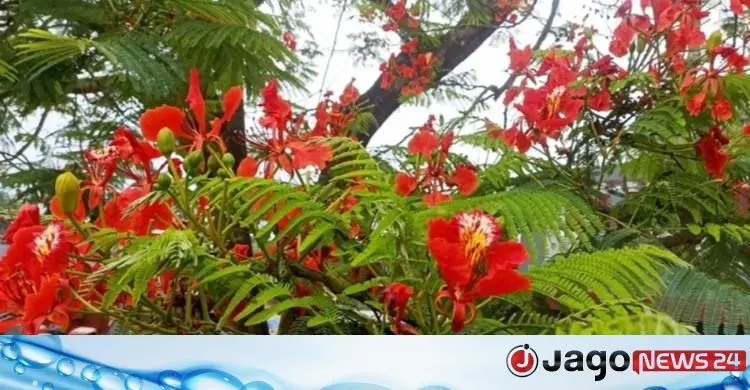
Fiery krishnachura flowers have bloomed in Narail at the start of summer. Amid the scorching sun and dry weather, they seem to have brought new life to nature, making the summer landscape bright and attractive. Students, passers-by, local residents and lovers of flowers and nature are enchanted by the sight.
The scientific name of the krishnachura tree is Delonix regia. It is a perennial ornamental tree of the Fabaceae family, known for its fine foliage and fiery red flowers, and is also called agunchura, lalchura or gulmohar. The flowers are usually bright or deep red and look like flames from a distance, though there are also orange and yellow varieties. Each flower has five petals. Krishnachura usually blooms in late spring and early summer.
Along roads, at educational institutions and around homes across the district, krishnachura trees are covered in deep red flowers. From a distance it looks as if red fire has been lit in the heart of the green. People of all ages are enjoying the sight; some are taking photographs with the flowers, while girls and young women wear them in their hair buns and plaits, and children carry them too.
Residents and teachers on the flame tree
Flower lover Mousumi told Jagonews: "When krishnachura blooms, it feels as if summer has truly arrived. The colour and beauty of this flower lift our mood. Standing under the tree for a while, even in a busy day, brings a kind of peace. At this time you see krishnachura flowers everywhere you go."
Mim Khatun of Dhopakhola village said: "There are a few krishnachura trees in our area. When they bloom, the whole place becomes colourful. I really like the sight. Children and young people in particular are keen to take photos under the trees at this time."
College lecturer Prafulla Kumar told Jagonews: "Krishnachura is not just a flower; it is tied to our emotions. At this time every krishnachura tree is full of flowers. On the way anywhere, the flowers catch your eye and fill your heart. People of every age are drawn to it. There is a krishnachura tree in front of our college's main gate, and we enjoy its beauty."
Kamrunnahar Lina, assistant professor at Lohagara Government Adarsha College and joint coordinator for Narail of the environmental organisation Green Voice, said: "The krishnachura tree is important for the environment, not just for its beauty. It gives shade and brings passers-by some relief in the intense summer heat."
Environmental activist and Green Voice member Sohel Rana Laxmi said: "Krishnachura is one of my favourite flowers. But the number of these trees is falling day by day, which is a threat to the environment. I call for new krishnachura saplings to be planted."
S M Hayatuzzaman, headmaster of Lohagara Government Pilot High School, an environmental activist and an adviser to Green Voice, said everyone was drawn to the krishnachura, whose beauty grows when the sun falls on the flowers.
Medicinal uses
Md Mosharraf Hossain Mollah, principal of Lohagara's Dighalia College, told Jagonews that krishnachura was not only a symbol of beauty but also had some medicinal properties. In Unani medicine, its leaves and flowers are used in various herbal preparations, and its extract is considered useful for reducing inflammation, healing wounds and some skin problems.
"Trees like this play an important role in people's physical and mental well-being," he said. "So everyone should come forward, from wherever they are, to plant krishnachura and other native trees to keep the environment in balance and for future generations."
Source: Jagonews24. First published in Bengali on The Agro News.

Comments
(0)