
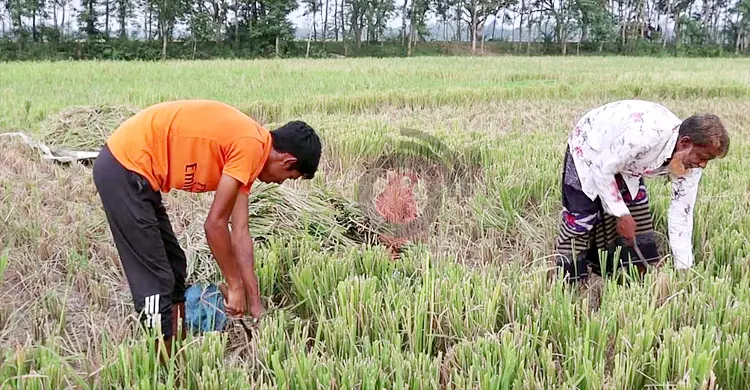
Straw is one of the main sources of feed for cattle. Many farmers also give their animals green grass and concentrate feed, but straw is the easiest to get. It comes from the paddy grown three times a year. To make carrying easier, however, workers cut the paddy and leave about half the straw in the field, so straw worth lakhs of taka is left lying there.
According to the district office of the Department of Agricultural Extension (DAE), the district has about 4 lakh 42 thousand hectares of land suitable for IRRI-boro, aus and aman. Each year this land produces straw worth about a crore taka (at Tk 3,000 per bigha). The straw left over in the fields has a market value of about Tk 50 lakh.
Stubble left knee-high
A visit to several upazilas, including Sadar, Badalgachhi, Niamatpur and Dhamoirhat, found that the IRRI-boro harvest and threshing are almost over and the fields now lie empty. After the paddy was cut, about one to one and a half feet of straw remained in the fields, and more in some places. Some people are cutting that straw for their cattle, while others are cutting and discarding it to prepare aus seedbeds. If the right amount of straw were cut from the fields, it would be possible to supply cattle feed in times of shortage.
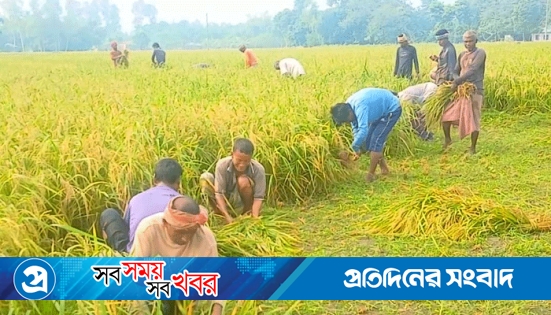
Favourable weather meant a good boro crop this year, and farmers were able to bring the harvest home smoothly. Cutting the paddy cost farmers about Tk 4,000–5,000 a bigha. In some places workers took 6–7 kg of paddy per maund along with their wages. Yet even after being paid extra, the workers cut the paddy leaving about half the straw in the field.
Workers said straw cut down to the base is heavier and hard to carry from the field on the shoulder or head. It also takes more time, so they are forced to cut the stalks halfway. If the paddy were cut from low down, there would be more straw.
What farmers say
Ashraful Islam, a farmer in Chakbalu village of Manda upazila, said each bigha yields about 18–25 pon of straw (one pon is 80 bundles). Old straw sells at Tk 250–400 a pon and is smaller, while new straw sells at Tk 120–150 a pon. The straw from one bigha is currently worth about Tk 3,000. About half the straw grown stays in the field, so roughly Tk 2,000 to 2,500 worth of straw is left behind, he said.
Sanaul Haque, a farmer in Fatehpur village of Dhamoirhat upazila, said cutting the paddy short needs fewer workers and makes transport easier. Workers do not want to cut the stalks long and want higher wages, and sometimes workers cannot be found at all. This year he had to give 6–7 kg of paddy per maund, he said.
Sirajul Islam of Chakprasad village in the upazila said he has to prepare a seedbed on the land. About half the straw has stayed in the field, and now he has to cut and clear it himself, even after paying wages to have the paddy cut. Harvesting this way also meant he got less straw, and at the end of the year he will have to buy straw again to feed his cows. At least Tk 3,000–4,000 worth of straw was left on every bigha, he said.
Kayem Uddin of the same village said: "I grew boro on four bighas. I have 12 cows. Because straw is cut like this, I face a shortage at the end of the year. I have to buy about Tk 10,000–12,000 worth of straw a year. If it were cut down to the base I would get more straw. The money spent on straw takes away part of the household budget. If I did not have to buy straw, I would be much better off financially."
Officials' views
Dr Mohammad Aminul Islam, Sadar upazila livestock officer, said that when the upper part of the paddy is cut, the lower part stays in the field, so farmers cannot meet the feed shortages their cattle face in lean or crisis times. His advice to farmers is to cut paddy right down to the base at harvest, so the straw can be stored and used to feed cattle all year round. He added that livestock farmers are also being encouraged to grow fodder grass.
Md Monirul Islam, Naogaon Sadar upazila agriculture officer, said the part left in the field after harvest is good for the land. The straw rots and turns into organic fertiliser in the soil, keeping the soil healthy. As for cattle feed, he said it is best to cut as much straw as is needed and leave the rest in the field.
Source: Jagonews24. First published in Bengali on The Agro News.
Comments
(0)