
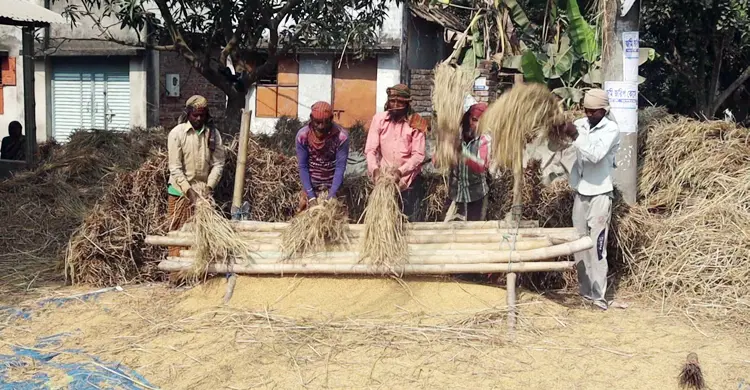
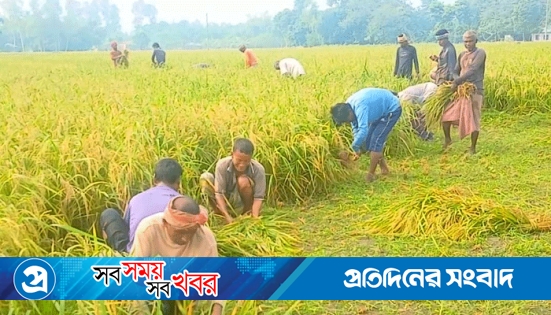
Farmers' golden dreams sway across the wide fields of Naogaon, and the sweet smell of aman paddy is everywhere. Farmers and labourers are busy cutting and threshing, for they will celebrate Hemanta's Nabanna festival with the new crop.
Farmers say the yield is better this year than in previous years, and they are bringing the paddy home without any natural disaster. Nabanna is bound up with traditional Bengali culture. The festival is held around cutting the new paddy and eating the first rice from it. Neighbours, relatives and everyone else are invited to eat payesh, polao, pitha and a variety of other food made from the new rice, and various rituals are observed according to social custom.
Pitha and new rice
Mou Begum, a housewife in Boalia Mondolpara village in Naogaon Sadar upazila, said homes are cleaned for Nabanna and many kinds of pitha are made from the new rice and rice flour, served with molasses and sugar. "New rice has a different fragrance. Neighbours, relatives, and daughters and sons-in-law are invited to eat. At that time it feels like a festival in every home in the village," she said.
Zahidul Islam, a farmer in Paharpur village, said cutting and threshing of the new paddy had begun and he was pleased with the good yield. "I have been able to bring the crop home without any problems. The yield is about 15-16 maunds a bigha. There was a little disease, but not much of a problem. But because fertiliser, pesticide and labour prices have gone up, production costs are higher. This time I will celebrate Nabanna with this new paddy," he said.
A tradition fading
Mostafa Al Mehmud Rasel, former general secretary of the local social organisation Ekushey Parishad Naogaon, recalled his childhood: "In my childhood and youth I saw a rush to make kheer, payesh and various pitha from new rice at Nabanna. Relatives would come, and rice from the new grain was eaten with shol fish and various vegetables. It is being lost to urban life, and even in rural Bengal it is not seen much."
On bringing back the Nabanna tradition, he said: "We are trying to revive the old festival, but no effective initiative is visible. To bring it back it must be spread among the new generation. Rural fairs and other events could be organised around Nabanna. Every effort must be made to sow the seeds of a non-communal spirit."
Dr Mohammad Shamsul Alam, associate professor of Bengali at Naogaon Government College, told Jago News that Nabanna is one of the main festivals of Bengali culture. "New paddy came into the granary in the month of Agrahayan, and people celebrated by making kheer and payesh from its rice. Now it is not celebrated like that. There used to be only one crop a year, and because of want, people had to wait a long time to bring that crop home. Now there are three crops a year, so Nabanna no longer has its old form, character and features among people. But village people still value the day properly; for them the day of Nabanna is an important one," he said.
Source: Jagonews24. First published in Bengali on The Agro News.
Comments
(0)