
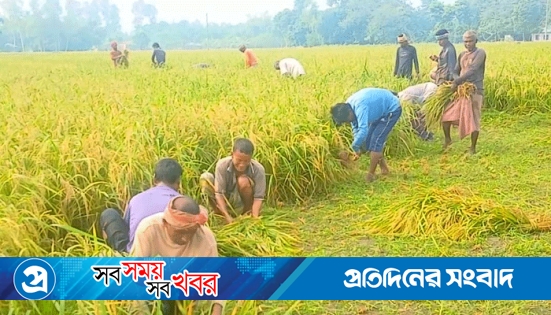
Its short growing period, savings on fertiliser and water, light sensitivity, good qualities and drought tolerance have made BINA dhan17 a source of hope for farmers in the Aman season. Speakers said this at a discussion held at Bottoli Hat after the harvest of the rice in the Shalabari field of Niamatpur upazila, at 12:30pm on Tuesday. The field day was held as part of the research and extension work of the Chapainawabganj sub-station of the Bangladesh Institute of Nuclear Agriculture (BINA).
According to the district Department of Agricultural Extension (DAE), Aman has been planted on 1,97,110 hectares in the district, of which BINA dhan17 accounts for 1,030 hectares. Of this, 520 hectares are in Raninagar, 125 in Dhamoirhat, 5 in Niamatpur and 20 in Manda, with more or less in other upazilas.
A 'green super rice'
Because BINA dhan17 needs less water, many also call it green super rice. The variety needs a third less urea and 50 per cent less irrigation. It matures in 110 to 115 days, each panicle carries 200 to 250 grains, and with a promising yield it is very profitable for farmers. It yields about 22 to 25 maunds per bigha and costs Tk 2,000 to 3,000 less to grow than other rice.
Farmer Ibrahim Khalil of Shalbari village said he planted BINA dhan17 on four bighas. The costs of irrigation, fertiliser, medicine and water for this variety are much lower, he said. "We planted at the same time, and my rice is already being cut, while the neighbouring plot will still need three or four irrigations over the next 20 to 25 days. I used to grow Swarna-5. Compared with that, my costs were Tk 2,000 to 3,000 lower per bigha. I think BINA dhan17 is profitable and is giving farmers hope. Many are now being encouraged to grow it."
Farmer Mofiz Uddin of Ghulkuri village said: "We didn't know about the qualities of the new rice. The plot next to mine was planted at the same time, and it is being harvested, with a good yield too, while mine will take another 20 to 25 days. I have seen for myself that BINA dhan17 grows in a short time. After this rice is cut, rabi crops will be planted. Where the land gave two crops, three are now possible. Next time I will grow this variety myself and encourage everyone around me."
'Three crops where there were two'
Dr Md Hasanuzzaman, senior scientific officer and officer in charge of BINA's Chapainawabganj sub-station, said BINA dhan17 is a short-duration, drought-tolerant variety that needs 30 per cent less water. It can be harvested within 110 to 115 days, and he put its average yield at 6.5 per hectare. On land that gave two crops, three are now possible with this variety: because of its short life, farmers can grow mustard, lentils or potatoes on the same land after harvest, then prepare the land and plant Boro rice. Farmers are being encouraged through publicity, he said.
Present at the discussion were BINA scientific officers Farhad Hossain and Jubayer Al Islam, Naogaon District Agricultural Training Officer K M Manjure Maula, Niamatpur Upazila Agriculture Officer Amir Abdullah Md Wahiduzzaman, farmer Ibrahim Khalil, and local farmers and dignitaries.
Source: Amader Shomoy. First published in Bengali on The Agro News.
Comments
(0)