
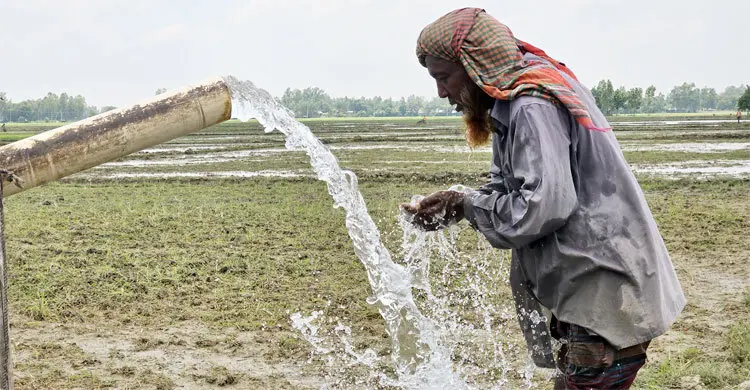
The month of Ashar has ended and there is still no rain in Shraban. Everything is drying up under the harsh sun. In Nandigram upazila of Bogura, Aman rice is grown in the monsoon and depends entirely on rainwater. The monsoon is under way, yet there is no sign of rain, and the upazila's farmers are in difficulty because rainfall has been inadequate.
Many have started ploughing after irrigating their fields with deep and shallow tubewells, and farmers are anxious about this year's Aman crop.
A monsoon without rain
Enquiries on Sunday, 28 July, found that in past years rain came at the start of Ashar. Farmers held the rainwater in their fields to cultivate, water lay all around, and rivers, canals and beels were full. Aman was planted with this water, and sometimes the crop was even submerged soon after planting.
This year, however, Ashar has passed and there is still no rain in Shraban. Scorching sun and sultry heat have made life unbearable, and people and animals alike are waiting for rain. Deep and shallow tubewells are being used to save the rice already planted.
In the fields of Yusubpur village in Nandigram upazila, the Aman plots have cracked in the intense sun. In several fields farmers were running deep and shallow tubewells to irrigate before planting Aman.
Bakul Hossain, a farmer from the village, said Aman is normally grown with monsoon rain, which keeps costs low. This year, however, the land is cracking in the drought and there is no rain. If this continues, it will cost about Tk 3,000 extra per bigha, he said, and he cannot tell whether he will recover his production costs.
Extra cost per bigha
Many farmers in Kathom, Ridhoil, Bijoyghat, Chaklma and Teghori said that preparing Aman land usually costs Tk 4,000 per bigha, but with the weather unfavourable this year an extra Tk 1,000 is being spent. Aman does not normally need irrigation and is grown on rainwater, but this time irrigation will cost an extra Tk 1,000 per bigha, they said.
Ferdous Sardar, a farmer in Kathom village, was ploughing his dry field. "The monsoon is passing and there is no rain. The dry land is filling up with grass. What's the use of sitting idle? I'm ploughing the dry land anyway," he said.
Abdus Salam, a farmer in Bijoyghat village, said: "Thirteen days of Shraban have gone and there's no sign of rain. We can't leave the land empty, so I'm irrigating with a shallow machine to get the land ready for Aman."
What the agriculture office says
The upazila agriculture office says there is nothing to worry about and that even if rain comes in the last part of Shraban, cultivation will not be disrupted. The upazila has a target of growing Aman on 19,850 hectares, and there are about 3,500 deep and shallow tubewells, large and small, in the upazila.
Nandigram upazila agriculture officer Gaziul Haque said Aman cultivation is set to be disrupted by the drought. Because there has been no rain, farmers are having to irrigate to grow Aman, which will reduce their profit this year. There is a chance of rain within the next week, he said, and if it rains farmers will benefit.
Source: Jagonews24. First published in Bengali on The Agro News.


Comments
(0)