
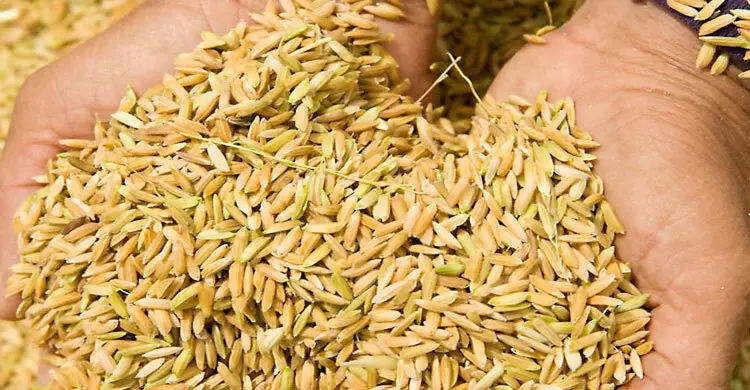
Mymensingh division has a large annual surplus of rice and other paddy-based food, but a big shortfall of wheat and maize. A regional official says farmers will be encouraged to grow wheat and maize.
Total food grain production in Mymensingh division is 47 lakh 88 thousand. Subtracting the total food demand of 18,06,378 tonnes leaves a surplus of 24,54,942 tonnes.
In the district, the report says, subtracting total production of 19,09,554 tonnes from total food demand of 10,76,771 leaves a total surplus of 8,32,783 tonnes.
Division figures
According to the divisional agriculture office, in the 2021-22 fiscal year total aus paddy production was 1,15,992 tonnes, aman paddy 25,20,544 tonnes and boro paddy 42,33,544 tonnes. Wheat production was 25,077 tonnes and maize 1,82,869 tonnes.
Rice production that year was 77,328 tonnes of aus, 16,80,363 tonnes of aman and 28,22,363 tonnes of boro.
According to the census, the division's population is 1,22,19,711. At 405 grams per person, total food demand is 18,06,378 tonnes. Subtracting 5,26,680 tonnes for seed and animal feed from annual food grain production of 47,88,000 tonnes leaves 42,61,320 tonnes. Subtracting total food demand of 18,06,378 tonnes from that leaves a surplus of 24,54,942 tonnes.
District figures
According to the district agriculture office, in 2021-22 aus paddy production was 78,162 tonnes, aman paddy 11,34,837 tonnes and boro paddy 28,64,331 tonnes. Total annual paddy production is given as 28,64,331 tonnes.
Annual rice production was 52,108 tonnes of aus, 7,56,558 tonnes of aman and 11,00,888 tonnes of boro, a total of 19,09,554 tonnes. Annual wheat production was 6,678 tonnes.
According to the last census, the district's population is 53,13,163. At 442 grams per person per day, total food demand is 8,57,173 tonnes. Annual crop wastage at 11.50 percent comes to 2,19,598 tonnes. Total food demand plus wastage is 10,76,771 tonnes.
Subtracting total production of 19,09,554 tonnes from the district's food demand including wastage of 10,76,771, the report says, leaves a surplus of 8,32,783 tonnes.
Farmers turn away from wheat
Suman, a farmer in Bhatipara, Char Lakshmipur, Sadar upazila, said: "We used to grow wheat, but we do not now, because if you grow wheat you cannot grow the boro crop. Growing paddy is more profitable than wheat. Besides, the agriculture offices give no help or advice for growing wheat." All in all, farmers' interest in wheat has fallen, he claimed.
Kashem Mia, a farmer in the Char Ishwardia Munshibari area, said: "We used to grow wheat. But if you grow wheat you can grow the boro crop. Paddy is also more profitable than wheat. Besides, agriculture office staff do not give the right advice at the right time and do not help. That hurts us. So now we hardly grow wheat at all."
Official urges new varieties and mustard
Md Ashraf Uddin, additional director of the Department of Agricultural Extension (DAE) for the Mymensingh region, said Mymensingh is essentially a paddy-producing region. Nationally, it is known as the biggest paddy producer among Bangladesh's 14 regions. About 1 crore 22 lakh people live in the division.
"We produce 47,88,000 tonnes a year including paddy, wheat and maize, from which 5 lakh tonnes are set aside, including animal feed and seed. Against demand, our division has a surplus of 24 lakh tonnes, which could feed another region. That is why we are proud of our region," he said.
He said boro production of the 28 and 29 varieties used to be high but yields are now falling. "This year we have taken an extension initiative, encouraging farmers to plant 88 instead of 28 and 89 instead of 29. If the 88 and 89 varieties are planted, 30 maunds of paddy per bigha is possible."
Ashraf Uddin said the government's target is to double productivity by 2030. "If we want to reach a developed Bangladesh by 2041, we must raise our income. To raise income, there is no way other than increasing farmers' production."
Besides raising paddy output, the government has another goal, he said: increasing oil production. "Twelve percent of our oil demand is produced in the country. The government wants to bring that to 40 percent. That is why we have made extensive plans for mustard. We hope it will be possible to increase mustard cultivation in this region by 4 to 5 percent, and it will happen."
Source: Jagonews24. First published in Bengali on The Agro News.
Comments
(0)