
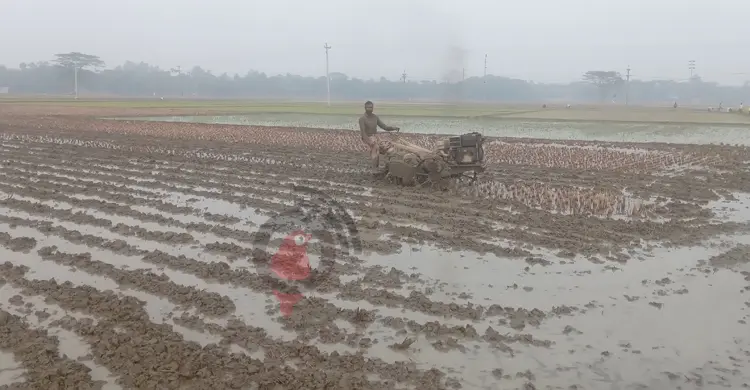
Severe cold has set in, and costs have risen with higher electricity bills and fuel prices. Farmers in Mymensingh have begun Boro cultivation fearing a loss, while labourers are frustrated that their wages have not risen in line with the prices of everyday goods.
Last Boro season, ploughing a bigha of land five times cost Tk 1,200. This season it costs Tk 1,800. Irrigating a bigha cost Tk 1,500 last season and costs Tk 1,800-2,000 this season. The cost of transplanting seedlings has also risen by Tk 300-400 a bigha.
Cold and fog delay planting
Liakat Ali Fakir, a farmer of Marakuri village in Mymensingh Sadar upazila, is preparing an acre for Boro this season and has made a seedbed. But severe cold and dense fog have kept him from transplanting.
"The cold and fog are so bad you can't leave the house, so it has become hard to prepare the Boro field," he said. "Without the cold, Boro seedlings could have been planted by mid-December. Because I couldn't plant on time, the seedlings in the seedbed are about to be ruined. Everything costs more as well. I am worried whether I will be able to bring the crop home properly this time."
Miaz Uddin Master, a farmer of Char Lakshmipur village in the same upazila, said: "Last Boro season we had to pay a daily wage of Tk 400 with breakfast and a midday meal of rice, or Tk 500 without meals. That has now gone up by Tk 100-120. If you don't pay more, you can't find labourers."
He added: "Here we count 10 decimals as one kotha. Last year ploughing a kotha cost Tk 400; this year it is Tk 500-520. With higher electricity bills, irrigation per kotha is costing another Tk 100 this year."
Mojibur Rahman, a farmer of Char Ishwardia village, said: "I am growing Boro on two acres this year. Ploughing, labour and irrigation costs have gone up by Tk 100-120 per kotha. If costs keep rising every season like this, it will become hard for farmers like us to grow paddy."
Pesticide prices double
Al Amin, a farmer of Ramgopalpur village in the district's Gouripur upazila, is cultivating two acres. "It is not only ploughing and irrigation. Growing paddy needs pesticide. A pesticide that cost Tk 100 last season now costs Tk 200-250. We ordinary people spend our days working in the fields and have never seen a profit," he said.
Moslem Uddin, another farmer of the same village, grew Boro on two acres last year but has cut back this time because of the rising cost. "Electricity, irrigation, ploughing, labour, fertiliser and pesticide have all gone up, but we don't get much of a price for paddy. So I have reduced my paddy this year. It would be good if the government extended a helping hand," he said.
Labourers say wages don't cover living costs
Ebadul Mia is transplanting seedlings in the Meri Agla Kandapara area of Char Ishwardia with five others, at Tk 550 a kotha. "We get up at dawn and start working in the mud and water in the bitter cold, and it goes on until evening. With the prices in the market, Tk 550 for a full day's work can't keep a family going. Still, we have to do it to eat," he said.
Seven men came from Kashiganj in Tarakanda upazila to work in Char Ishwardia village in Sadar upazila. At Tk 500 a kotha, they planted eight kothas in a day.
Sahabul Islam, one of the group, said: "In this cold I got up around 4am and walked about 20 kilometres to get here. We are working for Tk 500. The journey there and back costs about Tk 100. The way the market is, it is very hard to run a household on what is left."
Motiuzzaman, deputy director of the Department of Agricultural Extension in Mymensingh, told Jagonews that the district's Boro target this season is 262,550 hectares. So far seedlings have been planted on 66,610 hectares, and about 75 per cent of planting remains. He hoped planting would be finished in the time left and said they were trying to meet farmers' needs.
Source: Jagonews24. First published in Bengali on The Agro News.
Comments
(0)