
BINA dhan17, a high-yielding, short-duration, drought-tolerant variety with improved qualities, is also called "green super rice". It was developed over five years of research, and in 2015 the National Seed Board approved it for Aman cultivation across the country as a high-yielding, short-duration variety. Farmers had got good yields from it, but this year farmers in Mymensingh have been left disappointed.
The same happened with BINA dhan11, developed in 2013. It too failed to give the expected yield, and most of the grain turned to chaff. Many farmers borrowed money to grow these varieties and are now in despair.
At least 141 farmers in various villages of Mymensingh Sadar upazila have suffered losses growing these varieties. There are now doubts about growing them in future, and the affected farmers are demanding compensation.
Chaff instead of grain
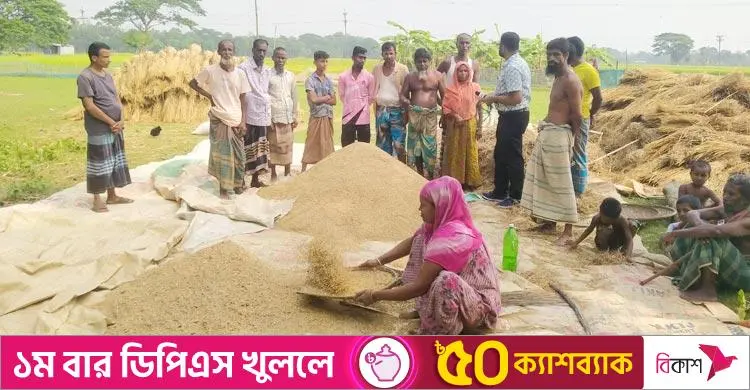
In the Madhyapara area of Ward 31 of the city corporation, men and women farmers were busy threshing and drying paddy, tirelessly separating grain from chaff, but with disappointment written on their faces.
Farmers said that besides this area, 141 farmers in various villages of Char Ishwardia union in Sadar suffered heavy losses from BINA dhan17 and BINA dhan11. All of them had received free seed from the Bangladesh Institute of Nuclear Agriculture (BINA) in Mymensingh. They got at most one to one and a half maunds of paddy per 10 decimals; the rest was chaff. Angry at the varieties, many farmers are likely to turn away from them, and for fear of losses they will not want to try any new variety.
Farmer Babul Mia said he owns only 30 decimals of land and grows paddy on it every year. Hoping for a bumper crop at low cost, he planted the short-duration, high-yielding BINA dhan17, but after removing the chaff he got one and a half maunds per 10 decimals. He spent at least Tk 12,000 in all, borrowed in the hope of a good harvest, and had planned to repay it by selling the paddy. Now he is worried.
Helal Uddin, a sharecropper, said: "I was given 10 kg of BINA dhan17 seed for free and grew it on 120 decimals. I sold a milking cow with her calf for Tk 70,000 to meet the cost. Now I have got 15 maunds of paddy in total."
Heat at flowering blamed
Dr Nasrin Akter Banu, deputy director of the Department of Agricultural Extension (DAE) in Mymensingh, told Jagonews that many farmers have suffered losses growing these high-yielding varieties, and that all kinds of help will be given to keep their spirits up.
Asked why the grain turned to chaff, Dr Shamsunnahar Begum, the varieties' breeder and head and chief scientific officer of BINA's plant breeding division, told Jagonews that yields were good in all areas, and that only most of the paddy of the 141 Mymensingh farmers turned to chaff. The temperature was too high when the paddy was flowering, and the chaff also resulted from too much or too little fertiliser and pesticide. The farmers will be helped with seed for other crops and fertiliser, she said.
Source: Jagonews24. First published in Bengali on The Agro News.


Comments
(0)