
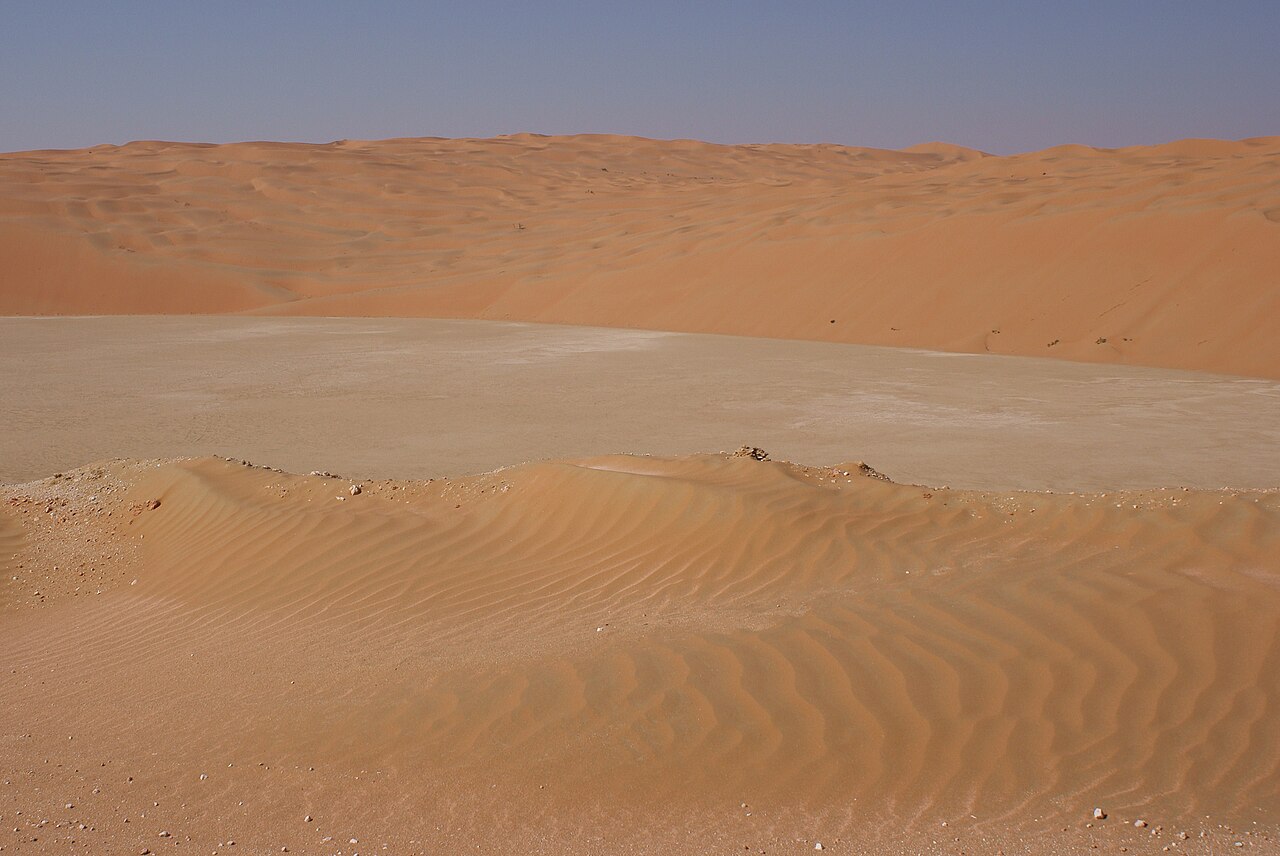
Where southern Saudi Arabia is now open sand, there were freshwater lakes, grassland and green vegetation some 125,000 years ago. Archaeologists have found the remains of one such lake at Uruq al-Julaybah in the Mundafan region in the south of the country. The study has been published in the journal Science.
The work was carried out jointly by the Saudi Heritage Commission, King Abdullah University of Science and Technology and Griffith University. The researchers link the lake to a period of climate change known as the Last Interglacial, when the Arabian Peninsula received far more rain. Water bodies, grassland and green vegetation took the place of today's dry desert, a period scientists also call Green Arabia.
Using satellite data and an analysis of the ancient landscape, the team reconstructed the lake. By their estimate it covered about 340 square kilometres and was as deep as about 29 metres in places.
More than 500 plant and animal fossil samples were recovered from over 130 locations around the lake. They include hippopotamus, an extinct long-horned buffalo, camel, Arabian oryx, gazelle and ostrich.
The researchers also found 5,511 stone tools, most of them made of flint by the Levallois technique. Microscopy and chemical tests identified plant residues on the tools, some from possibly poisonous plants, which the team thinks may have been used in hunting. Traces of wood and resin suggest that some tools were hafted onto wooden shafts.
The study also found evidence that tubers, shrubs and palm leaves were used, among the oldest evidence of palms in the region. The Arabian Peninsula has long been seen as a hostile desert between Africa and Eurasia; the find shows how completely the same land can change when the climate does.
The report is based on a photo story by Rahit Paramanik of Ei Samay.
Photo: Nepenthes / Wikimedia Commons (CC BY-SA 3.0)
Source: Ei Samay

Comments
(0)