
By Dr Forkan Ali
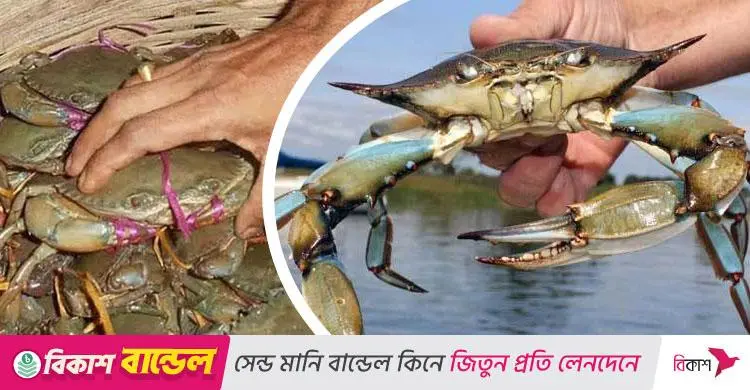
The crab is a hard-shelled aquatic animal of the arthropod group. Depending on the species, crabs live in both fresh and salt water: there are four freshwater species and eleven saltwater species. Freshwater crabs are small, while saltwater crabs, which live in the sea, are quite large. Freshwater crabs are not exported; large marine crabs are. Of the eleven marine species only one, the mud crab, is exported. Its scientific name is Scylla serrata, and in many places it is known as the mud crab.
Abroad, mud crab meat is a favourite food. In Bangladesh crabs are familiar to people of every class everywhere and play an important part in fisheries. Although most people here do not eat crab, exports earn a great deal of foreign currency. There is demand in South-East Asia and in Europe. Bangladesh exports about Tk 14 crore worth of crabs a year. As world demand has risen, collection has increased considerably, and thought has begun to be given to farming methods. Crab farming in Bangladesh is still at an early stage; almost all exported crabs are caught from coastal shrimp farms, estuaries and mangrove forests.
Identification and distribution
Mud crabs are found in mangrove areas along the east coast of Africa, the coast of India and the Indo-Pacific region. On the carapace on either side of the eyes they have nine teeth, called serrations, and juveniles can be identified by the number of serrations. In Bangladesh crabs are found almost everywhere along the coast.
Crabs generally become adult and able to breed at 16 to 18 months, when a crab weighs 300 to 500 grams. The heaviest crab found weighed up to 5 kg. A one-year-old crab usually weighs 400 to 500 grams.
Like tiger shrimp (bagda), the female crab releases "nauplii" in the deep sea, which pass through five larval stages to reach the megalopa and post-larval stages. Tides, waves and wind carry them to coastal mangroves, where they become juveniles. One female can lay 1 to 8 million eggs.
Like tiger shrimp, crabs have a shell, though a harder one, which they moult in order to grow. Crabs tend to eat their own kind, and can easily kill other animals with their strong claws. They like to dig holes in soil and embankments and shelter among submerged roots and branches, which is why they are found in mangroves. Crabs can live out of water for a long time and can easily walk from one place to another.
Advantages of crab farming
- The coastal belt of Bangladesh has a suitable environment for farming.
- Demand in the international market makes production profitable.
- Natural seed (juveniles) is currently available in Bangladesh.
- Crab feed can be obtained cheaply.
- Crabs grow quickly by weight.
- They protect the environment by eating rotting waste.
Suitable soil and water
Like tiger shrimp, crabs can be farmed in coastal saline water. The desirable qualities of soil and water are as follows.
Soil: soft loam or clay; soil with hydrogen sulphite and ammonia gas; organic matter of 7-12%; free of acid sulphate; an environment with light algae and aquatic weeds.
Water: salinity 10-25 ppt; temperature 25-30°C; pH 7.5-8.5; alkalinity 80 mg/l; hardness 40-100 ppm; dissolved oxygen above 4 ppm.
Choosing the site
Crabs can usually be farmed easily wherever tiger shrimp can. There must be ample scope for regularly changing the saline water in the pond. Places where salinity stays above 5 ppt for 8 to 10 months of the year are suitable, and the farm area must be free of wild animals and birds.
Building the pond
As with a shrimp pond, strong embankments must be built to hold water. Crabs are used to walking about and like to hide in burrows, so a fence must be put up inside the embankment, standing 0.5 metres above the water. It can be made of dense bamboo slats, closely woven bamboo twigs, cement walls or asbestos, and must be sunk at least 0.5 metres into the ground so crabs cannot tunnel underneath. The weave must be tight enough that juveniles cannot slip through and other harmful animals cannot get in.
There must be arrangements for draining the pond and supplying water, with a gate or sluice box as in a shrimp pond. Ponds of 0.2-1.0 hectare are easiest to manage, and a depth of 1.0-1.5 metres is best.
Preparing the pond
Drying and washing: as with a shrimp pond, the soil must be dried. After drying, the pond bottom must be washed to remove acids, salts and toxic substances from the surface soil; water can be let in and drained again a day later. If the bottom needs ploughing, it should be washed again the same way afterwards.
Liming: usually 300-800 kg of lime (Ca) per hectare should be applied to the soil and embankments before farming. Lime should be applied after testing soil pH, and can be applied at rates based on that pH.
Shelter: crabs like to hide while moulting to avoid attack by other aquatic animals. In nature they shelter among mangrove roots; pieces of cement or PVC pipe can also be used, usually 4-6 in diameter (the unit is not given). Pipes of different sizes let small and large crabs choose their own shelter. Shelters can be placed on the pond bottom and along the inner fence. Perishable materials must not be used.
Filling and fertilising: as in shrimp farming, water should always be filtered through nylon net with 0.25 mm holes to keep out other water. First let in 30 cm of water and apply organic and chemical fertiliser. Applying fertiliser in several instalments rather than all at once gives better, and more economical, results. Per hectare, 500 kg of organic fertiliser, 15 kg of TSP and 10 kg of urea should be dissolved in water and spread throughout, adjusting the dose to the water colour and the amount of phytoplankton. The water depth should be raised gradually alongside fertilising, preferably staying within 1 metre. Phytoplankton adds to the crabs' food and shades the pond bottom, which matters because crabs cannot tolerate sunlight and prefer shade. Plankton also helps keep water quality right and helps remove toxic substances.
Stocking
At present crab farming mostly means fattening crabs. Juveniles are caught with bamboo traps (chai), set nets and bag nets. Some 8,000-10,000 crabs of 20-40 grams can be stocked per hectare. Farming females is more profitable, so a ratio of 9:1, or 90% females and 10% males, is used.
Sex can be told from the claws and the abdominal flap. Males have larger claws; a female's claws are smaller than a male's of the same age. The female's flap is semicircular, while the male's is narrower and V-shaped. As it is very hard to collect crabs of the same age, stocking crabs of similar weight makes care easier. Juveniles can be moved in bamboo baskets.
For export, females with gonads are selected. Females found without gonads (ovaries) after harvest are locally called khosa crabs. These khosa or soft-shelled crabs are kept in a designated pond for 15-20 days and given suitable feed. This is called crab fattening and is practised in many places.
Feeding
Crabs are omnivorous and prefer live food: small fish, marine worms, snails, mussels and insects, though they also eat dirt and rotting organic matter. Small trash fish, snail and mussel meat, shrimp and shrimp heads, and various remains can be used as feed. Crabs need calcium-rich food to build their shells, so they also eat meat bones and fish bones. Rice bran, wheat bran, flour and fish meal can be mixed into feed as well.
Feed demand grows as crabs grow. Feeding should be controlled by placing feed in trays and watching how much is eaten. Like tiger shrimp, crabs are nocturnal, so they should be fed two or three times a day in the afternoon, evening and at night.
Water management
The pond water can be changed using the tides at new moon and full moon. Lime and fertiliser should be applied regularly to maintain water quality. If the plankton dies or the water becomes polluted, the water must be changed at once. Crabs leave if they do not find a suitable environment. They are hardy animals, but changes in the environment or polluted water can kill them and hurt production.
Harvest and marketing
Crabs can be harvested 3-4 months after stocking. The best farming period in Bangladesh is March to July, when water quality and temperature are suitable. Bamboo traps or net traps are best for catching them. A crab with a broken leg cannot be sold. Crabs can be caught in stages using lift nets or baited traps, and feeding should be stopped before harvesting.
Bamboo tongs must be used in a way that does not break legs when moving crabs between containers; crabs can be held from behind with tongs or by hand. Live crabs are currently exported, so they are tied firmly with cord or plastic strips and packed in baskets. During transport salt water should be sprinkled to keep the baskets damp, and the baskets kept in a dark or shaded cool place. Bangladesh does not yet export boiled or frozen crab; if it could, transport costs would be much lower.
Conclusion
The coastal region has a suitable environment for crab farming, though it has not yet spread much. At export prices farming is quite profitable: done properly, it can yield a net profit of more than Tk 60 a kg at current rates. Crabs are a farmable animal and their production is a profitable investment.
To demonstrate this, crab farms need to be set up in the country, and training should be arranged at government level. It would also help reduce poverty and unemployment. Exporting live crabs requires clearance from the Ministry of Environment; to encourage crab farming, this responsibility should be handed to the relevant directorate. Planned crab farming in the borrow-pit areas of the Water Development Board in coastal districts would make good use of the land. To secure the supply of crab seed, the use of behundi nets in the inner canals of the Sundarbans must be stopped. Everyone concerned hopes that planned management and enforcement of the law will increase Bangladesh's crab resources.
The writer is a researcher and former principal.
Source: Jagonews24. First published in Bengali on The Agro News.
Comments
(0)