
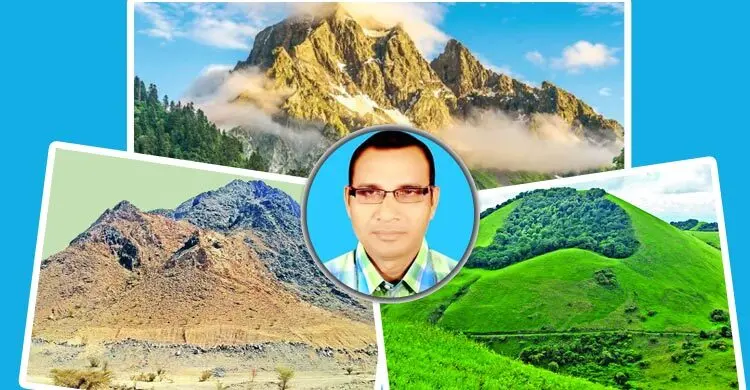
Mountains are one of nature's finest gifts, a treasury of natural beauty. Alongside many species of plants and animals, they hold sources of fresh water. Their beauty captivates people, and the scenic hill districts are a great attraction for travellers. Mountains are also very important for keeping the natural environment in balance and for improving quality of life.
As in other countries, International Mountain Day is observed in Bangladesh every year to raise awareness of the need to protect the balance of the natural environment. The day has been observed on 11 December since 2003 to raise awareness of the significance of mountains in people's lives and of protecting the planet's environment. The United Nations finalised the day as International Mountain Day on 20 December 2002, and it was first observed in 2003.
Water towers and biodiversity hotspots
Mountains are a very important natural resource. They are called biodiversity hotspots and sources of pure water. Mountain ranges cover about 27 per cent of the Earth's surface, and about 15 per cent of the world's population lives in mountains. A symbol of vastness and firmness, mountains are one of the elements that keep the environment in balance. They supply drinking water to an estimated half of humanity and shelter plants and animals. They are home to communities diverse in language and heritage. But mountains are suffering from the effects of climate change, so International Mountain Day is important to remind the international community to take steps to protect their biodiversity.
Mountains play an important role in almost every religion. In Greece, Mount Olympus is considered the home of the gods. In Japan, the volcano Mount Fuji is considered sacred. Mount Kailash in the Tibet Autonomous Region of China is held sacred by four religions: Hinduism, Bon, Buddhism and Jainism. Mount Brandon in Ireland, Mount Ararat and the Alps in Europe are also considered sacred.
The importance of mountains in human life is immense. Mountain ranges cover about 27 per cent of the Earth's total land area, more than a quarter. Some 22 per cent of the world's people benefit directly from them, and most people enjoy benefits from resources drawn from mountains. Mountains are the source of about 60 to 80 per cent of the world's fresh water. Life in the hill regions is very diverse, shaped by mountain ranges, rivers and many species of plants and animals.
Hill or mountain?
There is no universally accepted definition, which makes it hard to tell hills from mountains. Height, volume, relief, steepness, spacing and continuity have all been used as criteria, and whether a landform is called a mountain depends on local usage. By one measure, hills higher than 2,000 feet or 600 metres are called mountains and those below are called hills. In the language of physical geography, a hill is a sloping mass of rock raised above sea level, or a relatively low heap of earth; rock masses of limited extent 600 to 1,000 metres high are generally known as hills, while extensive rock masses with steep slopes rising at least 1,000 metres above sea level are known as mountains. Hills have no peak and gentler slopes, while mountains have high peaks and steep slopes. The Himalayas, Tajingdong and Keokradong are called mountains. The world's highest is Everest in Asia's Himalayas, whose peak stands on average 8,848.86 metres, or 29,031.69 feet, above sea level.
Under threat
Today the adverse effects of climate, the destruction of trees, global warming, overpopulation, unplanned industrialisation and urbanisation, and erosion including snow loss and landslides have pushed nature and the environment towards serious disaster and left mountains under threat. Hills are being destroyed. Aggressive hill cutting is destroying forests, causing landslides and upsetting the balance of the environment. The destruction of mountains is changing the courses of rivers, destroying biodiversity, raising temperatures and accelerating the adverse effects of global climate change.
In Bangladesh, hill areas make up one-fifth of the country's total land. Eight parts of the hill region are in the east and north-east, and the remaining ten parts are in other regions of the country. The Sylhet region has quite a few hills and hillocks. Hills provide many important things such as water, food, medicine and energy, but growing tourism and development are damaging them, and if this is not addressed the country will face very serious situations in future. Conserving hills matters not only for people but for the whole ecosystem.
The beauty of the mountains attracts tourists from home and abroad. Within this hill landscape, the diverse life and culture of the small ethnic groups living in the Chittagong Hill Tracts make the region unique. The Ministry of Chittagong Hill Tracts Affairs has taken special initiatives to improve the lives of the country's hill people and protect the hill ecology. To raise awareness of the importance of mountains and of protecting the environment, plans must be made to improve the lives of people in hill areas and build a sustainable future. For our own survival we must protect the mountains and the environment, and for Bangladesh's overall development, the development of the hill region is essential.
The writer, Prakash Ghosh Bidhan, is a journalist and columnist.
Source: Jagonews24. First published in Bengali on The Agro News.

Comments
(0)