
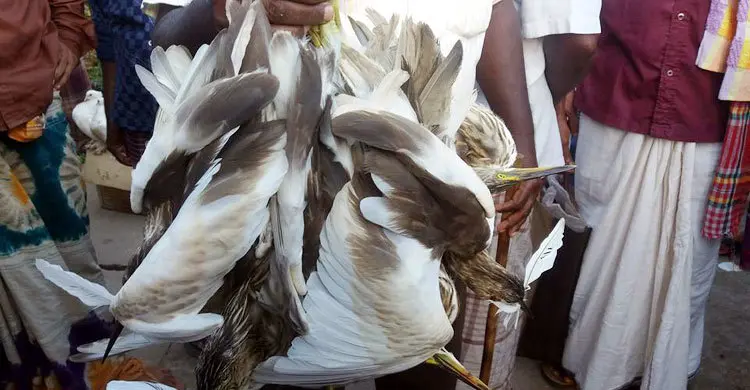
Migratory and native birds are being hunted on a massive scale in various parts of Moulvibazar, including Hakaluki haor and Baikka Beel in Hail haor. Defiant hunters are catching birds with poison bait, hunting nets and other novel methods. The birds end up in resorts, hotels and the homes of the wealthy, and are also sometimes sold openly in markets across the district.
The illegal sale and hunting of birds is seriously harming the environment on the one hand and increasing health risks on the other. Although the forest department and the administration do not know who the hunters are, a Jago News investigation has uncovered information about them.
Hundreds of birds taken every night
Baikka Beel is the protected area of Moulvibazar's Hail haor. About 11,000 birds were seen at the beel this year, according to a census by the Bangladesh Bird Club. But the investigation found that hundreds of birds are hunted every night from Baikka Beel and other parts of Hail haor. Although Baikka Beel is guarded, its birds are spread across the whole of Hail haor. People living around the haor, and fishermen, hunt birds under cover of darkness while they fish. For them, bird hunting is a seasonal business.
After hunting birds at night, they carry them at dawn in sacks or inside fish baskets to the settlements beside the haor. They contact particular customers by mobile phone and deliver the birds to their destination. Often the buyers come to them on motorcycles or in CNG auto-rickshaws.
At dawn on Thursday, Sanar Mia of Hajipur village brought about 50 dead birds, killed with poison bait, to Baruna bazar inside a fish basket. From there he handed them over to a pre-arranged customer who came on a motorcycle. The investigation found that Sanar Mia is not the only one: a number of fishermen in Hajipur village are involved in bird hunting. Among the regularly active hunters are Zaman Mia, Bahar Ali, Jasim Uddin, Aklim Uddin and Sadik Mia of neighbouring Baruna village.
It is alleged that 90% of households in Hajipur village, the settlement that has grown up by Baikka Beel, are feasting on bird meat. Because their homes are right next to the beel, migratory birds come to their homes on their own, so it is very easy for them to hunt, either from home or by going to the beel.
How easy it is to buy birds at Baikka Beel became clear from talking to some young men in neighbouring Hajipur village. When the reporter, posing as the owner of a resort, asked whether birds could be bought secretly, they said the order had to be placed in advance. If money was paid in advance, the buyer would be told by mobile phone once the birds had been hunted and could then come and collect them.
A member of the Baikka Beel Resource Management Organisation, speaking on condition of anonymity, said everyone is hunting birds however they can. "In many cases the protectors here are the predators," he said.
Poison bait at Hakaluki
The situation is the same at Hakaluki, the country's largest haor. This year 20,000 fewer birds came than two years ago. While conducting the bird census on 26 and 27 January this month, Tarek Onu, vice-president of the Bangladesh Bird Club, saw a number of birds killed with poison bait in Hakaluki haor.
Three days later, on 30 January, 300 ducks belonging to farmer Shamsul Islam died on the bank of Hakaluki's Dudhai beel because of hunters' poison bait.
Shamsul Islam alleged that a large syndicate, including Dudu Mia, Monaf Mia, Sunai Mia, Mona Mia, Anwar Hossain, Watir Ali, Chhalik Ahmad and Asad Uddin of Khuthaura village, is killing migratory birds every day by mixing poison with paddy in different beels of the haor. His ducks died after eating the poison bait laid out with paddy to hunt birds.
Meanwhile, birds are being sold openly on various highways in Sylhet, including in Moulvibazar. On the highway from Sherpur in Moulvibazar to the Mirpur area of Habiganj in particular, illegal bird sellers stand every day with hundreds of birds, targeting passengers in private cars. The highway police largely stay silent even when they see this. Wealthy people buy the birds at high prices.
Tarek Onu, vice-president of the Bangladesh Bird Club, told Jago News that the carcasses of several kinds of wild duck killed with poison bait in Hakaluki haor were proof of human greed and ignorance. "Those who buy these ducks and take them home are also buying their own death warrant," he said.
Divisional Forest Officer (Nature and Wildlife Conservation Division) Abu Musa Shamsul Mohit Chowdhury told Jago News that bird hunting has fallen a lot compared with before. "We are short of manpower, but we are still doing what we can. Various steps have been taken to make people aware. Only public awareness can free us from this situation," he said.
Source: Jagonews24. First published in Bengali on The Agro News.


Comments
(0)