
Engineers at the Massachusetts Institute of Technology have flown an insect-sized flapping-wing robot that carries its own sensors and computer for the first time, freeing it from the external camera rigs that have kept such robots inside laboratories. The university announced the work on 18 November; it is published in Science Robotics and was led by Kevin Chen and Jonathan How at MIT with Elizabeth Farrell Helbling at Cornell University.
The robot is about the size of a microcassette and weighs less than a paperclip. Four wings, driven by soft, muscle-like actuators rather than a motor, flap fast enough to lift it. Earlier versions from the same lab flew with insect-like speed and agility, but only in a room fitted with motion-capture cameras that tracked markers on the robot.
The new version carries a 244-milligram package: an inertial sensor for orientation, an optical flow sensor for sideways speed and direction, a time-of-flight sensor for height and a microcontroller that processes it all in real time. Because flapping-wing flight is unstable, the computer must estimate the robot's position and correct its course many times a second. The team's key step was a simplified estimation method that trades some precision for speed. Enlarging the actuators by 50 percent raised net lift by 46 percent, and the electronics use only about 6 percent of the robot's power.
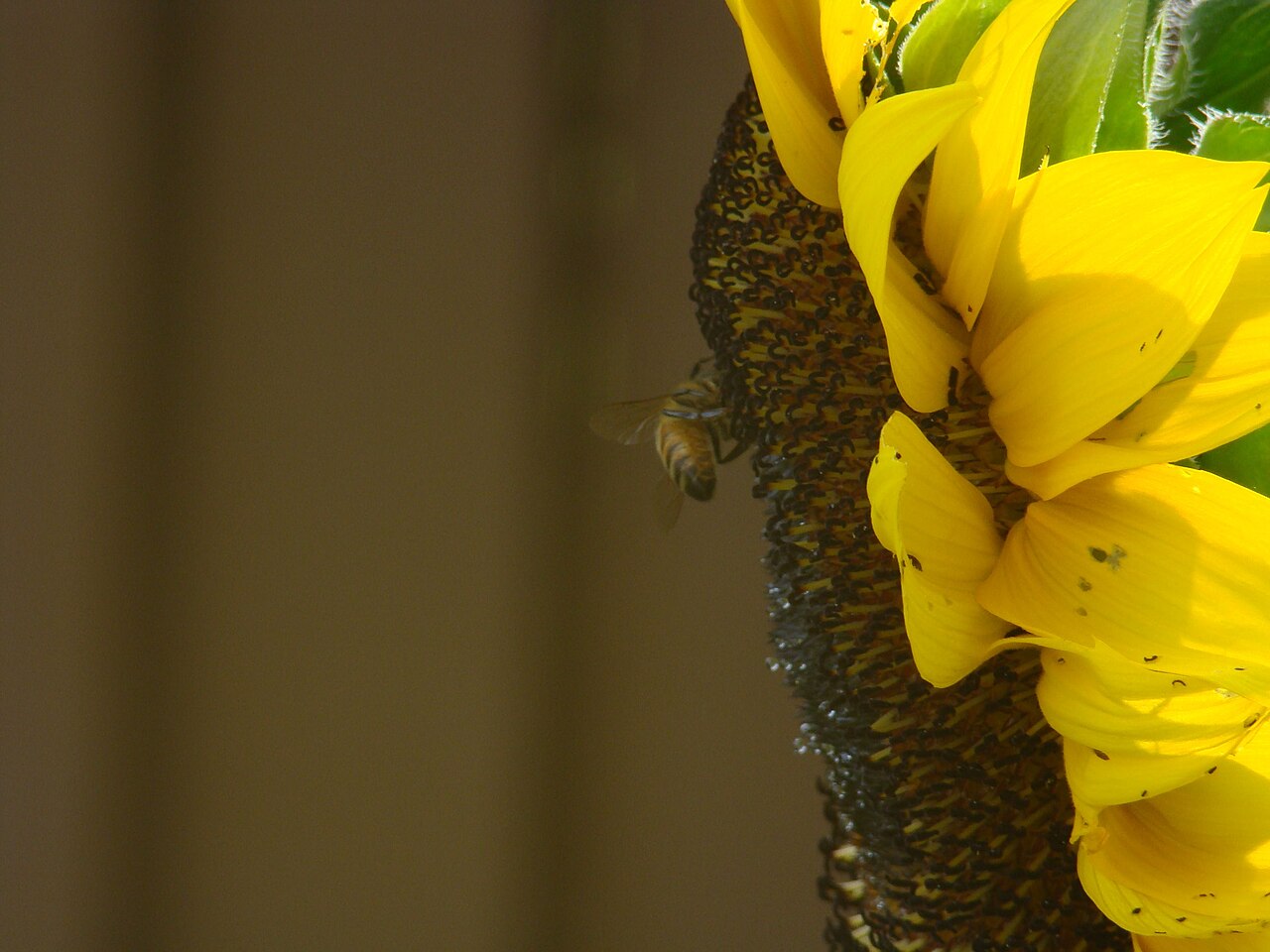
In tests it hovered at different heights and flew between points with a position error of a few centimetres, which co-lead author Yi-Hsuan Hsiao called “comparable to flying with offboard cameras.” Guided by joystick commands, it flew around several plants and landed precisely on a sunflower.
MIT points to two possible farm uses: hand-pollinating blossoms in orchards or berry fields where natural pollinators have declined, and hovering near plants to check crop health or spot pests early. Both are future possibilities, not demonstrated abilities. The robot is still tethered to an outside power source, and untethered, battery-powered flight, needed for any outdoor use, has not yet been shown. Chen called it “the first demonstration of an aerial microrobot that is sensory and compute autonomous,” a milestone for researchers rather than a field-ready tool.
Photo: dankeck / Wikimedia Commons (CC0)
Source: Global Agriculture

Comments
(0)