
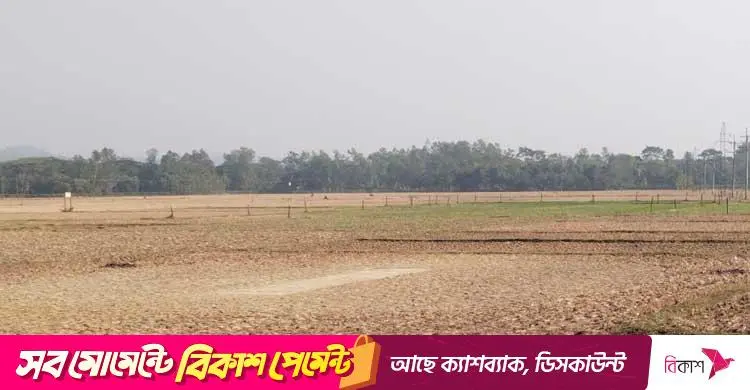
Farmers in Wahedpur union of Mirsharai, Chattogram, cannot grow Boro rice on 1,500 acres of land for want of enough water. If water could be arranged, this farmland that now lies abandoned could be brought under rice in the Boro season too. The farmers are demanding water from the Bawachhara irrigation project through deep tube wells and the excavation of streams and canals. With water, they say, crop output would rise and so would the area under cultivation.
According to the upazila agriculture office, Wahedpur union has about 2,000 acres of farmland in all. Of this, 425 acres are triple-cropped, Boro rice is grown on 120 acres and vegetables on 500 acres. On the remaining 955 acres farmers struggle to cultivate because of the lack of water.
How the Bawachhara project began
In 2005, through the efforts of Wahedpur union chairman Salauddin Selim, 2,000 farmers from wards 3, 5, 6, 7 and 9 were organised into a society. With them, a dam was built at the foot of the hills and a sluice gate installed. Bawachhara Water Management Cooperative Society Ltd stores water there in the monsoon and supplies it for farming in the dry season.
If the streams and canals under the project were freed from illegal occupation, some stretches excavated by the government, and Wahedpur beel linked to Majhgaon's Gangar beel with a sluice gate, the water could reach most of Wahedpur union's farmland through Gangar beel and several canals beside it. Cultivation of Aman and Boro rice, vegetables and other crops could then triple.
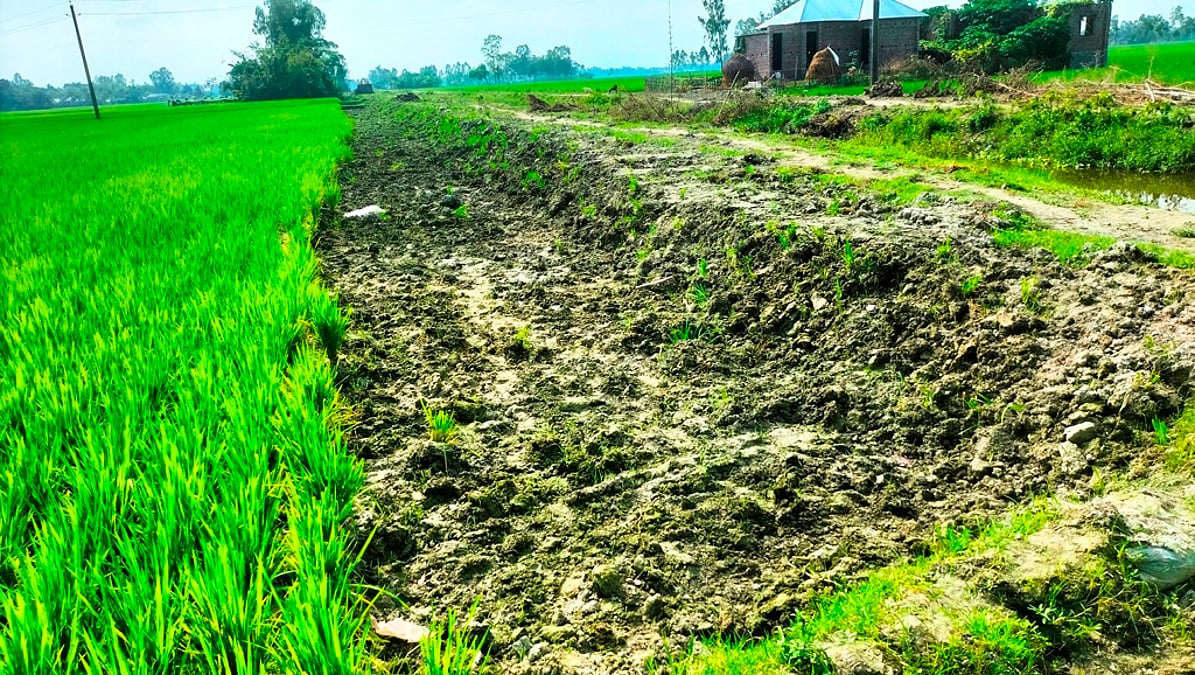
A visit to the union's Nizampur Baromasi stream and Gachhbaria canal found that illegal structures and silt have shifted the course of both. Because water does not flow properly in the monsoon, the banks of the stream and canal and nearby roads are eroding, damaging fields and fish enclosures. The Gangar beel stream, meanwhile, has almost disappeared.
Local people want the Nizampur stream and Gachhbaria canal dug out. With the canals silted up, the water has changed course and caused waterlogging, disrupting daily life and damaging Aman rice and other crops. Digging the canals and streams would ease the waterlogging on one hand and raise farm output on the other. Farmers are waiting for the government to draw up and carry out a long-term plan.
What farmers say
Abul Kashem, a farmer of Maddhyam Wahedpur, said: "More than 200 farmers in the village live by farming. In the dry season we struggle because there is not enough water. We have to fetch water from far away to irrigate the fields, so production costs go up a lot. Crops are ruined for lack of water, and Boro rice cannot be grown at all. With water we could grow Boro rice as well as vegetables. For that, water must be brought from Bawachhara by pipeline or by digging out the streams."
Saifuddin and Abul Hashem, farmers of Ichhamati village, said: "If the streams and canals where Maddhyam Wahedpur beel meets Ganga beel were dug, and water brought from the Bawachhara irrigation project and shared out under a proper plan, most of the farmland could be brought under Boro rice and all kinds of vegetables. This is the middle of the union. Most beels are linked to this beel's canals and streams, and most of the union's water drains through it in the monsoon."
Md Zakaria, Md Iqbal, Nuruddin and several other farmers of Gachhbaria village complained: "Because the Nizampur Baromasi stream has not been dug for a long time, farmers do not get water. If it were dug, its course corrected and a sluice gate built, waterlogging would ease in the monsoon and output would rise in the dry season. About 500 acres of farmland would come under cultivation."
Shakhawat Hossain, former president of the Bawachhara cooperative society, said: "Given the storage capacity of the Bawachhara irrigation project, one-third of Wahedpur union's total farmland could be brought under cultivation. That needs a proper long-term plan from the government."
Kazi Nurul Alam, sub-assistant agriculture officer of Mirsharai upazila, said: "We will inform the proper authorities so that the farmers of Wahedpur union can cultivate. A plan will be made on how water can be arranged and the necessary steps taken."
Source: Jagonews24. First published in Bengali on The Agro News.

Comments
(0)