
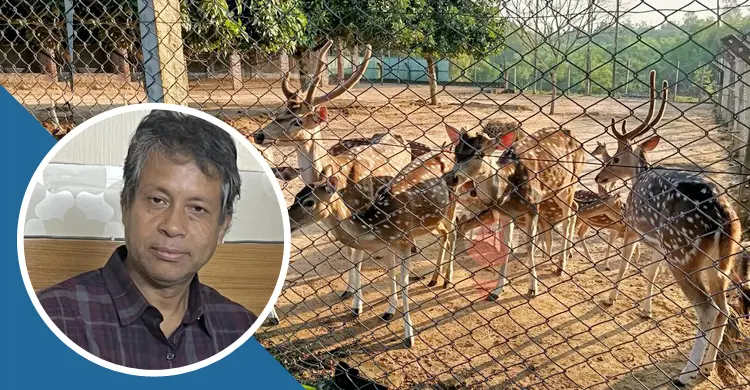
It began in 2013. Out of personal interest, expatriate Moin bought 11 deer from Rangpur Zoo and started keeping them. He has since built a largely commercial deer farm. The eye-catching farm is at Hillsdale Multi Farm and Madhurima Resort in the Olinagar area of Karerhat union, Mirsarai upazila, Chattogram.
A tourist spot has grown up around the deer farm. People of all ages come from far and wide every day. Besides deer, the farm, laid out with trees of many species, has a variety of birds and animals.
The farm covers 35 acres in Karerhat union and is planted with about 40,000 trees of various species. Its biggest attraction is the deer, which are raised under government rules and the constant supervision of the livestock department. Visitors crowd in every day to see the deer roam amid the natural beauty. The local livestock department monitors the deer to keep them healthy and free of disease. The farm has been named "Hillsdale Multi Farm".
From a hobby to a licensed farm
Australia-based expatriate Moin Uddin told Jago News: "Although I have lived abroad for 36 years, since 1986, I set up the deer farm at home out of love for deer. Besides the deer farm at Olinagar, I plan to build a sanctuary for animals and birds. It is not very profitable commercially, but I keep deer purely out of love."
He said the farm had become attractive to visitors. Besides deer, it has goral, horses, rabbits, peacocks, geese, local and foreign ducks, kalim birds, doves, jungle fowl and many other species of birds.
Moin Uddin said getting a licence for the deer farm took a great deal of effort. "After getting the licence in 2013 I started the commercial farm. First I bought 11 deer from Rangpur Zoo at Tk 25,000 each. At one stage they bred to 26 deer. A year ago three deer died in a lightning strike. Anyone who buys a deer must have a licence and possession certificate from the Forest Department," he said.
He said deer could once be slaughtered for meat, but slaughter has been banned under a new policy since 2018. Deer do not suffer much disease, but they sometimes get deer tuberculosis, for which there is no vaccine in the country. Deer often die after being injured by the antlers of males, and young fawns die of cold. With regular deworming, good-quality feed and minerals, deer rarely fall ill. The upazila livestock office regularly monitors the deer.
Feeding the herd
Deer like all kinds of sour fruit. With this in mind, Moin Uddin has planted amla, bahera, haritaki, carambola, olive, mango, jam, tamarind and other trees. What the deer do not need is sold at market. In winter, vegetables can be grown to meet the deer's feed needs; this year he has grown aubergine on 30 decimals. He grows hybrid grass and kalmi to meet the demand for green fodder.
The deer must be given crushed maize and wheat bran regularly, as well as grain feed and rock salt to keep them healthy. One person has been employed on a monthly salary to look after them.
Strict conditions
"If a deer dies or is born, the Forest Department must be informed with a certificate within 15 days," Moin Uddin said. "Every year we must give the government an account and pay Tk 1,000 per deer plus 15 percent VAT. The licence must be renewed and a possession certificate obtained every year. We sell a deer to a new farmer for Tk 75,000."
Deer cannot be farmed commercially within eight kilometres of a government forest, and the farm must be somewhere away from settlements. The government must be told of every birth, and the Forest Department must be informed within 15 days if a deer dies or is sold. Moin Uddin raises his deer while meeting these strict government conditions.
Although grass is their main natural food, each chital (spotted deer) must be given two kilograms of maize a day, or it will not develop normally. To keep them healthy, chital need grass, medicinal plants, sour fruit and other suitable feed.
Moin Uddin said maize alone costs Tk 5 to 6 lakh a year, and a lot is spent on grass and sour fruit too. Deer give birth once a year, and females start bearing young from about a year and a half. If a newborn fawn is touched by hand, the mother does not readily suckle it. At six months a deer weighs more than about 20 kg.
He told Jago News that five species of deer were once found in the country, but now only the chital and maya are seen. The sambar, barasingha and the natrini, or para, deer have disappeared from Bangladesh.
Visitors and officials
Schoolteacher Hamida Abedin Poly, who came with her family to see the farm, told Jago News that she was annoyed at first by the winding, hilly, broken road. "But once I entered Hillsdale Multi Farm and saw the deer, I forgot all the trouble in a moment. The farm is in a very beautiful place," she said.
Karerhat union parishad chairman Enayet Hossain Nayan told Jago News: "The deer farm built by brother Moin has become a place of recreation for local people. There is a crowd of visitors every day. Countless people come every day from Chattogram, Feni, Mirsarai and Cumilla to see the deer."
Mirsarai upazila livestock officer Dr Zakirul Farid said: "I have newly taken charge here. I have not yet been to the deer farm at Olinagar, but I have got the details from office staff."
Abu Naser Mohammad Yasin, divisional forest officer of the Nature Conservation Division, told Jago News that they inspect the Olinagar deer farm regularly. "The place is very beautiful. The owner is raising the deer in compliance with the law," he said.
He added that when many species of deer are disappearing, raising deer in this way is positive.
Source: Jagonews24. First published in Bengali on The Agro News.

Comments
(0)