
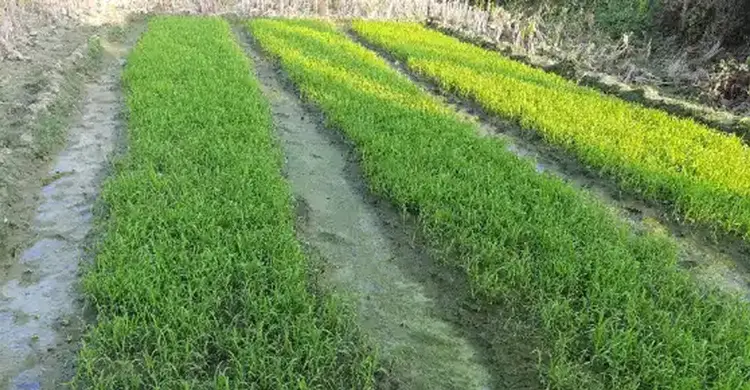
Boro cultivation in Mirsarai, Chattogram, looks set to exceed its target by 500 hectares. The target was set at 1,160 hectares, while cultivation is expected to reach 1,600 hectares; 100 hectares of seedbeds have been prepared, and Durgapur union is growing 450 hectares using water from the Mahamaya irrigation project.
Boro farming had declined because paddy prices were low and irrigation costs high, and the closure of more than a hundred irrigation schemes had also reduced cultivation. But the agriculture office says more land will be cultivated than targeted this year.
According to the upazila agriculture office, the boro target for the upazila's 16 unions and two municipalities this year was 1,160 hectares. One hundred hectares of seedbeds have already been prepared, and each hectare of seedbed will plant 16 hectares of land, so the 100 hectares of seedbeds will cover 1,600 hectares.
Closed irrigation schemes
The agriculture office said the Bangladesh Agricultural Development Corporation (BADC) had provided 140 water schemes in the upazila's 16 unions and two municipalities, which local farmers use to grow boro and various vegetables in the dry season. In return, BADC charges a fixed water fee. But about 100 of the 140 schemes have shut down, so in many unions farmers cannot grow boro because of the water shortage.
With more than a hundred irrigation schemes closed in Mirsarai, farmers lost interest in boro. But thanks to the Mahamaya irrigation project in Durgapur union, that union grows the most. The agriculture office said boro would be grown on 450 hectares there this year.
Freedom fighter Muktar Hossain of Durgapur union said: "Farmers in Durgapur union are benefiting from the Mahamaya irrigation project. Crop and vegetable production in our union has increased compared with before."
Costs outweigh returns
Several farmers in the upazila said boro needs irrigation, so costs are higher, and because the market price of paddy is low compared with the cost, they are not growing it. By their reckoning, growing boro on one decimal of land costs Tk 250 to 300, but one decimal yields only 12 to 15 kg of paddy, worth just Tk 150 to 160 on the market.
Upazila Assistant Agriculture Extension Officer Kazi Nurul Alam said: "This year boro has been grown on 500 hectares more than the target. Boro is expensive to grow, so many farmers do not want to grow it. Many schemes have also shut down."
Mirsarai Upazila Chairman Jasim Uddin said: "Because of the Mahamaya irrigation project, boro cultivation has increased in Durgapur union and the surrounding areas. Land that was once left uncultivated is now being farmed using water from the project, and farmers are benefiting."
Source: Jagonews24. First published in Bengali on The Agro News.
Comments
(0)