

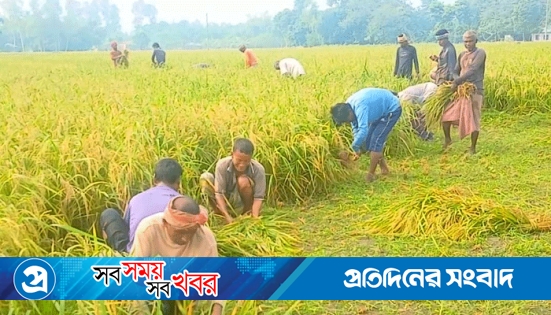
In our village home some native fine rice is still grown. As a child in the late autumn season of Hemanta I would see separate stacks, in the threshing yard or the outer courtyard, for the sheaves of different varieties of ripe paddy brought in from the fields. Threshing them took more than a month. The coarse IRRI paddy was threshed first, to be sold at market.
The native varieties did not ripen until the end of Kartik. Because coarse rice fetched a slightly higher price at market, farmers grew coarse IRRI paddy. After that the aromatic varieties, Bhogdhan, Jamaiaduri, Kalojira and Tulshimala, were threshed and stored, because aromatic paddy fields drew more attacks by birds and insects, and once the ripe paddy was cut and stacked in the courtyard the stacks drew more attacks by rats.
The stacks of native Aman paddy were threshed in Falgun and Chaitra and stored in the granary, because the weather was drier then and the paddy dried on its own. Naturally dried paddy was kept longer as seed. Rice from those native Aman varieties cooked soft and tasted very good.
I still remember native Aman varieties such as Patni, Gotadungra, Noyadang, Dhepa and Nairoljhopa. Enough was kept in the granary to feed the family all year, and the rest of the Aman paddy was sold before the new Boro crop came in. This was common practice among all well-off farmers. Later, when they turned to high-yielding IRRI varieties in the Aus and Boro seasons, the traditional Aman varieties headed towards extinction.
From native paddy to BRRI varieties
Then came many new BRRI varieties. My father was an officer in the government's agricultural extension department, so whenever a new rice or vegetable variety was developed he would talk about it and bring home pictures, books and leaflets. Reading them while at school, I learned a great deal about new crop varieties. Perhaps that is why I still grow vegetables and flowers in my garden.
After seed of IRRI-5 paddy was imported from the Philippines, Bangladesh began developing improved IRRI-type varieties with its own technology, which became known as BRRI. Various varieties followed, such as Chandina, BR Balam, Mala and China IRRI, and later the hybrid varieties BRRI-27, 28 and 30 and many other new varieties. Many more high-yielding varieties have since been developed. Because they yield far more per bigha, people turned to BRRI rice to feed a growing population. The tasty, traditional native Aus and Aman varieties have been lost, and so have naturally developed aromatic varieties.
For two decades the market has been flooded with hybrid IRRI rice. IRRI rice was developed in the laboratory to meet the shortage of rice, but over time it has swallowed up every kind of native paddy. Because native varieties yield less, farmers today are not interested in growing anything else. But because IRRI rice is coarse and not tasty, traders have cleverly polished it by machine and used various tricks to make it attractive to consumers.
A name without a paddy
That is where the trouble lies. The rice has been given new names, but neither seller nor consumer knows which paddy produces which named rice. Only the producers of this artificial rice know, and they sell it while hiding the facts.
A report of the agriculture ministry also says that there is in fact no paddy called Miniket in the country. At one time hybrid IRRI-type seed came into Bangladesh from India in small bundles or mini packets, and some people try to call the paddy grown from it Miniket. But because the varieties developed by the Bangladesh Rice Research Institute (BRRI) proved higher-yielding and more profitable, farmers in the country grow mostly local or BRRI varieties. Mill owners are thinning coarse rice by machine and selling it as Miniket: they trim IRRI rice fine and slender, blow off the husk coating, make it shiny and attractive and sell it in colourful sacks.
A study by the Department of Applied Nutrition and Food Technology at the Islamic University in Kushtia collected samples of rice sold as Miniket under eight popular brands and found that all of them had been made by trimming and polishing coarse rice. None of the fat, vitamin B-2 and other food calories that ordinary rice should provide was found in the Miniket sold at market.
According to a report on the president of the Bangladesh Auto Rice and Major Husking Mill Owners' Association and on Rashid Agro Food, "they were the first to thin coarse rice in modern machines and release it on the market as Miniket. Various government agencies dealing with paddy and agriculture have also acknowledged this."
A miller's view
The Kushtia district general secretary of the Bangladesh Auto Rice Mill Owners' Association said: "People believe coarse rice is cut down in size. We see the same in the media. But as far as I know there is no machine that can cut coarse rice into fine rice, or cut fine rice even thinner." He added: "In the old days, rice husked in a dheki gave starch when cooked. Now it doesn't, because everything that would give the starch is removed in the polishing machine. This powdery residue is now used to make rice bran oil, and fish and livestock feed are also made from it."
Rice mill owners are openly putting coarse rice through machines, shaving it on all sides to make it fine, and selling it as Miniket, Nazirshail, Kajol Lota, Pajam and BRRI-28. By thinning cheap coarse rice, mill owners get an extra Tk 15 to 20 a kg, and they make further profit by selling the shaved-off part as rice powder. On the other side of this booming trade, buyers lose out: they pay more for the inner part of coarse rice and are deprived of the nutrients in the outer layer.
According to experts, protein, vitamins and minerals are concentrated in the outer coating of the grain, while the whole grain contains carbohydrate. When the outer coating is removed to make the rice slender, the protein, vitamins and minerals are lost.
Fine rice from the machine
In the past, coarse rice was valued in middle-class homes, but with changing times fine rice is taking its place. People once ate dheki-husked rice, which had a brownish, dirt-like coating. Then came the husking mill, which made the rice clean. Put through an automatic colour sorter, the rice becomes cleaner still and thinner, and looks very shiny.
Many people are making slender rice even more slender, coating it with artificial fragrance and selling it as polao rice. Cooks run into trouble with it. Many are used to washing rice well and draining it before cooking polao, but packaged polao rice loses all its fragrance once washed and drained. Even after cooking it with ghee, it does not taste like real polao. Even rice sold as Miniket turns hard after cooking in a rice cooker, making it hard to eat a second time.
The saying that Bengalis are made of rice and fish is very old but still very true. Whatever luxurious foods are on offer, rice is the main part of the Bengali meal, and Bengalis cannot do without it for a single day. But with farmed hybrid fish, and paddy and vegetables all turned into hybrid, GM and EM food, rice has lost its traditional taste and quality.
Naturally grown aromatic rice and polao have become a thing of the past. Fine aromatic rice no longer grows in the field; it grows in the machine and is found in the market. Rice from it has no protein, vitamins or minerals. Eating fake, polished fine rice that has lost its nutritional value is lowering our immunity and creating health risks. A section of traders is making huge profits by trimming coarse rice into Miniket, but by stripping out its natural nutrients and creating health risks, they are doing a mega loss to rice-eating Bengalis.
Removing the nutritious coating to make coarse IRRI rice slim and selling it with artificial fragrance amounts to cheating consumers and is a clear violation of consumer rights law. Moreover, the rice of the aromatic varieties we export as GI products, such as Banglamoti, Tulshimala, Jamaiaduri and Kalobhog, is losing to other countries' aromatic rice abroad, damaging its reputation. Whose responsibility is it, really, to look into the excess profits and mega losses of Miniket?
The writer is a professor in the Department of Social Work at Rajshahi University and a former dean of the Faculty of Social Sciences.
Source: Jagonews24. First published in Bengali on The Agro News.
Comments
(0)