
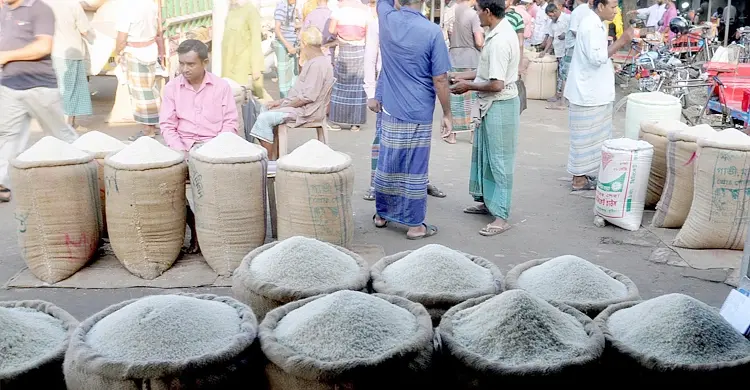
Many brands of rice are sold in the market under the name "minicket". The rice is in high demand and fetches a high price. But which paddy variety this slender, shiny rice actually comes from has long been debated. The Bangladesh Rice Research Institute (BRRI) has been saying there is no paddy called minicket, and that traders polish rice from various slender BRRI-developed varieties and sell it as minicket. Some millers and traders claim the opposite: they say there is a paddy called minicket, but very little of it is grown. Consumers ask where all the minicket in the market comes from, and no one has a clear answer. Yet day after day "minicket rice" sells at high prices.
Sources at the Ministry of Food and BRRI say minicket is made by trimming rice of various varieties. The government is making a law to stop this practice and has instructed traders and millers not to market any rice under the name minicket.
But studies by two bodies under the Ministry of Food have produced different findings. One group of researchers says: "Minicket paddy exists, but little is grown. Rice sold as minicket is polished to some extent. But there is no evidence for the allegation that coarse rice is trimmed by 25-30 percent to make minicket." Another group says: "There is no minicket paddy. Various BRRI varieties are trimmed, polished and sold in the market as minicket."
Traders and millers, for their part, say there is no machine for trimming rice. Jirashail paddy is grown widely in the northern region, farmers sell it in the market as minicket, and minicket rice is made from it. If the government bans selling rice as minicket, it will be sold under another name, they say; at the end of the day it will be the same thing under a different label.
The different views
According to one group of researchers, the rice sold as minicket traces back to a packet of paddy seed from India. The word "minicket" comes from the English "minikit", which is not a variety but a kind of programme: the packets of paddy seed the Indian government gave farmers as a gift were known as "minikits". Cultivation of this seed began in Bangladesh's border areas, then spread widely in Bangladesh, and later became known as minicket.
The other group of researchers disagrees. They say coarse rice of any local variety is scrubbed until it is shiny and slender and then sold as minicket. Because slender rice is popular, millers trim brown rice and coarse rice and then sell it under the minicket name. Millers have to buy two additional machines for this, which make it possible to turn coarse rice slender at low cost.
A section of millers and traders claims that Jirashail paddy is grown widely in the north and is bought and sold in local markets as minicket. The rice millers make from this paddy is sold as minicket.
Research fails to solve the mystery
Neither traders nor consumers have a clear idea of which paddy minicket rice comes from, or by what process it reaches the market. The relevant ministry and the departments and agencies under it are also "silent" on the question. The government carried out research to solve the mystery: in 2020 the Food Planning and Monitoring Unit (FPMU) under the Ministry of Food conducted a study.
Its report said auto rice mill owners use modern machines to change the size of rice grains and polish them to a shine, a process they call "rice milling". Once rice is prepared and marketed this way, there is no way to tell which paddy it came from, so rice from various varieties is passed off as minicket.
However, a study by another body under the Ministry of Food, the Bangladesh Food Safety Authority, presented different findings. It said rice mills buy BR-28, BR-29 and other varieties of paddy to make rice. The allegation that this rice is cut slender or trimmed by 25-30 percent is not true; the mills polish it somewhat. And although in small quantities, paddy called minicket is grown in the boro season, and minicket rice is also made and marketed from it.
The Food Safety Authority's report also supported the claim that the Indian government distributed paddy seed under the name "minikit" and that it spread to Bangladesh.
The head of the Food Safety Authority's research team was Prof Md Iqbal Rouf Mamun of the Department of Chemistry at Dhaka University. He told Jagonews: "The idea of rice trimming is wrong. It is true that there is some polishing. But coarse rice can never be trimmed into slender rice, because any rice trimmed by 25-30 percent will break."
A law amid the uncertainty
With researchers, farmers, millers and traders contradicting one another and the existence of minicket paddy unclear, the government has ordered an end to selling rice under the minicket name. Rice sacks must carry the name of the paddy variety the rice comes from, and a law on this is being made.
Ministry of Food sources said a draft law provides for up to five years in jail, a fine of Tk 10 lakh, or both, for selling rice made from a different variety under the minicket name. The draft has already been approved by the cabinet committee. After vetting by the Law Ministry, it may be passed in the winter session of parliament.
The existing Food Grains Supply Ordinance, 1979 and the Food Act, 1956 have been updated as the Food Products Production, Storage, Transfer, Transport, Supply, Distribution and Marketing Act-2022. Once the law is in force, food products cannot be marketed under a different or fictitious name.
S M Nazer Hossain, vice-president of the Consumers Association of Bangladesh (CAB), said: "What good will it do if the variety name is written on the sack but the sack contains over-trimmed or polished rice? Consumers will get no benefit. How rice is being trimmed or polished must be identified, and then the government must take steps to stop it."
Traders allege a 'deep conspiracy'
Traders allege that the "issue" being made of banning minicket rice is a deep conspiracy. They claim that, having failed to bring rice prices down, the government has banned minicket to dangle a carrot in front of consumers, a tactic to divert attention from its failure to control prices.
The auto rice mill owners' association and the paddy and rice wholesalers' association allege that unscientific and unrealistic statements are being made from various quarters to discredit rice mill owners, and that these statements have no basis.
Nirod Baran Saha, president of the Naogaon paddy and rice wholesalers' and traders' association, told Jagonews: "Minicket rice has been in the market in some quantity for more than 30 years. We have been buying paddy from farmers under the name minicket. Now we hear there is no minicket paddy. Then what paddy have we been buying? That is not being made clear either. Yet it is being publicised that rice is made slender by trimming or polishing it in machines. The reality is that no rice mill in the country has a machine to trim rice or make it slender."
He said: "There is a deep conspiracy over minicket rice. What the government is publicising is misleading and divorced from reality. It is not at all desirable that a law to ban minicket is being made without anything being clarified."
Saying BRRI is pushing hard to popularise its own varieties, Nirod Baran Saha said: "We see two reasons behind the minicket ban. One is that BRRI (Bangladesh Rice Research Institute) wants rice to be marketed under the names of its own varieties, such as BRRI-28 and BRRI-19 rice. The most popular name in the market is still minicket, which is not a BRRI variety. They are pushing hard to stop it."
"The second reason is that big corporate companies want their brands to capture the market quickly once minicket is banned. Small mills that sold rice as minicket will be pushed out of the market. They are patronising the government to capture the market," the trader alleged.
Source: Jagonews24. First published in Bengali on The Agro News.
Comments
(0)