
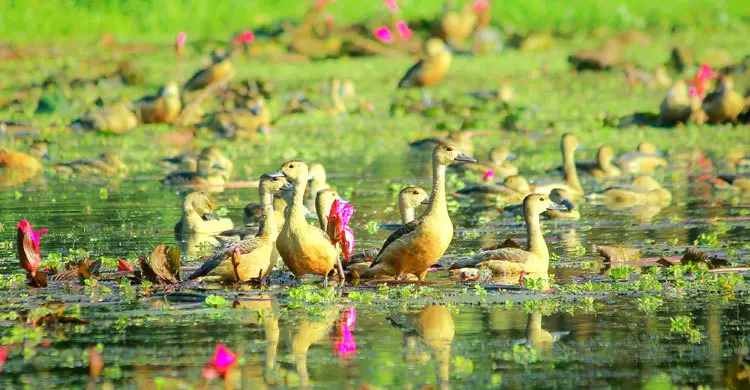
Migratory birds begin arriving at Jahangirnagar University (JU) in mid-September, heralding winter. But this year, for lack of habitat, far fewer of these birds from as far away as the Siberian region have come than in previous years.
Each year the university's lakes are prepared so that the birds can move and feed freely. The lakes are normally cleaned between late August and the first week of September. Billboards with instructions for visitors are also put up beside the lakes, and barbed-wire fencing is erected so that visitors cannot disturb the guest birds.
This year, however, the lakes have not yet been made suitable for migratory birds. As a result, only a few birds can be seen, on just two lakes.
Lakes filled in and overgrown
According to university sources, the campus has a dozen or so lakes of various sizes. In past years migratory birds were seen on six of them: the lake inside the Wildlife Rescue Centre, the lake beside the swimming pool, the lake behind the old registrar building, the lake behind the new registrar building, the lake inside the Botanical Garden and the lake behind the transport yard.
Some of these lakes are shrinking as they silt up, while others have filled with water hyacinth and weeds for want of conservation.
A visit found that weeds had not been cleared except in visible spots. This time only the lakes at Bishmail and beside the transport yard have been cleaned, and because a road runs beside the latter, only a few birds use it. The lake in front of the old registrar building has shrunk as it has silted up from almost every bank towards its depths, and the rest is full of weeds. No birds have come there at all this year.
The lake beside the swimming pool is choked with water hyacinth and weeds, leaving no environment for guest birds. The lakes in front of AFM Kamaluddin Hall and behind the new registrar building are also dirty and crowded with people, so no birds have landed there either.
Water hyacinth covers three-quarters of the lake inside the Botanical Garden, and only a few birds are seen on the remaining quarter. People have also been seen secretly fishing from rafts on the lakes the birds use.
Teacher blames lack of conservation
Md Kamrul Hasan, a professor of zoology, blamed the lack of conservation efforts for the shrinking habitat. He told Jago News that migratory birds start arriving from mid-September, their numbers rise from late November, and the peak comes at the end of December. The birds started arriving on time this year too. But because admission tests were held in November, there were larger crowds at the lakes, so not many birds are settling. Numbers may rise in a week or two, he said.
He added that the big lake still has water hyacinth, which the estate section should have cleared, as birds feel comfortable when there is more open water.
Deputy registrar (estate) A Rahman said that for lack of time they could not start cleaning the lake at the new arts building. During the coronavirus period they could not bring in outside workers, so the other lakes could not be cleaned. Some lakes have silted up and have no open water, and the water hyacinth has become attached to the soil. There is no way to fix them without renovating the lakes, he said.
Migratory birds were first seen at Jahangirnagar University in 1986, when they sheltered on the lake in front of the old registrar building that winter. For a time after that, the number of birds coming to the campus kept rising, and so did the areas they used, spreading from one lake to four. Guest birds stay mainly on lakes with a natural environment and plenty of food, and those are now under threat.
Source: Jagonews24. First published in Bengali on The Agro News.
Comments
(0)