
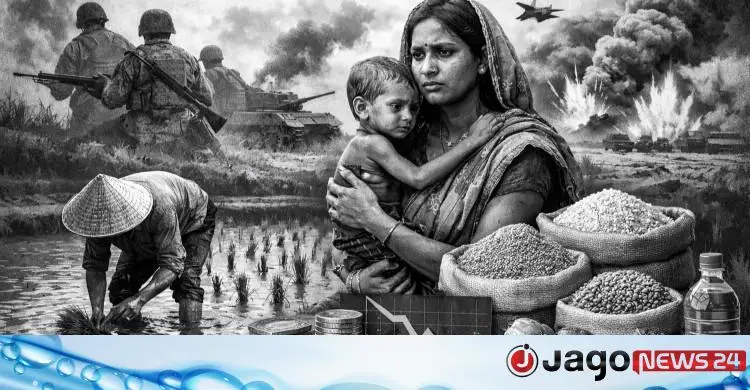
The Middle East is an important centre of the world economy, especially in the production of fuel oil. When war or political instability breaks out in the region, its effects spread quickly through global markets. Bangladesh, as an import-dependent country, relies heavily on the situation in the Middle East, particularly for imports of fuel oil, fertiliser and food grains. So when war in the Middle East pushes up oil prices on the international market, the effect falls directly on Bangladesh's agriculture.
Agricultural production is closely tied to fuel. Diesel or electricity is essential for irrigation, land preparation and transporting crops. When oil prices rise, irrigation costs go up and farmers' production costs rise significantly. The cost of producing and importing fertiliser also rises, because gas and fuel play an important role in fertiliser production. As a result, farmers cannot use enough fertiliser, which reduces crop output.
Instability in the Middle East also affects foreign exchange earnings, because a large number of Bangladeshi workers are employed in the region. If their jobs are disrupted by war, remittances may fall, putting pressure on the economy. That in turn may limit the government's ability to provide subsidies to agriculture.
In short, a war in the Middle East is not just a regional problem; it has many-sided effects on the agriculture, economy and food security of an import-dependent country such as Bangladesh.
Where farmers feel the impact
Because of its dependence on fuel, agricultural production comes directly under threat. A large part of Bangladesh's irrigation depends on diesel, so when oil prices rise internationally, farmers feel it directly. With irrigation costing more, many farmers cannot water their crops as needed, and output may fall.
At the same time, production costs rise considerably. As diesel prices rise, so do the costs of fertiliser, pesticides and transporting farm produce. This cuts farmers' profits and pushes up food prices in the market, making life harder for ordinary people.
A fuel crisis also disrupts supply. With transport costs higher, fewer trucks and other vehicles run, so produce takes longer to get from field to market. Losses of perishable goods rise, and farmers are deprived of fair prices.
Finally, the combined effect of all this puts food security at risk. Falling output and weak supply systems could lead to food shortages, which hit the poor hardest.
What can be done
Sustainable, long-term planning is urgently needed to deal with this crisis:
- First, the use of alternative energy must increase. Solar irrigation pumps and biogas can reduce dependence on diesel, cutting costs and protecting the environment.
- Second, efficient irrigation technology must be used more widely. Drip and sprinkler irrigation can secure higher yields with less water and less fuel, which is profitable for farmers.
- Third, local production must be prioritised. Producing organic fertiliser at home and using local farm inputs can reduce dependence on imports.
- Fourth, the government needs to build strategic reserves. Adequate stocks of diesel and fertiliser, and higher subsidies for agriculture, can protect farmers.
Wider use of smart farming technology is also very important. Applying irrigation and fertiliser according to soil conditions, using IoT-based soil sensors, cuts costs and raises output. And cooperative farming systems must be built: when farmers share irrigation equipment and other inputs, costs are shared and production becomes more efficient.
Although the fuel crisis is a big challenge for agriculture, it is not insurmountable. With proper planning, modern technology, wider use of alternative energy and effective policies, it can largely be brought under control. If coordinated steps are taken now, the crisis could even open a new path towards sustainable farming in future.
A long-term plan for resilience
Instability caused by the war in the Middle East has created a major challenge for Bangladesh's agriculture, but it can be tackled with proper planning and effective policies. First, the use of alternative energy must be increased to reduce agriculture's dependence on fuel. Solar-powered irrigation would reduce reliance on diesel and lower farmers' costs in the long run.
Second, domestic fertiliser production must be increased and the use of organic fertiliser expanded. This would reduce dependence on imports and keep soil healthy. At the same time, modern technology such as soil sensor testing, smart farming systems and information technology must be used more widely to secure higher output at lower cost.
Third, it is very important to ensure easy-term loans and subsidies for farmers. The government must give effective support to protect farmers from the volatility of international markets. Food storage and supply systems must also be strengthened so that markets stay stable even in a crisis.
Finally, long-term planning is essential to make agriculture a sustainable and resilient sector. Research, innovation and training for farmers must build a strong farming system able to guarantee the country's food security amid any global turmoil.
So while the effects of the Middle East war cannot be avoided, their negative impact can be greatly reduced through far-sighted measures.
Source: Jagonews24. First published in Bengali on The Agro News.



Comments
(0)