
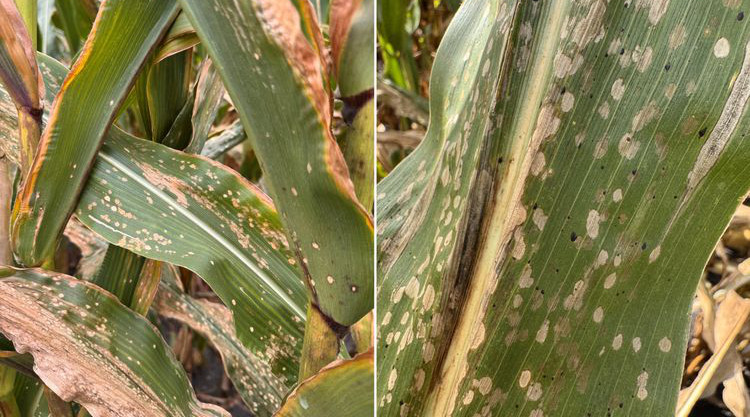
Researchers at Michigan State University are investigating a leaf spot disease of corn that has appeared this season in about 14 Michigan counties, with further reports from New York and Pennsylvania, and in some fields with notable incidence and severity.
The symptoms resemble those historically described as Phaeosphaeria leaf spot or maize white spot, but the researchers stress that they do not yet know which fungus is responsible. Older literature links the disease to Phaeosphaeria maydis, yet the identity and taxonomy of organisms under that name remain unresolved.
Samples from Michigan have consistently yielded a phomoid fungus whose fruiting structures, pycnidia, show under magnification as small black spots inside the lesions. Preliminary DNA sequencing has not been precise enough to name the species, and repeatedly finding a fungus in diseased tissue does not prove it causes the disease.
The team is combining fungal isolation, morphology, DNA sequencing and pathogenicity tests to identify the cause, which would allow a reliable diagnostic assay and wider surveys of how far the disease has spread. It is also asking for information on severity and any effects on yield or grain quality.
Growers are asked to collect several leaves with fresh or developing lesions, note the county, field location, hybrid, growth stage and any fungicide use, dry the leaves in a paper bag if they cannot be sent at once, and contact plant pathologist Martin Chilvers at MSU.
The appeal was written by Martin Chilvers and Jan Byrne of MSU's Department of Plant, Soil and Microbial Sciences and published by MSU Extension.
Source: Morning Ag Clips

Comments
(0)