
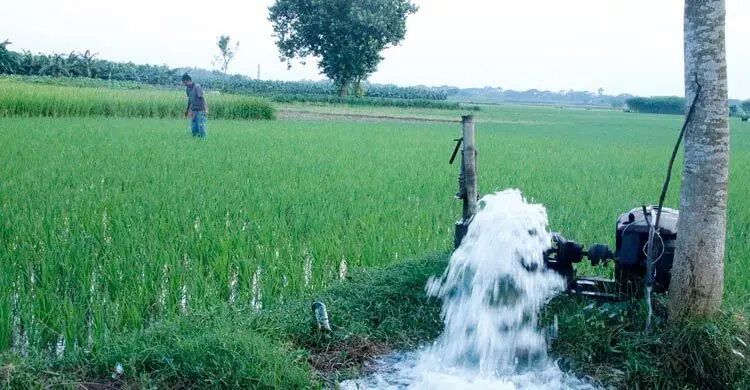
Meherpur is burning in an intense heatwave this season, and the boro crop is caught in drought. With no rain and continuing dry weather, the district's farmers are in serious trouble with this season's boro and are at a loss over irrigation costs.
In the prolonged heat, boro plants in the fields have begun to turn yellow and the panicles are drying. The land dries even as it is being irrigated.
Farmers say the water evaporates, and the dry soil soaks up what remains quickly. The agriculture department advises supplementary irrigation to save the crop, but this is multiplying production costs.
According to the agriculture department, the boro target in Meherpur this season was 19,250 hectares, while 19,097 hectares were planted. The paddy has reached the panicle stage, just as the drought struck.
Daily irrigation and double the diesel
Milon Hossain, a farmer in Sadar upazila, said the soil in paddy fields is drying in the heat and must now be irrigated every day. Shallow machines are drawing less water in the extreme heat, so it takes longer, and some fields are using four litres of diesel a day instead of two. Production costs have multiplied and farmers fear losses this year.
Sohanur Rahman, a farmer in Mujibnagar upazila, said panicles are drying in the drought and pest attacks have increased, with pesticides not working. Land that needed irrigation three days a week now needs it every day.
Kamal Hossain, a farmer in the same upazila, said the cost of growing paddy had multiplied because of the heat this year.
Farmers want the paddy price to stay at Tk 1,500 to 1,600 a maund to save them from losses; otherwise they will lose heavily.
Mojibar Rahman of Ujalpur village in Meherpur Sadar said there had been no rain for a long time and the heat was disrupting cultivation. Each irrigation of boro costs Tk 300, and farmers are also irrigating under seasonal contracts with pump owners. This year growing paddy on one bigha means an extra Tk 7,000 to 8,000 in irrigation costs.
Arifur Rahman of Pirojpur village said he has paddy on three bighas and has to irrigate daily because there is no rain. With fertiliser, pesticide and diesel prices high and extra irrigation on top, farmers are close to ruin, he said.
Nohan Ali of Kathalpata village said the boro crop, the district's main crop, has been hit by drought. In other years there is enough rain in the peak boro season and no irrigation is needed, but this year there has been no rain. He has paddy on two bighas and must irrigate daily; irrigation alone will cost him an extra Tk 20,000 to 25,000 until harvest.
Bijoy Krishna Haldar, deputy director of the Department of Agricultural Extension, said the drought had lasted a long time and some panicles were dying in patches of the fields. Farmers are being advised to irrigate and keep 2 to 3 inches of water standing in the fields, and to spray insecticide and fungicide against pests.
Source: Jagonews24. First published in Bengali on The Agro News.
Comments
(0)