
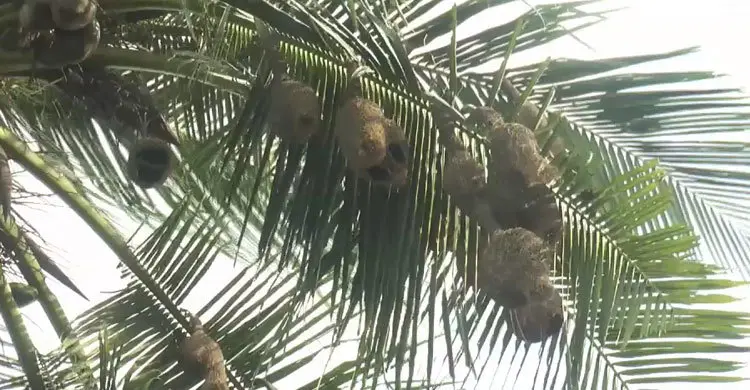
The baya weaver, or babui, and its handsome nest are disappearing day by day. These nests were not just works of art; they gave people food for thought and encouraged self-reliance. But with the passage of time and environmental damage, we are about to lose the bird. It once nested in the palm, coconut and date trees of villages, and as palm and date trees vanish from nature, the babui is vanishing too.
Three species of weaver were once seen in Meherpur: the desi babui, the dagi babui and the Bangla babui. The Bangla and dagi babui are now on the way to extinction, and only a few desi babui are seen today. The weaver's first choice for nesting is the palm tree, followed by coconut, betel nut and date palms. It builds its nest with strips of straw, rice leaves, young palm leaves, tamarisk and kash grass. The structure is complex but the shape is beautiful, and the nest is as sturdy as it is pleasing to the eye.
How the nest is built
At first the bird leaves two downward-facing holes in the nest. When the nest is half built, the male looks for a mate. If the female likes it, the nest is finished in just four days. One hole is closed to make room for the eggs; the other is left open as an entrance and exit. The bird smears mud inside and outside, so the nest survives even strong storms and winds. It brings fireflies into the nest to light it at night. The male does a great deal to win a partner: to attract the female, he bathes in canals, beels and ditches and then dances merrily from branch to branch.
The breeding season usually runs from May to August. A male can have several nests and families. The weaver lays two to four eggs, which the female incubates. The chicks hatch within two weeks and fly off after three weeks. They are mainly seed-eaters, so their beaks are cone-shaped for eating seeds easily and thick at the base. They live by pecking at seeds, paddy, rice, insects, grass, the leaves of small plants and the nectar and pollen of flowers.
Trees lost, pesticides used
Akhtaruzzaman of Bhatpara said the chirping of these golden and green weavers used to be heard in the evening and morning. The bird was both an artist and an alarm clock, waking people with its lovely song. Now there are no big palm or coconut trees; with nowhere to build nests the bird could not breed and has left the area. Planting palm and coconut trees is essential to protect the environment and the birds, he said.
Professor Rina Akhtar of the biology department at Meherpur's Gangni Women's College said: "Now that farmers use pesticides in their fields and seedbeds, baya weavers die. They have left the area to save their lineage. To keep nature in balance, palm, date and coconut trees must be planted so that the weavers can multiply, and the necessary steps must also be taken to stop the misuse of pesticides."
Source: Jagonews24. First published in Bengali on The Agro News.
Comments
(0)