
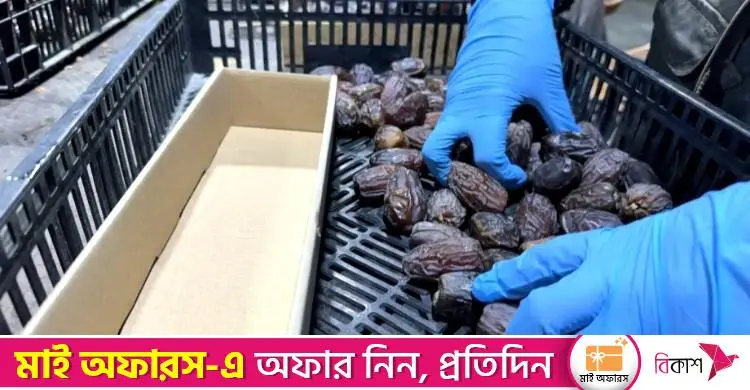
Fifty per cent of the Medjool dates sold worldwide are Israeli, grown mainly on occupied Palestinian land. The fact is hidden at the point of sale: the dates are spread on the world market simply as "Product of Israel" or under the name of some other source.
Qatar-based Al Jazeera reported this on Wednesday, 25 February, and Turkish news agency Anadolu Agency confirmed the same information.
Al Jazeera said Israelis are growing Medjool dates by occupying large areas in the Jericho region of the West Bank, on the border with Jordan.
Water crisis in the West Bank
For decades Israel has kept the West Bank in severe water shortage, and Medjool cultivation lies behind it. Illegal Israeli settlers first began growing Medjool dates in the West Bank in 1989. This variety needs large amounts of water; each tree can absorb about 180 litres a day. The huge number of Medjool trees planted by Israel has made farming difficult for Palestinian farmers in the West Bank.
Because they are grown on occupied Palestinian land, these Israeli Medjool dates are mostly sent to other countries with their origin concealed. The packaging sometimes says only "Product of Israel" or "Product of the Jordan Valley", when in reality they are crops from occupied, illegal land, and the entire profit goes to Israel. The dates are exported almost everywhere, including the United States, Europe and Arab countries.
Labelling rules in Europe
Under European law, marking goods from Israeli-occupied land simply as "Product of Israel" is not enough; the origin must be stated clearly to avoid misleading consumers. In the case of Israeli Medjool dates, however, this law is often not followed.
According to the allegations, Israeli Medjool dates are sent to Europe through intermediate countries or complex logistics networks, and on entering the European Union market they are labelled only as "Product of Israel" or presented as coming from a neighbouring country. Some exporters repackage goods in free trade zones or reroute them through intermediate countries, so the place of production stays hidden.
According to World Bank data, about half the dates sold in the Netherlands and more than a third in France are of Israeli origin. These two countries also serve as packaging and re-export hubs in Europe. In Germany, an estimated 25 per cent of total date supply is thought to be Israel-linked.
According to CBI, an organisation that promotes imports from developing countries, about 50 per cent of Medjool dates exported to Europe come from Israel. Some international food trade publications have put the figure as high as 75 per cent.
According to industry data, Israel exports about 35,000 tonnes of dates a year, but production within its internationally recognised borders is only about 8,800 tonnes, grown mainly in the Arava valley. If these figures are correct, about 75 per cent of Israel's date exports may come from occupied Palestinian land.
"Date laundering"
Critics use the term "date laundering" for such cases. Dates produced in illegal settlements are allegedly marketed under labels from the Netherlands, Morocco, the United Arab Emirates or Palestine. There are also claims that in some cases settlement produce is mixed into Palestinian supply chains.
The Palestinian Authority has taken steps in the past to stop such practices. In 2014 the Palestinian Ministry of National Economy seized 20 tonnes of Israeli dates brought in to be sold under a "Palestinian product" label, and similar investigations have been reported in later years.
Source: Jagonews24. First published in Bengali on The Agro News.

Comments
(0)