
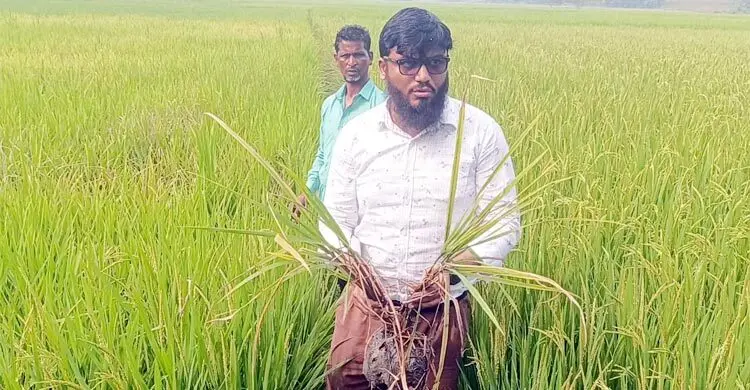
Farmers in the Meghna-Dhonagoda irrigation project at Matlab Uttar in Chandpur overcame many difficulties this season to transplant Aman rice seedlings, and the fields have turned green. But "leaf blast" has now struck some fields, turning the green crop gradually yellow and then brown, leaving farmers worried.
In several fields under the project, Aman rice was seen affected by leaf blast. Some call it sheath rot. The leaves are rotting and being destroyed, and farmers say applying pesticide has not helped.
Target and a difficult season
According to the Matlab Uttar upazila DAE office, the Aman target under the Meghna-Dhonagoda irrigation project in the upazila is 8,045 hectares across one municipality and 14 unions. About 80 percent of people in this district depend directly or indirectly on farming to meet their basic needs, and Aman rice is the most profitable crop. Floods strike every year at Aman transplanting time, but this year they had little effect.
For most of the transplanting period the area was hit by drought, and most farmers transplanted the seedlings with irrigation at extra cost. Hoping for a higher yield, they have nearly finished tending and fertilising. The green fields had brought smiles to farmers' faces at the prospect of a bumper harvest, but those smiles are now fading. Insect attacks and an outbreak of leaf blast, or sheath rot, have appeared in several fields, turning the rice yellow and then brown, and farmers fear their crops will be ruined.
"This year I have grown Aman on 45 decimals," said farmer Alauddin of Adhurbhiti village in Chhengarchar municipality. "At the start I had to irrigate to transplant because of drought, and I paid extra for labour and seedlings and applied fertiliser. Now rot has appeared in the field. Even pesticide is not helping."
Two other farmers, Abdus Sobhan and Nasar Uddin, said that despite the disease in the fields, agriculture officers are nowhere to be seen, so they are buying and applying pesticides on shopkeepers' advice.
Officer: not blast
"This is not rice blast; it is a bacterial disease," said Matlab Uttar upazila agriculture officer Faisal Mohammad Ali. "The problem may be worse because of standing water. It could be seed-borne: if the seed they collected already carried the disease, this can happen. It mostly occurs in BR-11 rice fields. My advice to farmers is not to grow BR-11; there are several good Aman varieties such as BR-87, 92 and 95, which suffer fewer attacks."
"The disease can strike at any time from the seedling stage until the rice ripens," he said. "Having learnt of attacks in some places in the upazila, we have advised farmers through the sub-assistant agriculture officers, and we are warning farmers by distributing leaflets in various parts of the upazila to protect the rice."
Source: Jagonews24. First published in Bengali on The Agro News.
Comments
(0)