
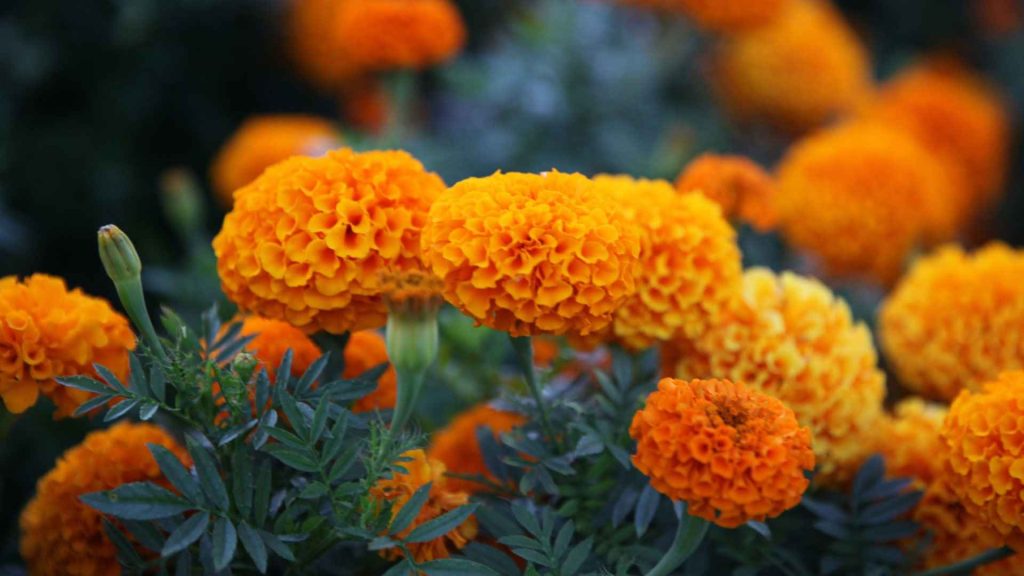
Marigold is one of the leading winter flowers. At weddings, birthdays, anniversaries, home decoration, Victory Day, Independence Day, Martyrs' Day and every other occasion, there is no substitute for marigolds. The juice of marigold leaves is very useful for stopping bleeding from cut skin, healing cuts and as an antiseptic.
Chinese, rajgada, African and French marigolds are the most widely grown in Bangladesh. By colour, marigold varieties are yellow, red, orange, dark brown, mixed red and yellow, and so on. African plants are upright and tall, 30-100 cm high, with orange, yellow and dark brown speckled flowers. French marigold plants are short and bushy, 15-30 cm high, with small red flowers borne in large numbers. The Komola Sundari plant is very sturdy, with deep orange flowers; because it branches heavily it bears more flowers. The flowers are 4.5 to 5 cm across, keep coming for a long time, number 55-60 per plant, and the plant tolerates disease.
Propagation
Marigold seedlings can be raised from cuttings and from seed. Seed is sown in a seedbed in November to raise seedlings. Marigolds can be grown all year, but yields are better in winter. For cuttings, marigold branches should be cut 8-10 cm long and planted in the seedbed with one or two nodes each. The right time is March. The seedbed must be kept moist with regular watering. Leaves appear within 20-25 days.
Soil and fertiliser
High, well-drained, fertile loam is suitable for marigold. Plough and harrow four or five times to make the soil friable. For growing in tubs or pots, mix three parts clay loam or loam with one part cow dung to make a soil-manure mix, and fill tubs, pots or polybags with it.
Per decimal of land, rotted cow dung 40 kg, urea 2 kg, TSP 3 kg and MOP 2 kg are needed, mixed into the soil.
Planting and care
One-month-old seedlings raised from seed or cuttings are planted in December, with 40-50 cm between rows and 30-40 cm between plants. Marigolds can also be grown directly from seed without raising seedlings, sowing 5-6 grams of seed per decimal.
Water before the soil dries out, and arrange drainage if water collects at the base of the plants. Remove weeds with a weeder as soon as they appear. Marigolds suffer little from disease, but if aphids attack, spray 2 ml of malathion mixed in 1 litre of water. Tying tall plants to stakes keeps them upright and improves flower quality. To increase the number of flowers, pinch off the growing tips a month before flowering. If a branch carries many crowded flowers or buds, keep one or two at the top and remove the rest so the flowers grow larger. Fifteen days after planting, 50 grams of urea per decimal can be applied as a top dressing. Replace seedlings that die, and thin them if they are too dense.
Harvesting
Cut the flowers with their stalks using scissors or a blade, very early in the morning. Flowers can be harvested within 35-40 days of planting. On average a plant bears 15-40 flowers depending on the variety.
Source: Staff Correspondent. First published in Bengali on The Agro News.
Comments
(0)