
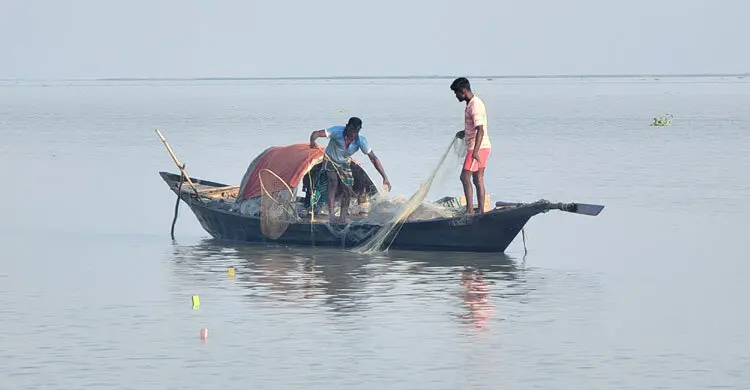
Once, a net cast into the Padma would come up with shoals of silver hilsa. In the peak season fishermen were busy on the river and fish landing points along the banks were bustling; many families lived on hilsa. That picture has largely changed. Fishermen casting their nets in the Padma no longer find the hilsa they hope for. Time and costs of fishing have risen while income has fallen, forcing fishermen to change their trade to survive.
The lives and livelihoods of people in Daulatpur, Shibalaya and Harirampur upazilas of Manikganj, bounded by the Padma and Jamuna, are directly tied to the two rivers. Padma hilsa in particular was one of the main sources of income for fishermen here. With hilsa becoming scarcer in the river over the past few years, that dependence has turned into a crisis.
According to fisheries experts and officials, falling navigability, silt forming chars and submerged shoals, water pollution, less food for hilsa, changes in freshwater flow and climate change may be hampering hilsa movement and breeding in the Padma. Catching jatka and brood hilsa with banned current nets and China duari nets is also harming breeding.
Catch down by nearly half
An analysis of the Department of Fisheries' Yearbook of Fisheries Statistics of Bangladesh for 2020-21 to 2024-25 shows the hilsa catch in the Padma has fallen significantly.
The catch in the lower Padma was 1,159 tonnes in 2020-21, falling to 1,117 tonnes in 2021-22. It rose slightly to 1,122 tonnes in 2022-23 and fell again to 1,090 tonnes the following year. In 2024-25 it collapsed to just 622 tonnes, a fall of 537 tonnes or 46.33 per cent from 2020-21.
The figures show little change over the first three years, then a sudden drop in 2024-25. Against 1,090 tonnes caught in 2023-24, the catch fell by 468 tonnes in a single year.
Fishermen turn to other work
The figures match the experience of fishermen along the river, who say that without the hilsa of old it has become hard to support a family by fishing.
Faruk Bepari, a fisherman from Baharchar village, said: "I used to run my family by fishing. Now there aren't fish in the river like before. I have to farm as well as fish. It's no longer possible to run a family on fishing alone."
He also blames the river's reduced depth. "I think the river isn't as deep as before, so the fish don't come like they used to. We can't understand where all those fish went."
Lalon Molla, a fisherman from Bhelabad village, said the same. There used to be plenty of fish in the river and now there are none, he said. The river has become shallower, and the fish may be frightened by the noise of ships. He thinks these are the reasons fish have declined.
The shortage has also changed fishermen's jobs. Liton, a card-holding fisherman from Dorikandi village, said: "There's no hilsa in the river, so I sold my boat and net and bought a rickshaw. Now I support my family by driving the rickshaw."
Why hilsa are declining
According to fisheries experts and researchers, environmental changes in the river can affect the normal movement and migration of hilsa. When silt builds up chars and submerged shoals at river mouths and along channels, the natural route for hilsa entering the rivers from the sea can be blocked.
Hilsa usually come from the sea into rivers to spawn. Water flow, temperature, salinity and food availability all play an important role in their movement and breeding. Reduced freshwater flow, changing rainfall patterns and changes in river water quality can affect their normal movement.
Rising unplanned waste and pollution in the rivers are also damaging the aquatic environment. Catching jatka and brood hilsa with banned current nets and China duari nets threatens breeding and future production.
Harirampur upazila fisheries officer Md Nurul Ikram said various natural factors can affect hilsa breeding and movement. Less food for hilsa, the formation of chars, shipping and river pollution must all be taken into account.
On banned nets, he said some people are using current nets and China duari to catch brood hilsa and other fish, hampering breeding. Action is being taken against illegal fishing and will be tougher in future.
Manikganj district fisheries officer Sheikh Monirul Islam Monir said hilsa had declined in the Padma and Jamuna because of reduced navigability, river pollution, lack of public awareness and some seasonal fishermen catching brood hilsa during the ban.
According to the district fisheries office, its June 2026 report shows 262 drives were carried out to protect hilsa, the national fish, with 75 mobile courts held, 3 tonnes of hilsa and 2 lakh 29 metres of net seized, and 109 regular cases filed. Seventy people were jailed and Tk 2 lakh was collected in fines.
Source: Jagonews24. First published in Bengali on The Agro News.

Comments
(0)