
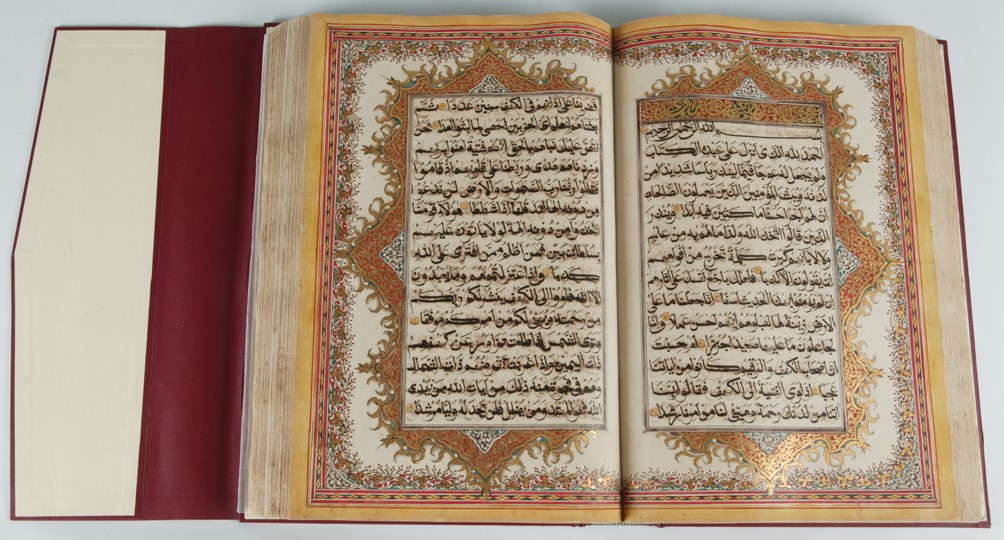
The Nasrul Quran complex in Putrajaya, about 28 kilometres from Kuala Lumpur, prints 15,000 copies of the Quran a day. Malaysian authorities call it the second-largest Quran printing centre in the world. First is the King Fahd complex in Madinah, which by the Saudi state news agency's count prints more than 20 million copies a year with translations in 79 languages. Nasrul Quran can print three million a year, in 30 languages.
Muhammad Asraf Amir, a guide at the complex, told the Associated Press that anyone who handles the Quran or works there must remain in a state of ablution throughout. Printing starts on large sheets; after the colours are checked, the text is proofed by the Lajnah Tashih, a correction committee whose members must have deep command of Arabic or have memorised the whole Quran. Machines fold about 8,000 sheets an hour before sewing and hardback binding.
Each bound copy is then weighed on its own. A copy should weigh about one kilogram, Asraf said; heavier or lighter means a page was added or left out. Malaysia's Printing of Quranic Texts Act of 1986 requires government approval to print, import, sell or distribute the Quran, and covers Quran mobile apps. In 2022 the home ministry seized 6,914 unapproved copies in Kedah.
The work began in 1987, when Abdul Latif, head of the non-profit Yayasan Restu, set out with a team of two to write the Quran in their own script and design. Malaysia is not an Arabic-speaking country, and the first complete manuscript took ten years. A calligrapher still needs two to seven years to write the roughly 600 pages by hand, at six to ten hours a page. Yayasan Restu now trains calligraphers in its own college.
The complex is known for its illumination: each translated edition is decorated in the designs and colours of the country whose language it carries. The Chinese translation took seven years. Islam's beauty, Latif told AP, is that it adapts to local colours, motifs and traditions. The complex cost an estimated 60 million ringgit, paid for by government agencies, Yayasan Restu and public donations.
Charities can receive copies free for distribution on condition they are not resold; in September 2025, 20,000 copies with a Khmer translation went to Cambodia. The complex plans translations into 30 more languages over the next few years, which would bring the total to 60. Prothom Alo's report drew on AP and the complex's website.
Photo: Unknown artist, Islamic Arts Museum Malaysia / Wikimedia Commons (Public domain)
Source: Prothom Alo

Comments
(0)