
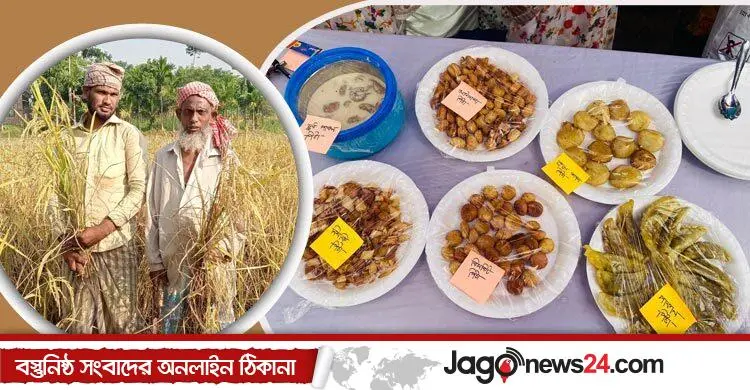
With the Nabanna festival approaching, paddy harvesting is in full swing in Magura. Farmers are cutting the new paddy and taking it to market. The festive mood is not only in the fields but also in farm women's courtyards and kitchens, where they are busy preparing pitha. Paddy is being dried in the yards; it will be husked into rice and then pounded into flour in the dheki. From Wednesday, homes across Magura will use it to make the many kinds of pitha, payesh and rice-flour roti of rural Bengal's Nabanna.
Kashem Mollik, a local farmer and van driver at Tangakhali Bazar, said: "Nabanna is the festival held to mark the first cooking of rice from the newly harvested aman. It is usually held in the Bangla month of Agrahayan, in late autumn, after the aman ripens. Although the Nabanna festival has faded, when new paddy comes in, sales of molasses, patali and sugar boom in the market. People buy these and prepare rice from the new crop, pitha and other new dishes at home. I saw this festival celebrated locally since childhood, but now it belongs to the past. To keep some of the old memories alive, I hold a small celebration at home every year. Tomorrow there will be a small Nabanna at home."
A celebration of the new harvest
Poet, writer and history researcher Sikder Waliuzzaman said: "Magura's Nabanna celebrates bringing the new paddy home. It is usually held in Agrahayan, with new pitha made and various cultural events organised. It marks the end of the harvest season and expresses gratitude to nature. Rural areas fill with joy and entertainment, and in town life there are competitions and programmes organised by the district Shilpakala Academy and the Shishu Academy, such as kite making, pitha exhibitions and discussion meetings, so that the new generation can learn about Nabanna."
It is a traditional farming festival, part of an ancient agricultural culture that marks the arrival of the new crop. Nabanna is a tradition of Bengali culture and a symbol of joy and new beginnings, when pitha are made from the new paddy.
Essayist Tarun Baidya said: "Modern life is erasing the way the festival used to be celebrated, from harvesting through pitha exhibitions and kite-making contests. Nabanna is part of an ancient agricultural culture that marks the arrival of the new crop; it is a symbol of joy and new beginnings, when rice comes from the new paddy. Remembering those childhood days makes me emotional. In the past there was also a custom of offering Nabanna to the household deity on Poush Sankranti. It is believed that ancestors pray for food at the time of the new harvest, which is why, according to ritual practice, shraddha ceremonies are also held at Nabanna in some places. But these ancient customs are rarely seen now."
This festival is not bound by individual, family, place, time or religion, yet it holds all of them. Farmers celebrate it to mark bringing in the new crop in Agrahayan. In some areas, before harvesting, an odd number of paddy ears are cut and tied to the roof of the house, and the rest is husked to cook payesh.
Fading customs
District cultural officer Partha Pratim Das said: "Agrahayan and Nabanna bring an inseparable message of joy into the lives of the people of Bengal. Agrahayan means the month at the start of the year, and its first day is known in Bangladesh as the day of Nabanna. Nabanna is one of the country's oldest festivals. Although Agrahayan is the eighth month in the Bangla calendar, the first day of this second month of late autumn is Bangladesh's Nabanna. To celebrate it, households invite daughters, sons-in-law and relatives and hold feasts with pitha and payesh made from new rice. Village wives wait to visit their parents' homes to celebrate Nabanna. The air fills with the aroma of pitha, payesh, muri-murki and rice from the new crop."
At one time villages and market towns held many events around Nabanna, such as fancy-dress contests, biscuit races, pitha exhibitions and kite-making competitions. With the passage of time, that spirit and tradition now belong to the past, and residents hope the old-style Nabanna of pitha will return.
Source: Jagonews24. First published in Bengali on The Agro News.

Comments
(0)