
Mustard was in full flower across Magura district at the start of January 2026, and both farmers and the district's agriculture officials expected a bumper harvest. Jagonews24 reported from the district on 1 January 2026 that the fields of Abalpur, Deruya, Pakakanchanpur, Satyapur Raghabdar and Patkelbari villages in Magura Sadar upazila had turned into a yellow sheet, with mustard flowers swaying in the winter-morning breeze as if someone had rolled out a yellow carpet. In some fields the pods had already formed.
The district office of the Department of Agricultural Extension (DAE) said mustard had been sown on 22,893 hectares that season, against a target of 25,090 hectares, and that the favourable weather pointed to a very good yield. The farmers who spoke to the reporter expected to bring the crop home within about two months, and the DAE's deputy director in Magura said seed and fertiliser had been given to farmers free of charge to encourage them to grow it.
Area sown in Magura's four upazilas
According to the district agriculture department, the 22,893 hectares under mustard were spread across all four upazilas of the district. Magura Sadar had the largest share, with 10,408 hectares. Shalikha followed with 7,360 hectares, Mohammadpur had 3,720 hectares and Sreepur 1,405 hectares. The target set for the year was 25,090 hectares, so at the turn of the year the sown area was still below the goal the department had fixed for the season.
The department said it expected a bumper yield because the weather had stayed favourable through the growing period. In many fields across the district the crop was at full bloom, while in others the flowers had begun to give way to pods. Mustard is a rabi crop, sown in the dry, cool months after the monsoon rice harvest, and the timing the farmers described, with flowering at the turn of the year and ripening some weeks later, follows that winter calendar.
What the farmers said
Jamil Mia, a mustard farmer from Narsinghati village in Magura Sadar, said he had sown mustard on two bighas that season. "The cost is low and it takes little labour," he said. "The weather has been favourable, so the mustard has come on very well. Pods are starting to appear in my field now. I think I will be able to bring the crop home within two months."
Shafiqul, a farmer from Chhaychar village, had grown mustard on one bigha. "I get a good result from this crop every time," he said. "Compared with last year the weather has been favourable, so I hope my field will give a good yield."
Nazim Uddin of Baliadanga village in Chauliya union had sown three bighas. "Yellow flowers brighten field after field," he said. "In a short while the flowers will start turning to pods, and then the mustard will begin to ripen within one and a half to two months."
The bigha in which the farmers measured their plots is the common land unit in rural Bangladesh; The Daily Star, describing a government incentive scheme in 2023, gave one bigha as about one-third of an acre. All three farmers spoke of the weather as the reason for their hopes, and two of them put the harvest about two months away.
Free seed and fertiliser, and the official outlook
Agriculturist Md Tajul Islam, deputy director of the DAE in Magura, told Jagonews24: "Because the weather and conditions have been favourable this year, there will be a bumper mustard yield. Severe cold, fog and cold waves will not do much harm to the mustard. Seed and fertiliser have been distributed free of charge to encourage farmers to grow it." He did not say how many farmers in the district had received the inputs or how much each had been given.
Free inputs of this kind were handed out in many districts that autumn under the government's agricultural incentive programme for the rabi season, paid for from the 2025-26 fiscal year's allocation for agricultural rehabilitation assistance. At Nalitabari in Sherpur district, for example, the upazila agriculture office opened distribution on 1 November 2025 for 3,440 small and marginal farmers. Of them, 3,200 were each to receive 1 kilogram of mustard seed, 10 kilograms of DAP fertiliser and 10 kilograms of MOP fertiliser, Khobor Sangjog reported the next day. The other farmers there were given packages for wheat, winter onion and lentil.
The programme follows a pattern set in earlier years. In September 2023 the Ministry of Agriculture announced an incentive of Tk 188.49 crore for ten rabi crops: wheat, maize, mustard, sunflower, groundnut, soybean, winter onion, mung, lentil and khesari. It was to be given free to 1,953,700 small and marginal farmers in 64 districts from the ministry's regular budget lines for agricultural rehabilitation assistance and for seed and seedlings. Each farmer could receive support for one of the ten crops on one bigha of land, and the mustard or sunflower package included 1 kilogram of seed, The Daily Star reported.
Magura district and its farmland
Magura is a district of Khulna division in south-western Bangladesh. Banglapedia, the national encyclopedia published by the Asiatic Society of Bangladesh, gives its area as 1,039.10 square kilometres, lying between 23°15' and 23°41' north latitude and 89°15' and 89°42' east longitude. It is bounded by Rajbari district to the north, Jessore and Narail districts to the south, Faridpur district to the east and Jhenaidah district to the west.
The district has four upazilas, the same four that appear in the agriculture office's mustard figures: Magura Sadar, with an area of 401.58 square kilometres; Mohammadpur, 233.70 square kilometres; Shalikha, 228.65 square kilometres; and Sreepur, 175.15 square kilometres. Banglapedia lists one municipality, 36 unions, 513 mouzas and 711 villages in the district. Its main rivers are the Gorai-Madhumati, the Nabaganga and the Kumar.
Magura was made a sub-division in 1945 and became a district on 1 March 1984. The 2011 census counted 918,419 people there, with a density of 884 people per square kilometre. Banglapedia records agriculture as the district's main source of income, with a share of 66.3 percent, which is why the size of the rabi harvest matters to so many households in villages like those named in the report.
Mustard in Magura in earlier seasons
Mustard has been a growing crop in Magura for several years, and earlier newspaper reports from the district told a similar story of favourable weather and official support. In January 2018 The Financial Express reported that about 20,000 farmers in Magura were growing high-yielding mustard. A DAE official in the district told the paper that Magura's soil and weather were congenial to mustard and that the department gave growers seed and training. A farmer from Kullia village in Sadar upazila said he had earned Tk 35,000 the year before from two bighas and had planted four bighas that season, while a farmer from Kachundi village said growers were getting both bumper production and a fair price.
Three years later, in January 2021, the same paper reported that the DAE counted 13,310 hectares under mustard in the district and projected an output of 18,634 tonnes. The department had given 9,200 mustard farmers 20 kilograms of MOP, 10 kilograms of DAP and 5 kilograms of seed each, and the deputy director at the time said seed, fertiliser and training had been provided and that the weather of the previous week would help produce a bumper crop. A farmer in Defulia village expected about 12 maunds from his two bighas.
The 22,893 hectares reported at the start of 2026 was well above the 13,310 hectares reported in January 2021, and the target of 25,090 hectares showed that the department was planning for still more.
Mustard, rapeseed and the short-season varieties
Banglapedia describes mustard (sarisha) as herbs of the family Cruciferae whose seeds give oil, among them Brassica napus, the rape plant, and Brassica nigra, black mustard. Only a few decades ago mustard oil was the only cooking oil used in Bangladesh. In many places the oil was pressed from the seed in a traditional mill called the ghani, turned by a bullock for long hours, and the man who ran it was called the kolu; today most mustard oil is pressed in electric mills. Mustard is grown as a rabi crop in almost every district of the country.
In everyday speech, Bangladeshi farmers call both rapeseed and true mustard "mustard", as the United States Department of Agriculture has noted. According to a Dhaka Tribune report of January 2025, Bangladeshi research institutes had released more than 20 varieties. Among the rapeseed types in common use were Tori-7, SS-75 and BARI Sharisha-6 to -8, and among the true mustards Rai-5, Daulat, Sambal and BARI Sharisha-10, -12 and -16. An agricultural university professor quoted in the same report put the national average yield of mustard at 1.3 tonnes per hectare.
Much of the spread of mustard has come from short-duration varieties that fit into the gap between two rice crops. At a farmers' field day held by the Bangladesh Agricultural Research Institute (BARI) at Burirhat in Rangpur, reported by BSS and The Financial Express on 1 January 2020, BARI scientists described BARI Sarisha-14 as a short-duration, high-yielding variety that matures in about 75 to 80 days and yields about 1,400 to 1,600 kilograms per hectare. They said it could be grown between transplanted Aman rice and Boro rice, on land that would otherwise lie fallow, in a T. Aman, mustard, Boro sequence.
A demonstration by the Cereal Systems Initiative for South Asia in Bangladesh (CSISA-BD) in neighbouring Faridpur, reported in January 2014, showed why timing matters. Land there had usually sat unused for about two months between the Aman harvest in December and Boro transplanting in February. When short-duration Aman varieties were grown, and mustard seed was sown into the wet paddy soil just before the rice harvest so that it could use the moisture left in the field, at least 20 days were saved. In those trials on 34 farmers' fields in Faridpur Sadar and Nagarkanda upazilas, BARI Sarisha-14 produced 0.94 tonnes of grain per hectare in 80 days, the best of the mustard varieties tested.
The farmers in Magura described the same calendar: flowers at the turn of the year, pods soon after and a harvest within about two months, in time to free the land for the next crop.
Cold, fog and the crop's health
The deputy director's remark that severe cold, fog and cold waves would not do much harm answered the main worry of mustard growers in mid-winter. During a cold spell in January 2024, the Ministry of Agriculture issued advice to farmers on protecting their crops. For mustard it warned that Alternaria blight could appear, and advised that as soon as the disease was seen, a fungicide of the iprodione group should be sprayed at the approved dose three to four times at intervals of 10 to 12 days. Because products and approved doses vary, farmers are best advised to confirm any spray with their upazila agriculture officer before using it.
Alternaria blight is caused by fungi of the genus Alternaria. One of them, Alternaria brassicae, can infect most Brassica species, including oilseed rape, cabbage and broccoli; it causes damping off in young plants and leaf spots on older ones.
The other common enemy of the crop is the mustard aphid, Lipaphis erysimi, also called the turnip aphid. It feeds only on plants of the cabbage family, both crops and weeds such as wild mustard, and it can carry at least ten plant viruses, among them turnip mosaic virus and cauliflower mosaic virus. A wingless female can produce some 80 to 100 young over 20 to 40 days, which is why colonies can build up quickly. Farmers who find aphid colonies on the flower heads or young pods are advised to seek the upazila agriculture office's advice on control.
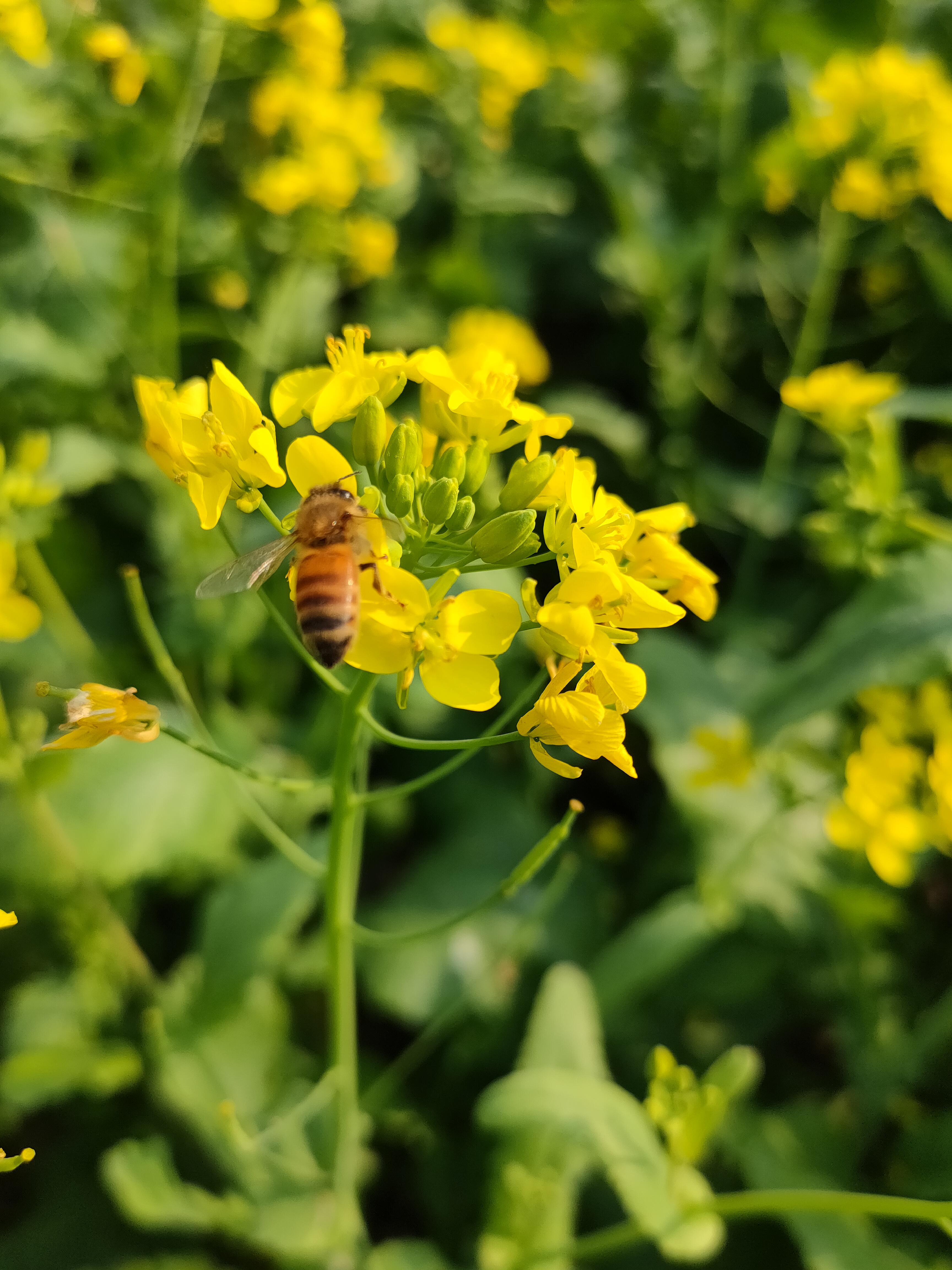
Bees and honey from the mustard fields
The yellow fields bring a second harvest. Bangladesh produces nearly 10,000 tonnes of honey a year, mostly between November and April, and about 80 percent of it is collected during the mustard season, according to a former head of a beekeeping project at the Bangladesh Small and Cottage Industries Corporation (BSCIC), quoted by The Daily Star in January 2021. Mustard flowers for 40 to 60 days, longer than any other crop, which is why beekeepers move their boxes into the fields, the president of the North Bengal Beekeepers Association told the paper.
The former BSCIC project head said keeping bees in mustard fields raised the yield by 15 percent per bigha, and that many farmers who had once refused to let beekeepers in, fearing lower output, had changed their minds. One farmer told the paper that his yield had risen from 4 to 4.5 maunds per bigha to 6.5 maunds after he let beekeepers use one bigha. From the mustard fields, beekeepers move on through the season to coriander, black cumin and litchi.
Mustard and the country's edible oil
Behind the free seed and the push for more mustard lies the country's dependence on imported cooking oil. In May 2023 the Ministry of Agriculture said, citing DAE figures, that mustard had been grown on 812,000 hectares that year, up from 610,000 hectares the year before, and that production had risen from 824,000 tonnes to 1,152,000 tonnes. It put the country's annual demand for edible oil at about 2.4 million tonnes, of which about 300,000 tonnes, or 12 percent, came from local mustard, sesame and sunflower; the rest was imported.
The ministry said then that a three-year plan aimed to produce 40 percent of the country's edible oil demand at home, about 1 million tonnes, by the 2024-25 fiscal year, saving roughly Tk 10,000 crore in imports.
In January 2025 the Dhaka Tribune, citing the DAE, reported that oilseeds had been grown on 1.34 million hectares in the 2023-24 fiscal year, with output of about 1.83 million tonnes, increases of 31 percent and 29 percent on the year before, driven mainly by the spread of mustard, the country's largest oilseed crop. The same report put edible oil demand at about 3 million tonnes, with soybean and palm oil making up roughly 75 percent of purchases, and the cost of edible oil imports at more than Tk 30,000 crore a year.
Photo: Hopeoflight / Wikimedia Commons (CC BY-SA 3.0)
Sources: Jagonews24 (1 January 2026), Banglapedia (Asiatic Society of Bangladesh: Magura District; Mustard), The Financial Express (6 January 2018, 1 January 2020 and 8 January 2021), The Daily Star (7 January 2021), The Daily Star Bangla (1 May 2023 and 4 September 2023), Desh Rupantor (15 January 2024), Dhaka Tribune (25 January 2025), Khobor Sangjog (2 November 2025), CSISA (2 January 2014), Wikipedia (Lipaphis erysimi; Alternaria brassicae)
Comments
(0)