
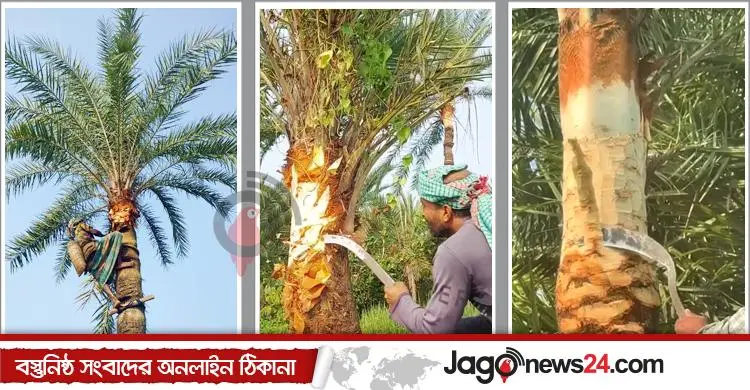
Date palm sap, a special ingredient of winter, is knocking at the door. Sap collectors (gachhis) have already begun preparing trees, and demand for them is rising from village to village. As across the country, preparations for sap production are under way in Magura. Magura's reputation has always been closely linked with date palm sap, hence the old saying: "Magura's fame, the date palm's sap."
Light cool breezes in the mornings and evenings herald the coming winter. Although winter has not yet set in, Magura's gachhis have started preparing to collect sap. They are now busy cleaning, trimming and scraping the trees, and their activity has spread a sense of bustle through the villages.
As the temperature drops, the sap gets sweeter. So winter brings with it fresh date palm sap and the aroma of the beloved patali jaggery. For generations Bangladeshi housewives have used date palm sap and jaggery to make traditional dishes such as pitha, puli and payesh.
Rising costs, thin profits
Daud Mia of Barabil in Magura has made his living selling date palm sap and jaggery for about 20 years. The traditional trade passed down through generations is still his family's main source of income. "The trees have dwindled and the price of everything has gone up. It's a struggle to support a family of seven. I have to buy wood and firewood to make jaggery, which raises costs. If we got some benefit from technology, the work would be much easier," he said.
A Khalek, a gachhi from Khamarpara in Sreepur upazila, said: "We've started cutting the trees. It will take 7-8 days for the sap to come. After I collect it, my wife boils it down into jaggery. It's very hard work, but we still do it. There's almost no profit. The price of the chhen, dao and knives has gone up, and pots have become very expensive. Even though the price of jaggery has risen a little, I fear I will face a big loss this year."
According to the Department of Agricultural Extension (DAE), Magura has about 1.05 lakh date palms this season, planted on about 200 hectares. The trees are declining because they are used as fuel in brick kilns, and a shortage of gachhis is also reducing the number of date palms in the district's four upazilas.
Shariful, a farmer from Barabila village in Sreepur upazila, said: "At the start of winter I take other people's date palms on a share basis along with our own. I make jaggery commercially, give the tree owners their share, meet my family's needs and sell the rest at market. Cutting date palms is hard work, but when I see the pots full of sap in the morning I forget the hardship. But because the cost of jaggery-making materials has risen abnormally, the price of jaggery will also rise."
Retired teacher Manju Sheikh said: "Date palms are used as fuel in brick kilns, so the trees are disappearing day by day. On winter mornings gachhis used to collect sap and sell it from village to village, with pitchers hung from bamboo poles. Pitha and puli made with date palm sap are irresistible, and most winter pitha are made with date palm jaggery. At this time of year every home celebrates with pitha. Many people are also becoming self-reliant by making jaggery from the sap and selling it at market."
Source: Jagonews24. First published in Bengali on The Agro News.

Comments
(0)