
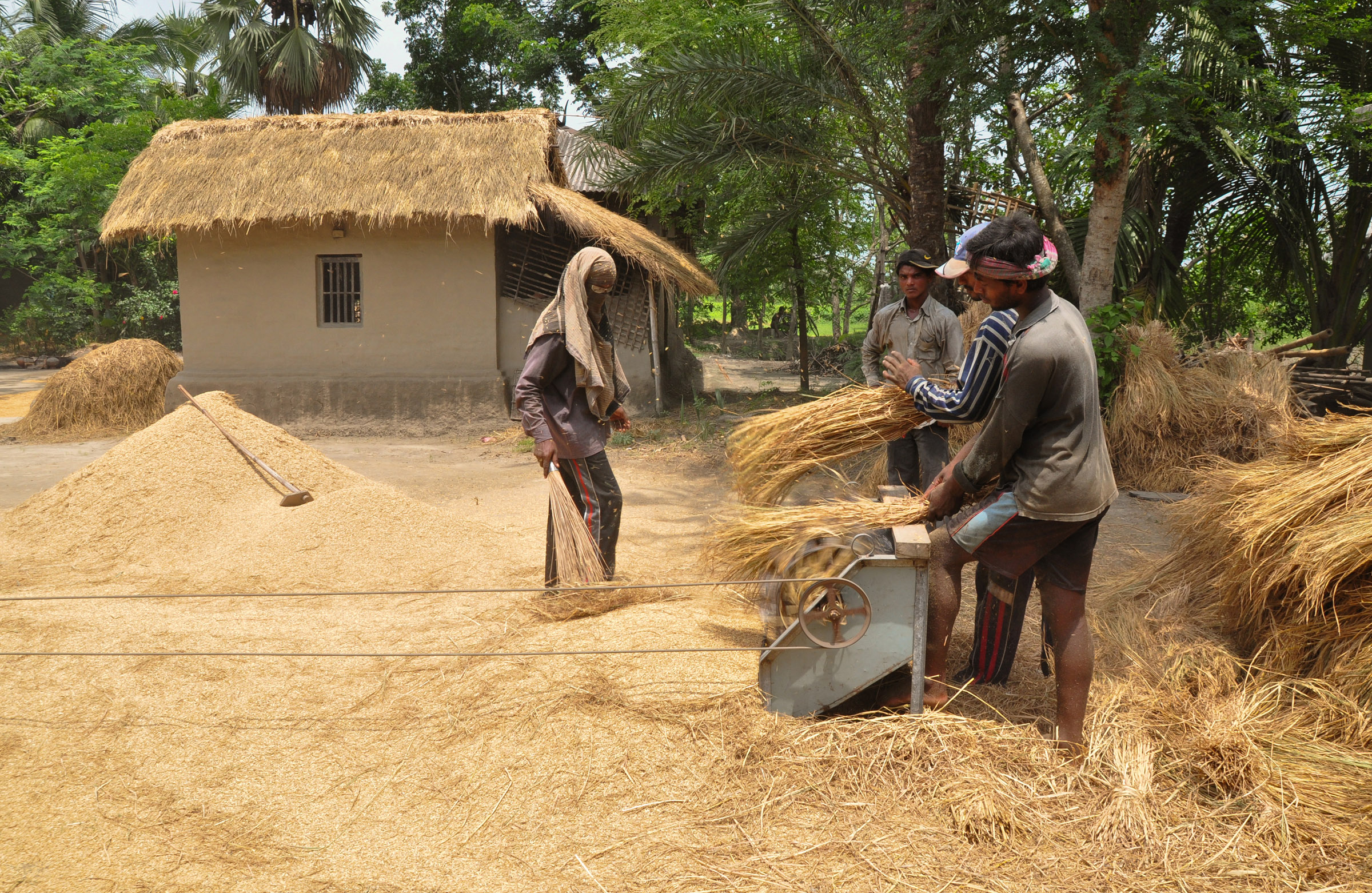
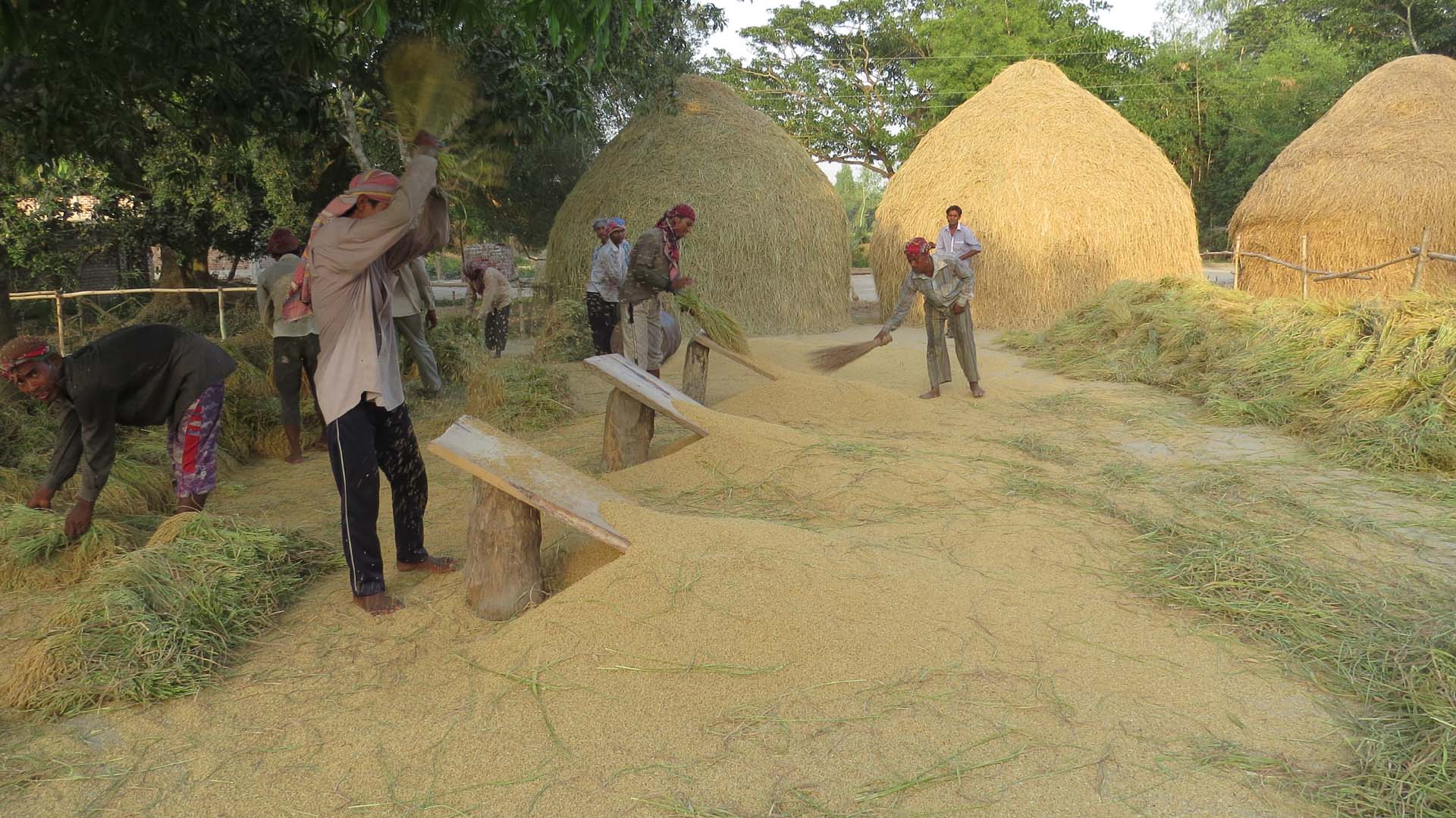
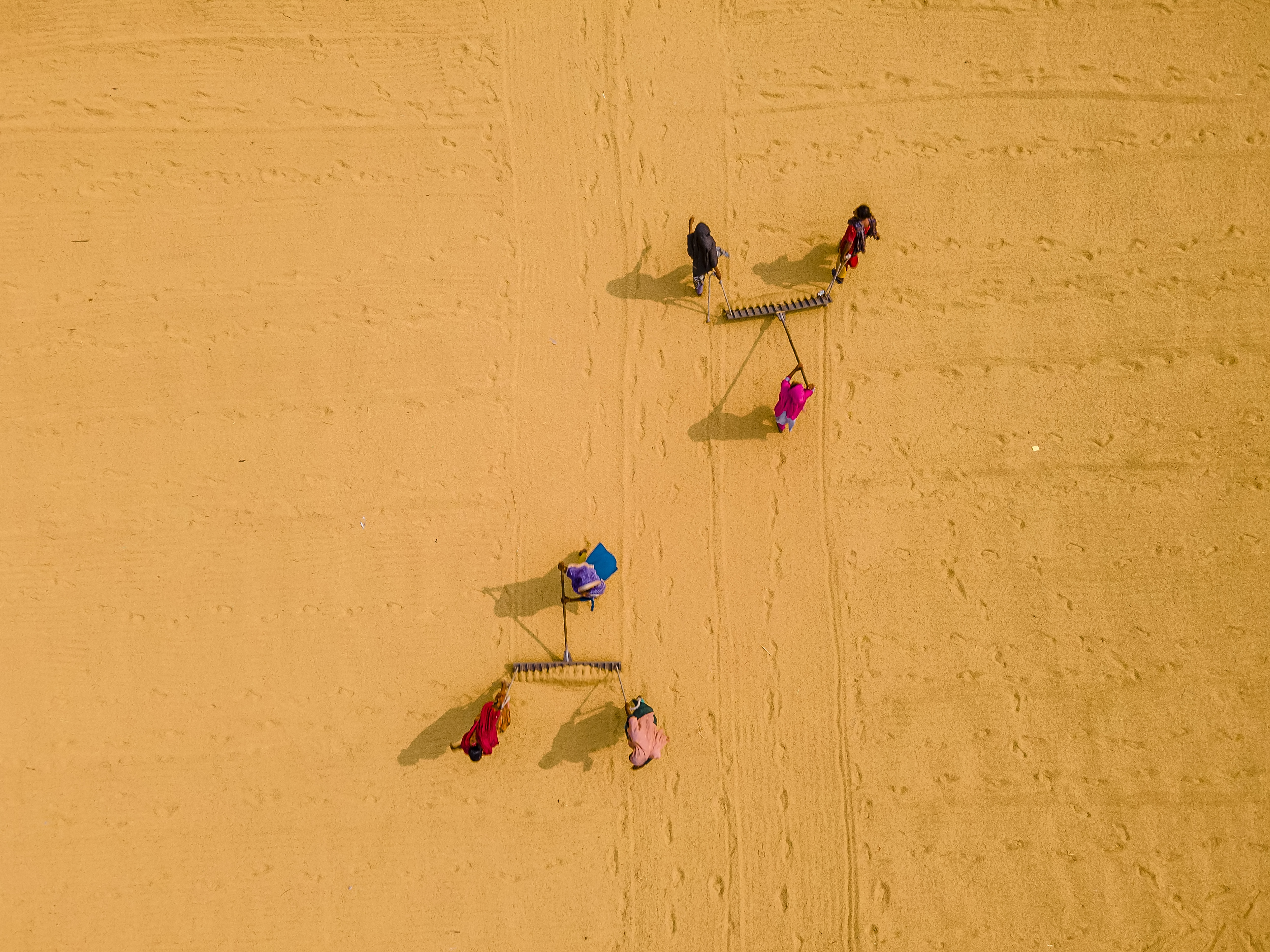
Aman paddy produced a bumper yield in many parts of Magura district in the 2025 season, and in early November 2025 farmers there were busy cutting and threshing the crop, Jagonews24 reported on 4 November 2025. Farmers told the paper that heavy rain during the season had raised aman yields several times over, both on land they farm every year and on land that usually lies uncultivated. Officials of the Department of Agricultural Extension (DAE) in Magura said the weather had been favourable and the supply of fertiliser good, while some farmers voiced worry about paddy that rain and wind had already flattened in their fields.
Magura is a district of Khulna Division in south-western Bangladesh, and aman, the rice crop grown through the monsoon, is one of its main field crops. The report came as the harvest of the season's transplanted aman was getting under way across the country, at a time when farmers were weighing a good yield against the price the new paddy would fetch in the market.
What Magura's farmers said
Araj Ali, a farmer in Magura Sadar upazila, told Jagonews24 that he had grown different varieties of paddy on 20 bighas of land this season. With plenty of rain, he said, the yield had been good, and if farmers received a fair price in the market they would not have to sell their paddy at a loss.
Dhala Sheikh, a farmer from Bhitashair village in Magura Sadar, said he had grown aman on eight bighas. His paddy had done well, he said, and because insect attacks and diseases had been fewer than usual, the yield was better than in other years. He added that rain and wind had already flattened the paddy on a good deal of land, which left him somewhat worried.
Taleb Mia, a farmer from Nakol village in Sreepur upazila, said the weather and the availability of fertiliser had both been in farmers' favour this year. He also said that after several years of continuous losses, many farmers had not planted aman this time, and that this was perhaps one reason why farmers were now getting a fair price. Nakol is one of the eight unions of Sreepur upazila, alongside Amalsar, Kadir Para, Gayeshpur, Dariapur, Sreekol, Sreepur and Sabdalpur.
What the agriculture office said
Md Tozammel Haque, an upazila agriculture officer quoted in the report, said the overall condition of the fields was good at that moment.
Md Tajul Islam, deputy director of the DAE in Magura, said the weather had been favourable this season and the supply of fertiliser had also been good. Overall, he said, production had been good this time and farmers were getting good prices as well. Above all, he told the paper, the smiles on farmers' faces were what mattered most.
The DAE is the government agency that carries farming advice and programmes to the field. It works under the Ministry of Agriculture through district offices headed by deputy directors, upazila agriculture officers and, at union level, sub-assistant agriculture officers who visit farmers. It also implements the government's large farm mechanisation project described below.
Rain, wind and flattened paddy
Farmers in Magura gave the season's rain much of the credit for their crop. Aman grows through the rainy season, and Magura's average annual precipitation is about 1,681 millimetres.
Rain and wind near harvest time carry a risk, however, and Dhala Sheikh's worry was about exactly that. When the stems of a grain crop bend over near ground level, agronomists call it lodging. It usually happens when a crop's standing power is not enough to withstand rain, wind or hail, and it is influenced by the soil, the lie of the land and the previous crop. Lodging can cut yields sharply, makes a crop very difficult to harvest, and depending on when it happens can affect disease, the moisture of the grain, its quality and how evenly the crop ripens. Shorter, dwarf varieties are one way breeders have reduced the problem.
The last days of October 2025 brought unsettled weather to the Bay of Bengal. Prothom Alo reported on 28 October that a cyclonic storm named Montha, a Thai name meaning "fragrant flower", had intensified into a severe cyclonic storm and was expected to cross the coast of Andhra Pradesh in India. At noon that day the BMD placed its centre about 1,265 kilometres south-west of Chattogram port and 1,105 kilometres south-west of Mongla port, with maximum sustained winds of about 90 kilometres an hour near the centre, gusting to 110. The Bangladesh Meteorological Department (BMD) asked the ports of Chattogram, Cox's Bazar, Mongla and Payra to keep distant warning signal No. 2 hoisted, and told fishing boats in the northern Bay to stay close to the coast. BMD meteorologist Md Bazlur Rashid told the paper that the storm's effect on Bangladesh would mainly be rain: little on 28 October, more likely in coastal and other regions from 29 October, and possibly heavier on 30 and 31 October.
Machines in the fields
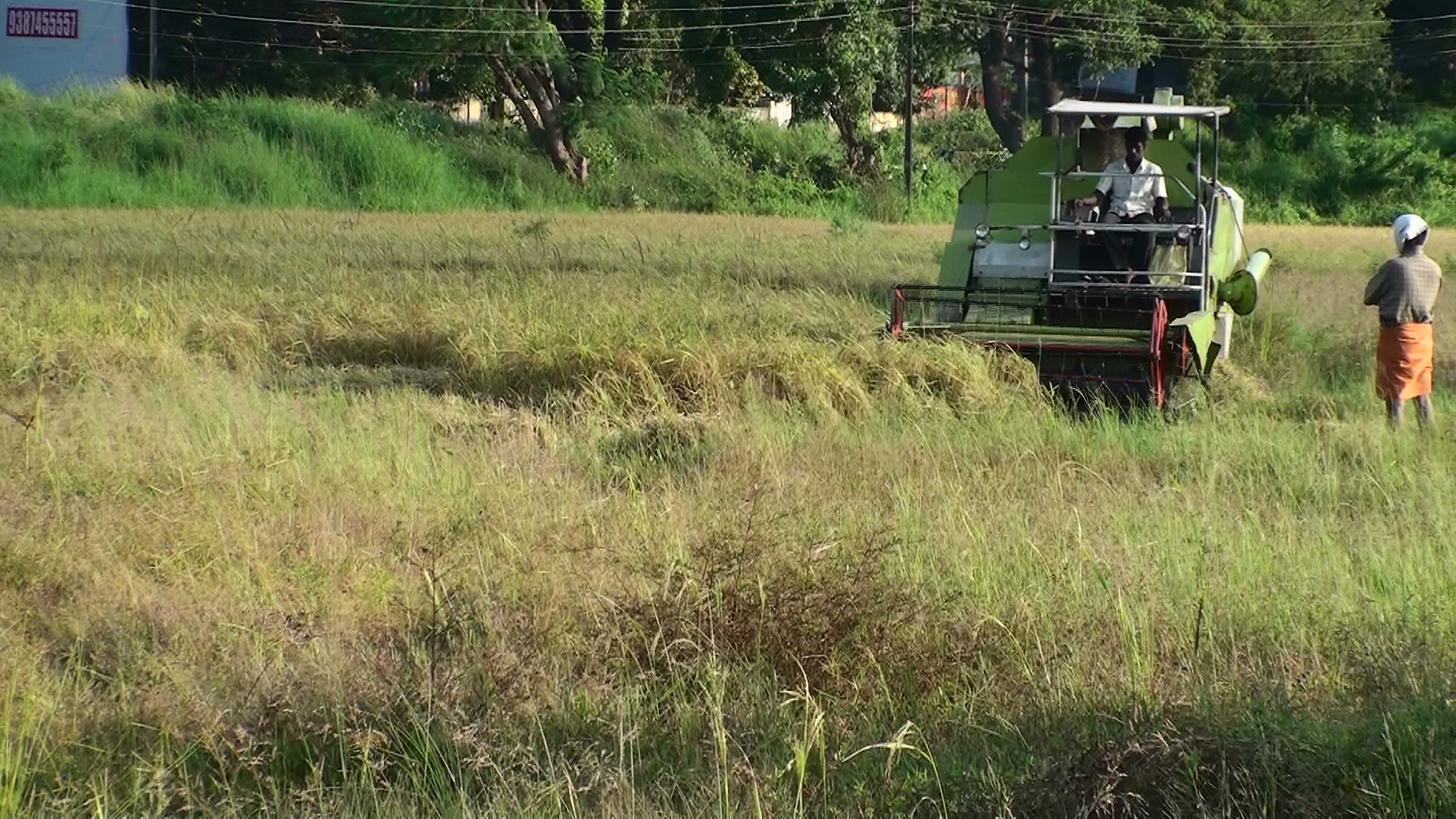
Jagonews24 reported that Magura district had 26 combine harvesters, four rice transplanters and 33 reapers. A combine harvester can cut the paddy on one acre of land in an hour, according to the report. Small and marginal farmers told the paper that hiring a machine cost Tk 4,000 to 5,000 to harvest an acre, and that this saved them some of the cost and time of growing paddy.
These machines reached Bangladesh's fields largely through government subsidy. In July 2020 the Executive Committee of the National Economic Council (ECNEC) approved a project titled "Agricultural Mechanisation through Integrated Management", Dhaka Times reported on 16 July 2020. It was to cost Tk 3,020 crore 6 lakh, all from government funds, and to run from July 2020 to June 2025, with the DAE as the implementing agency. It planned to supply about 51,300 machines, including combine harvesters, reapers and rice transplanters, at a subsidy of 50 to 70 percent depending on the region.
A Prothom Alo report of 30 April 2020 described how the subsidy worked in the field. The government generally paid half the price of a combine harvester, and 70 percent in the haor wetlands. A Japanese-brand Yanmar harvester sold by ACI Motors cost Tk 28 lakh, and a Chinese-brand machine sold by Metal Group cost Tk 20.5 lakh. According to the report, cutting paddy by hand cost Tk 9,000 to 10,000 an acre while a harvester did it for about Tk 5,000, and machine harvesting cut crop losses from about 12 percent to under five percent. ACI said farming in Bangladesh normally faced a labour shortage of 40 percent at harvest, and its executive director Subrata Ranjan Das told the paper that 1,000 harvesters could cut the rice on four lakh acres in a season.
Magura district: rivers, people and crops
Magura covers 1,039.10 square kilometres between 23°15' and 23°41' north latitude, according to Banglapedia, the national encyclopaedia. It borders Rajbari to the north, Jashore and Narail to the south, Faridpur to the east and Jhenaidah to the west, and lies about 176 kilometres from Dhaka on the flat plain of the Ganges delta. Its four upazilas are Magura Sadar (401.58 square kilometres), Mohammadpur (233.70), Shalikha (228.65) and Sreepur (175.15). The district has one municipality, 36 unions, 513 mouzas and 711 villages. Its main rivers are the Gorai-Madhumati, the Nabaganga and the Kumar.
Magura became a subdivision in 1945 and a district on 1 March 1984. The 2022 population census counted 1,033,115 people in 254,154 households, about 994 people per square kilometre, with 18.90 percent living in urban areas. In the 2011 census, agriculture was the main source of income for 66.3 percent of the district's households.
Banglapedia lists paddy, jute, wheat, mustard, gram, lentils, sugarcane and vegetables as the main crops of Magura Sadar upazila, where 61.64 percent of households own agricultural land and 38.36 percent are landless. In Sreepur, the main crops are paddy, jute, wheat, mustard, pulses and vegetables, and about 64 percent of income comes from agriculture. Jute, yarn and vegetables are among the main exports of Magura Sadar.
Aman in Bangladesh's rice calendar
Bangladesh grows rice in three seasons: aus, aman and boro. Banglapedia describes transplanted aman as the most important type of rice by area, covering about 46 percent of rice land in 2009-10, against 41 percent for boro, nine percent for aus and four percent for broadcast aman. By production, boro ranks first, followed by aman and then aus. Transplanted aman is grown throughout the country and harvested from November to January, while broadcast aman, sown directly into the fields, is grown mostly in the south and south-east and harvested in November and December. In 2009-10, total aman production was 12.207 million tonnes from 13.993 million acres.
The crop had come through a difficult year before the 2025 season. The Financial Express reported on 6 July 2025 that, according to the Bangladesh Bureau of Statistics (BBS), aman production in the 2024-25 fiscal year was 16.5 million tonnes, only slightly below the 16.6 million tonnes of 2023-24, even though more than 350,000 hectares of farmland had gone under the flash floods of August 2024 and only 30,000 hectares were replanted. Yield per hectare rose to 2.95 tonnes from 2.81 tonnes the year before. DAE director general Md Saiful Alam said the aman area had shrunk by 100,000 hectares and that the higher yield had offset the loss of land. Aman made up more than 40 percent of the country's total rice output in 2023-24, the paper said.
The season elsewhere in the country
Reports from other regions in the days before the Magura story described a similar picture. In the Rangpur agricultural region, BSS reported on 31 October 2025, short-duration aman had been harvested on 32,990 hectares, producing 1,07,112 tonnes of clean rice. Md Sirajul Islam, additional director of the DAE in Rangpur region, said farmers were getting an average yield of 3.25 tonnes of clean rice (4.875 tonnes of paddy) per hectare, and that recent rain had acted as a tonic for the plants after a drought-like spell during transplanting.
In that region the DAE had set a target of 20,10,505 tonnes of clean rice from 6,20,430 hectares for the season across five districts, and farmers had planted 6,21,505 hectares, or 100.17 percent of the target, with more than 62,000 hectares under short-duration varieties. Early short-duration varieties were yielding 4.60 to 6.50 tonnes of paddy per hectare. Ariful Haque Batul of Najirdigar village in Rangpur said sharecroppers had planted BRRI dhan75, BRRI dhan51, BRRI dhan52 and BINA dhan17 on his eight acres, and that he expected 48 to 58 maunds an acre, counting a maund as 40 kilograms.
Prices, procurement and the farmer's margin
Price was a thread through the Magura farmers' comments. Araj Ali tied his hopes to a fair market price; Taleb Mia believed that fewer farmers planting aman after years of losses had helped prices; and the DAE's deputy director said farmers were getting good prices this season. The report did not give a market price per maund in Magura.
The government also buys paddy and rice from farmers and millers each aman season. For the previous season, the Food Planning and Monitoring Committee decided on 6 November 2024 to buy paddy at Tk 33 a kilogram, boiled rice at Tk 47 and atap (non-parboiled) rice at Tk 46, bdnews24.com reported. The prices were Tk 3 a kilogram higher than the season before because production costs had risen. The targets were 3.5 lakh tonnes of paddy, 5.5 lakh tonnes of boiled rice and 1 lakh tonnes of atap rice, with paddy and boiled rice bought from 17 November to 28 February. The same meeting approved the import of five lakh tonnes of rice.
Consumers had felt the pressure of the poor 2024 season. The Financial Express reported in July 2025 that coarse rice was selling at Tk 55-56 a kilogram in Dhaka, medium rice at Tk 64-66 and finer varieties at Tk 78-100, after rising Tk 6-8 in a month, and that 1.25 million tonnes of rice had been imported. SM Nazer Hossain of the Consumers Association of Bangladesh said the effects of the floods had kept prices high until May 2025, after which they began rising again in June.
Varieties and research behind the crop
Most of the aman varieties grown in Bangladesh come from the Bangladesh Rice Research Institute (BRRI), founded in 1970 with its headquarters at Joydebpur in Gazipur. Its work covers rice breeding, agronomy, pest and disease control and, through a dedicated division, farm machinery and post-harvest technology. One of its regional stations is in neighbouring Kushtia.
In April 2022, BRRI and the International Rice Research Institute (IRRI) shared the results of three years of head-to-head adaptive trials at locations across the country, Prothom Alo reported. BRRI dhan87 gave the best yield nationwide among the transplanted aman varieties tested; BRRI dhan79 and an IRRI line, IR13F441, were recommended for areas prone to flash floods; and BRRI dhan93, BRRI dhan94 and BRRI dhan95 were identified as alternatives in the north to Swarna, a variety from India.
Field reports have shown what such varieties can mean for a farmer. The Daily Star reported in November 2020 that in a test cultivation in Baniary village of Nazirpur upazila in Pirojpur, in which 16 farmers grew it on three acres for the first time, BRRI dhan87 yielded about 52 maunds an acre against about 25 maunds for the local variety, and matured in up to 130 days compared with 160 days for the local aman. Farmer Projesh Kumar Mondal said growing BRRI dhan87 cost about Tk 1,000 more than the roughly Tk 5,500 spent on the local variety, and added that because the paddy grows in the rainy season, farmers did not need to spend money on irrigation. Farmer Ananda Roy told the paper that those growing BRRI dhan87 could prepare their land for rabi crops after the harvest, while farmers growing the local variety would have to wait almost another month. The Magura report spoke only of "different varieties" and of hybrid paddy, without naming them.
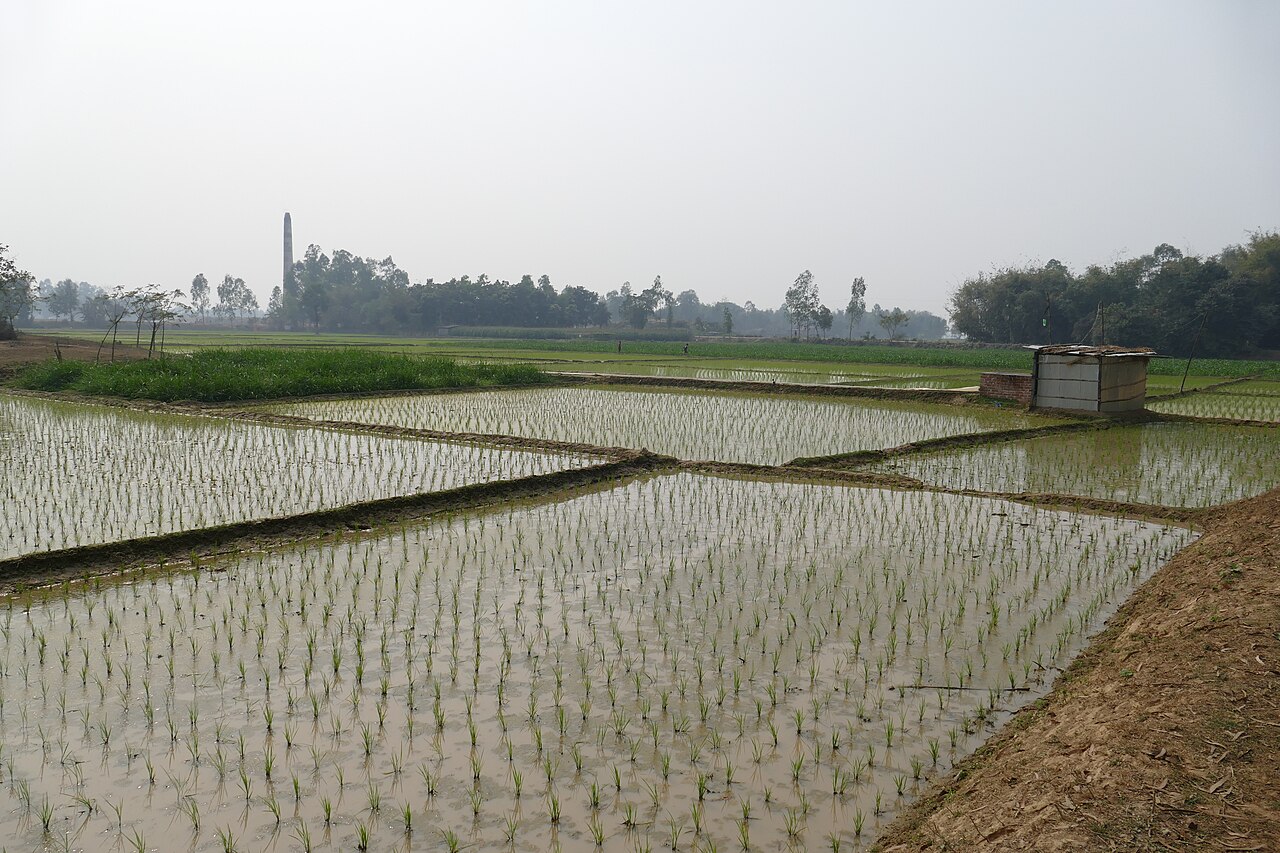
Photo: Balaram Mahalder / Wikimedia Commons (CC BY-SA 3.0)
Sources: Jagonews24, Banglapedia, Wikipedia, The Financial Express, Bangladesh Sangbad Sangstha (BSS), Prothom Alo, Dhaka Times, bdnews24.com, The Daily Star
Comments
(0)