
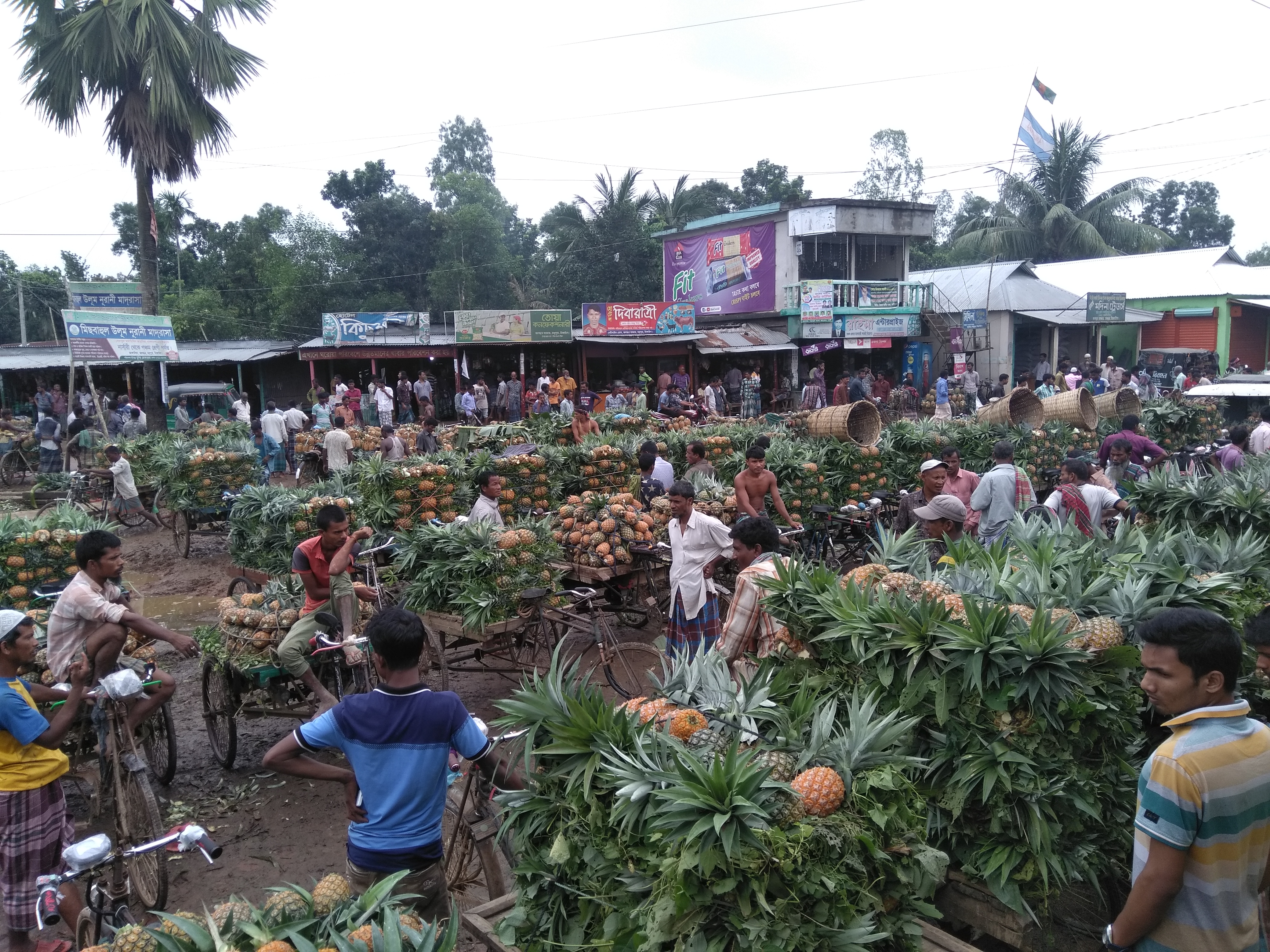
Pineapple farming kept spreading in Madhupur upazila of Tangail in early July 2026, at the height of the season for the jaldugi variety. Growers told Jago News on 3 July that prices were good and that they were making a profit, wholesalers from across the country were buying at the upazila's markets, and the district office of the Department of Agricultural Extension (DAE) put this season's pineapple area in Tangail at 7,773 hectares. Madhupur's pineapple, recognised as a geographical indication (GI) product of Bangladesh in September 2024, is known nationwide for its taste and quality, and growers, traders and officials said that processing and exports would be the way to secure fair prices outside the peak season.
Madhupur is known for its red-soil sal forest, and its pineapple has a long history of its own. Farmers said they again expected a good harvest this year, while the agriculture department said it was giving them all-round support.
Jaldugi season at Jalchatra and the other markets
June and July are the busiest months for the jaldugi pineapple, and in early July jaldugi from the Madhupur tract was going to districts all over the country. Trading at the markets began at dawn and continued all day. Each pineapple was selling for Tk 15 to Tk 50 depending on its size, and demand was high because, as local people put it, the fruit is unmatched in quality, taste and aroma.
Jalchatra in the Madhupur tract is the largest pineapple market, followed by Moter Bazar and Garo Bazar. Wholesalers come to these markets from Mymensingh, Jamalpur, Kishoreganj, Sherpur, Dhaka, Sylhet, Rajshahi, Kushtia, Barishal, Gazipur and other districts, and a great deal of fruit changes hands every day. Pineapples worth crores of taka are traded each year, and the fruit is now regarded as the mainstay of Madhupur's economy. Banglapedia, the national encyclopedia, lists the Jolchhatro hat, Garo Bazar and Moter Bazar among the upazila's noted markets and names pineapple first among Madhupur's main exports to the rest of the country, ahead of jackfruit, silk, cassava, cotton and honey.
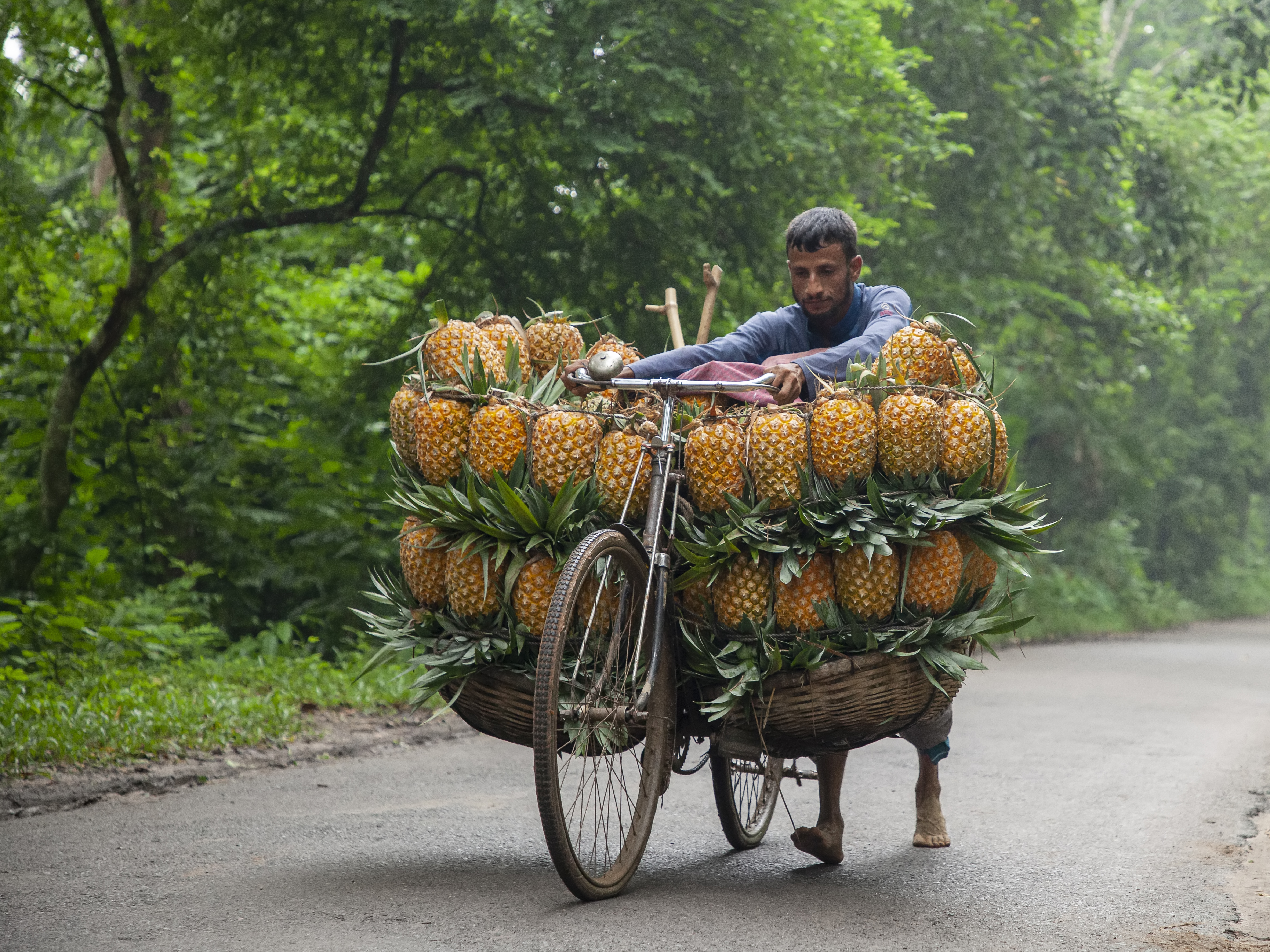
The scale of this trade had been reported before. In October 2024 the Dhaka Tribune called the Madhupur Garh region the "Pineapple Capital" of Bangladesh and reported that daily transactions in its pineapple markets exceeded Tk 1 crore. Bangla Tribune described in September 2024 how farmers set out from before dawn with pineapples loaded on bicycles, battery-run auto-rickshaws and vans to reach the markets in time for the best prices.
This season's area, output and farmers' costs
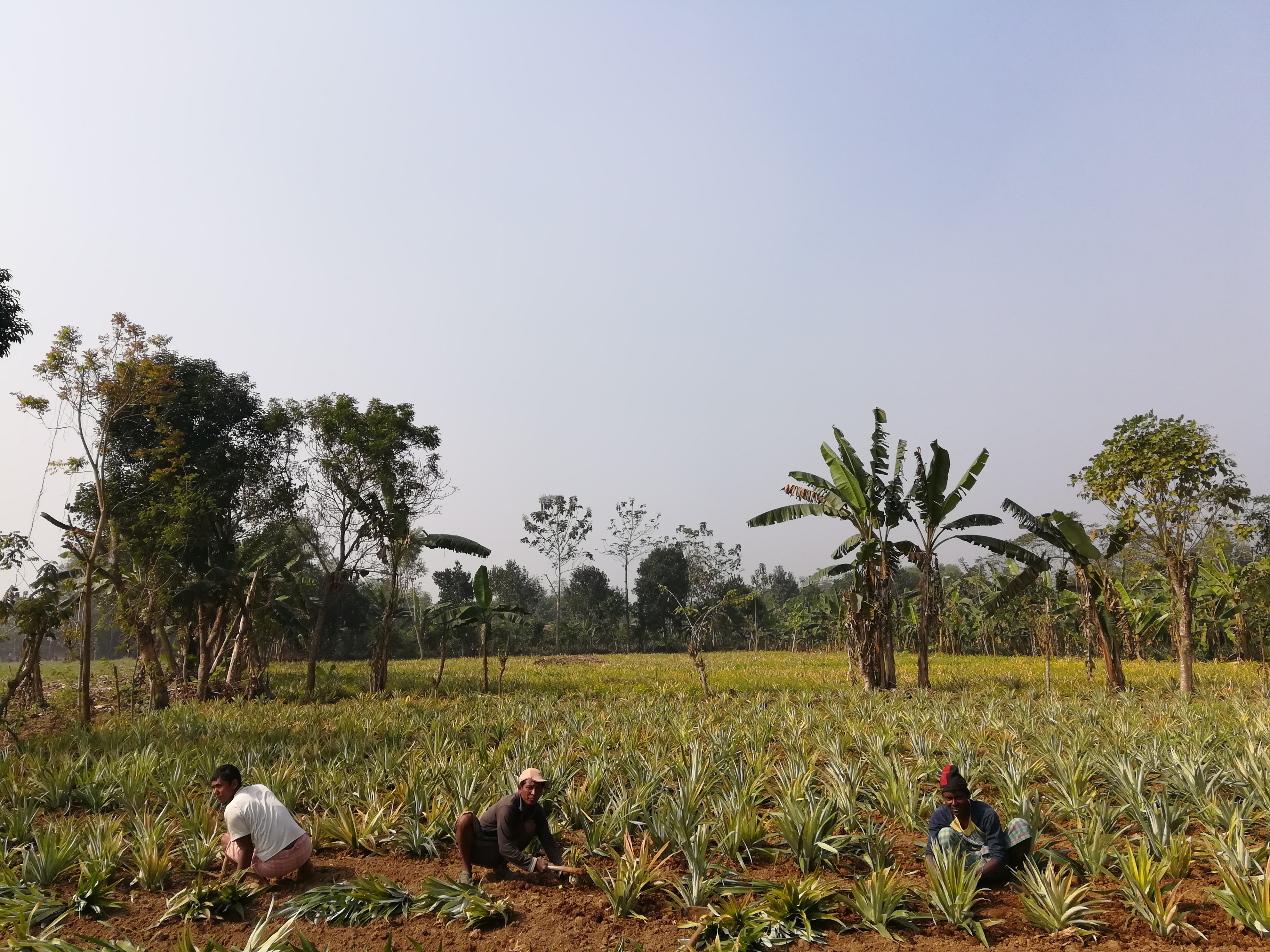
According to the agriculture department, pineapple was grown on 7,773 hectares in Tangail district in the 2026 season, with production of 2,87,182 tonnes. Of this, Madhupur upazila accounted for 6,943 hectares and 2,58,132 tonnes. Jaldugi and Calendar were the most widely grown varieties, along with MD-2, a variety brought in from the Philippines.
Madhupur upazila agriculture officer Rakib Al Rana told Jago News: "Red-soil pineapple is in demand all over the country because of its taste and quality. With favourable weather, we hope for a good yield this year. Production could reach 35 tonnes per hectare. This year jaldugi pineapple sales could reach about Tk 500 crore. We give farmers the advice and support they need."
Farmer Chhanowar Hossain said he had grown pineapple on two acres this time. "My pineapples are chemical-free, so each sells for Tk 30 to 60 depending on size. Because prices are good this year, we are making a good profit," he told Jago News. Growing pineapple costs Tk 60,000 to 70,000 per bigha, he said, and with good prices the crop from a bigha can sell for up to Tk 1,20,000. Another farmer, Kabil Uddin, said he had planted 10 bighas. "If the market is good, you can profit from pineapple farming. Each pineapple costs Tk 12-13 to produce. I hope the yield will be good this time," he said.
The 2026 figures follow two seasons of similar size. When the GI certificate was announced in September 2024, a DAE sub-assistant agriculture officer in Tangail told The Daily Star that pineapple had been planted that year on 7,773 hectares in the district, 6,630 of them in Madhupur and 1,140 in Ghatail upazila, and that in the previous year 7,661 hectares in the two upazilas had produced 2,82,000 tonnes. The Madhupur upazila agriculture office gave bdnews24.com the same previous-year figures at the time.
Good years have not been guaranteed. Bangla Tribune reported in September 2024 that pineapple prices that season had fallen to about half of the previous year's while production costs had risen, and quoted a young grower who said he had spent Tk 6 lakh on seven bighas, sold fruit worth Tk 4.5 lakh and lost Tk 1.5 lakh. Farmers made the same point to Jago News in 2026: the price of pineapple depends on the weather, and heavy rain, bad weather or a natural disaster brings it down.
Calls for processing and exports
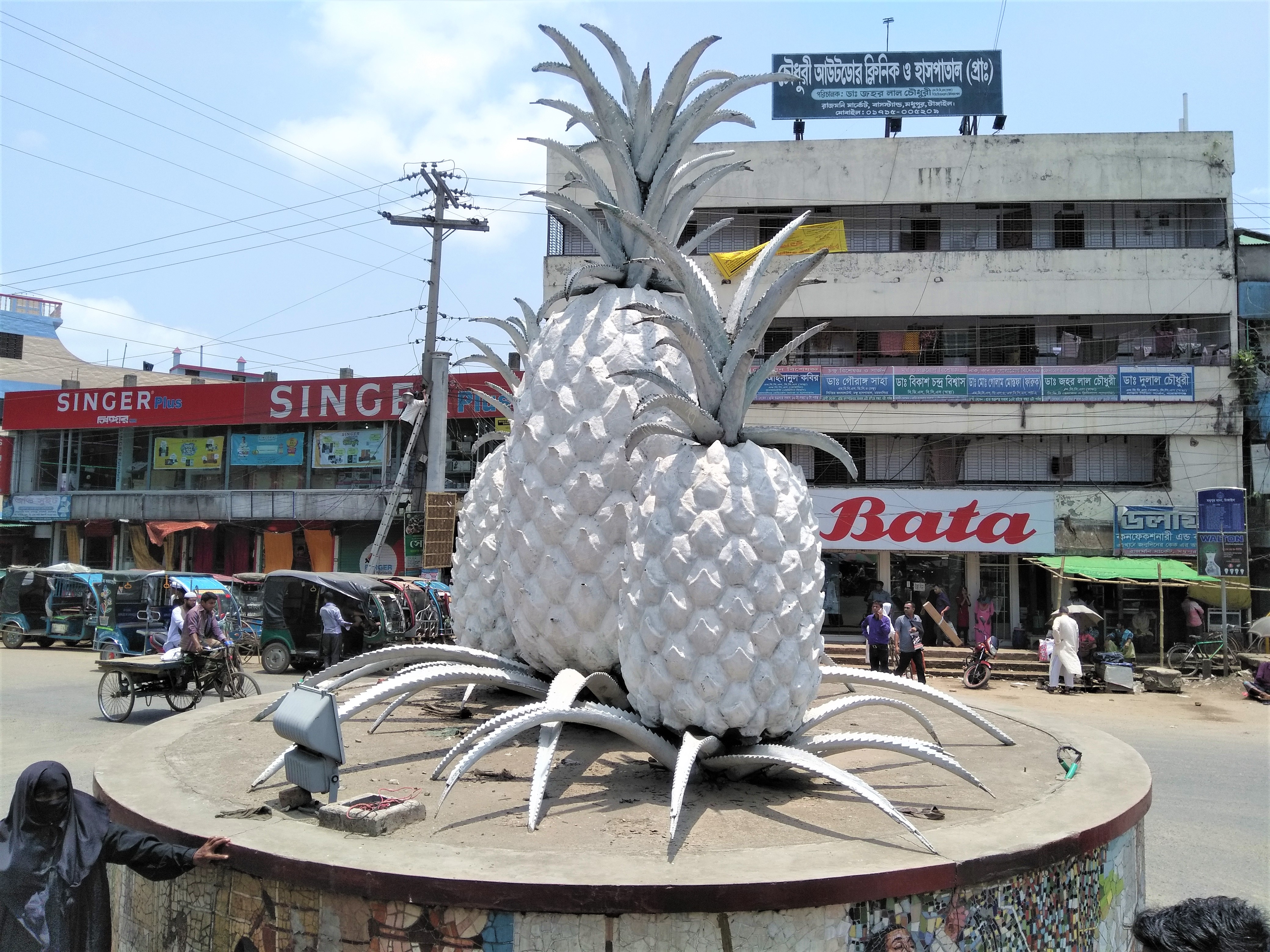
Because prices fall whenever the weather turns, farmers said fair prices would come only if processing, cold storage and pineapple products such as juice and jelly were developed. Local traders said Madhupur pineapples were going to Dhaka and across the country and fetched good prices in the season, but not at other times of the year. Processing and exports would raise the price, they said, and growing the crop organically to protect its reputation and win foreign buyers would bring back its tradition, give farmers fair prices, earn foreign currency for Bangladesh and create jobs in processing plants.
Local people said Prime Minister Tarique Rahman, at a farmer card distribution event in Tangail, had promised to arrange pineapple processing and exports, and that his remarks had given farmers new hope. The farmer card programme was inaugurated in Tangail on 14 April 2026.
Madhupur upazila nirbahi officer Zubair Hossain told Jago News: "Madhupur's GI pineapple is going all over the country. If pineapple-based industries and exports can be established, farmers will benefit." Ashek Parvez, deputy director of the DAE in Tangail, said: "We have sent a proposal to the ministry on safe production, proper marketing and export of Madhupur pineapple. We are supporting pineapple farmers in various ways. Pineapple is grown to some extent all year round."
Days earlier, on 29 June 2026, the same DAE official had told the state news agency BSS that world demand for pineapple was large, that Thailand and the Philippines led the world in exporting the fruit and its products, and that some domestic beverage companies were already exporting pineapple juice for which there was strong demand. Through value addition and food technology, he said, world-standard food products could be made from safely grown pineapple, and the department had sent the government several project proposals on the matter.
How pineapple came to Madhupur
Pineapple is not native to Bangladesh. Banglapedia describes it as a native of Brazil that probably reached India in 1548; Julia Morton's Fruits of Warm Climates, published by Purdue University, says Portuguese traders are said to have taken it to India from the Moluccas in that year. According to Banglapedia, the fruit came into what is now Bangladesh through Assam and Manipur in India and was first cultivated in Sylhet at the beginning of the twentieth century. It is now grown in almost every district, with the largest areas in Sylhet, Tangail, Dhaka and Rangamati.
Accounts differ on how it reached Madhupur. According to the history that Jago News recounted, in the late 1960s a man named Verena Sangma of Aushnara union brought a few saplings of the Giant Kew variety from Meghalaya in India and planted them in the Madhupur tract. The first crop yielded well and tasted good, more land was then planted, neighbours followed the example, and cultivation in the tract has grown ever since, with farmers profiting as yields rose.
The reports published when the GI certificate was announced in September 2024 gave an earlier date. The Daily Star, Ittefaq and Bangla Tribune all wrote that cultivation began in 1942, when a woman of the Garo community from Idilpur village in Madhupur brought pineapple saplings from Meghalaya, where she had been visiting relatives, and planted them at her home; Ittefaq and the Dhaka Tribune put the number at 750 saplings, and the Dhaka Tribune said they were of the Calendar variety. That 1942 date is the start from which Jago News's "about eight decades" before the GI recognition is counted. Both accounts agree that the plants came from Meghalaya and that the crop then spread from household gardens to the whole tract.
GI recognition in September 2024
On 24 September 2024 the Geographical Indication Unit of the government recognised Madhupur pineapple as a GI product. The registration certificate, signed by the director general of the Department of Patents, Designs and Trademarks (DPDT) under the Ministry of Industries, lists the fruit as GI No. 52 in class 31. The application had been sent by the Tangail district administration. Tangail's deputy commissioner said at the time that after the Tangail handloom saree and chamcham, the pineapple was the district's next GI product, that the recognition would help its branding worldwide and the spread of commercial cultivation, and that applications had been made for several more of the district's products. Farmers and traders welcomed it.
Registration rests on the Geographical Indication of Goods (Registration and Protection) Act, 2013 (Act No. 54 of 2013, dated 10 November 2013). According to its FAOLEX summary, the Act's 46 sections place all work on the geographical indication of natural or agricultural products, handicrafts and industrial goods, including foodstuffs, with a Geographical Indication Unit inside the DPDT, whose registrar also acts as registrar of geographical indications, and protect a registered indication and its defined territory against other indications.
By early 2024, The Daily Star counted 21 products registered under the Act, and reported that ten products had been recognised in the eight days from 8 February 2024, after news that India had registered the Tangail saree as its GI. Jamdani was the first, in 2015, hilsa was registered in 2017 and bagda shrimp in 2022. The same report warned that Bangladesh had not yet turned these registrations into commercial gains: no GI tags were being used on jamdani sarees, and a Department of Fisheries official said no trader had yet sold hilsa or bagda shrimp under a GI tag. An Oxford University doctoral researcher in intellectual property law told the paper that GI-certified products generally sell for 20 to 30 per cent more than similar goods on world markets. Tangail's DAE officials said in 2024 that the recognition opened the way to exports, while Bangla Tribune reported that many growers were worried that heavy chemical use could make exporting difficult.
The Madhupur tract: red soil and sal forest
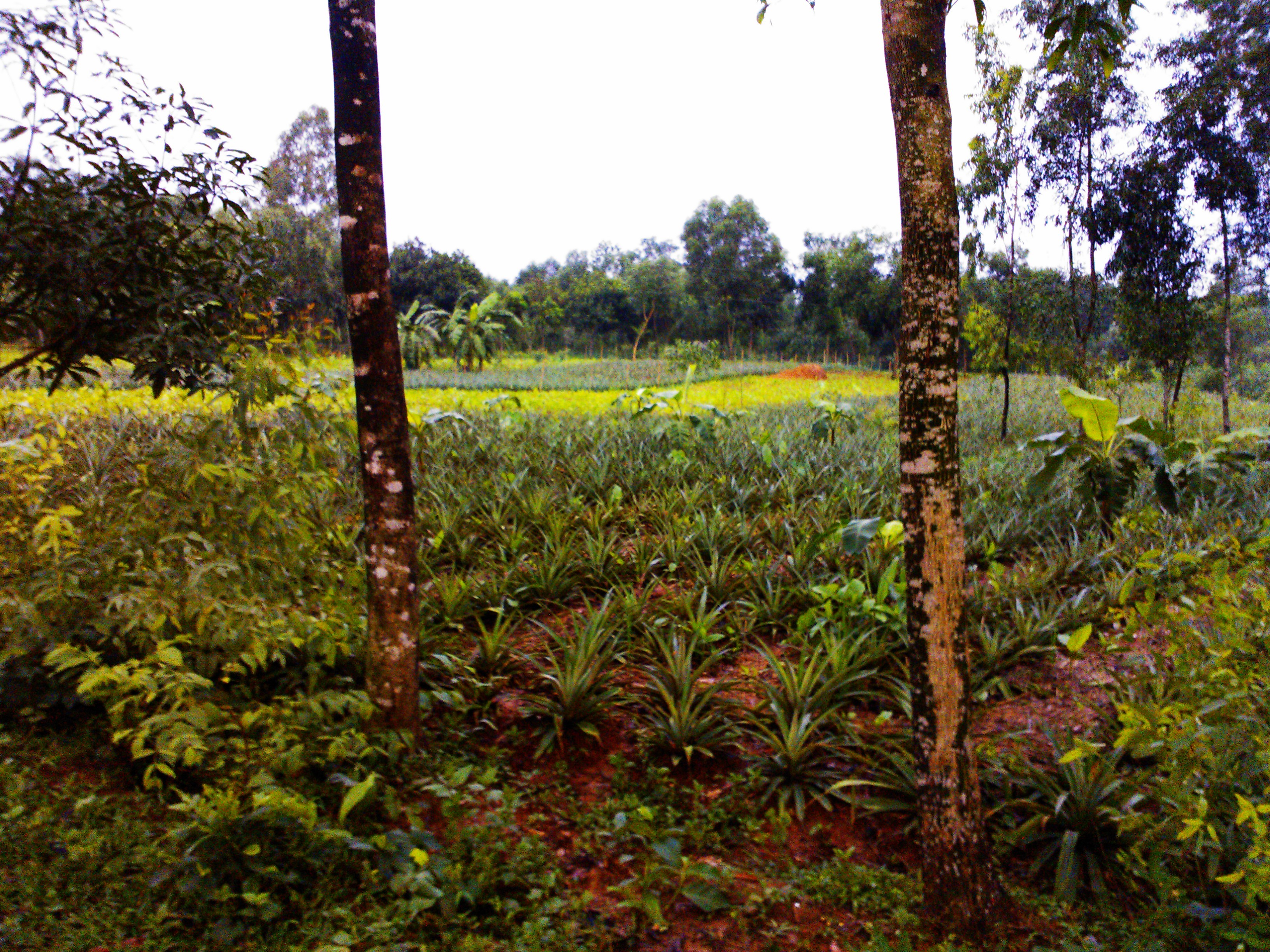
Madhupur's pineapple grows on the Madhupur Tract, a large upland in central Bangladesh whose northern part is called Madhupur Garh and whose southern part is Bhawal Garh. Banglapedia describes it as a terrace one to ten metres above the surrounding floodplains, 4,244 square kilometres in extent, stretching from just south of Jamalpur to Fatullah in Narayanganj. Its soils developed on the Madhupur clays, which are red or brown, poor in nutrients and somewhat acidic. The higher land is called chala and the valleys between are called baid; the valleys are farmed with boro rice in the dry season, while the chala is known for jackfruit gardens and, in Madhupur, for pineapple, mainly of the Giant Kew variety. Annual rainfall is 1,000 to 1,500 millimetres.
Much of the tract was once covered by sal forest, and the Madhupur National Park in the north keeps part of it. Two indigenous peoples who depend on these forests live in the tract, the Koch and the Mande or Garo, whose main centre is the Garo Hills in India.
Madhupur upazila covers 366.92 square kilometres in the north of Tangail district, bordered by Muktagachha and Jamalpur Sadar to the north and Gopalpur and Ghatail to the south. It has a municipality and six unions, among them Aushnara. The 2011 census counted 2,96,729 people, among them a Christian population of 13,600, and Garo and Koch communities. Agriculture was the main source of income for 63 per cent of households, and Banglapedia lists mango, jackfruit, pineapple, papaya, litchi and olive as its main fruits. Tangail district, of which Madhupur is one of twelve upazilas, covers 3,414.35 square kilometres and had 36,05,083 people in 2011.
The varieties: Calendar, jaldugi and MD-2
Banglapedia names three cultivated varieties in Bangladesh: Giant Kew, known locally as Calendar; Honey Queen, known as jaldubi or jaldugi; and Red Spanish, known as Ghorashal. In Tangail, DAE officials told The Daily Star in 2024 that Giant Kew is the main variety of the Madhupur region, followed by Honey Queen, MD-2 and Ashwina. The Dhaka Tribune reported the same year that Calendar, jaldugi and the more recently introduced MD-2 were grown, that a crop takes about 18 months, and that farmers use both organic and chemical fertilisers. The deputy director of the DAE in Tangail listed Giant Kew, Honey Queen and MD-2 imported from the Philippines when he spoke to BSS in June 2026.
Giant Kew belongs to the Smooth Cayenne group, the most important pineapple class in world trade. Morton describes Giant Kew as well known in India and bearing a large fruit averaging 2.75 kilograms, often up to 4.5 kilograms, with a large core. The Queen class, by contrast, gives a smaller, deep-yellow, more fragrant fruit with a small, tender core that keeps well and is sold fresh.
Banglapedia says pineapple flowers from March to May and fruits from June to September in Bangladesh. The fruit develops from a head of 100 to 200 flowers fused around a central core, weighs 0.5 to 5 kilograms and matures five to six months after flowering. Morton notes that plants grown from crowns, slips or suckers fruit in 15 to 22 months, that the crop does best on well-drained, acidic soil with a pH of 4.5 to 6.5 and that it cannot stand waterlogging.
According to the United States Department of Agriculture's FoodData Central, 100 grams of raw pineapple contain about 86 grams of water, 50 kilocalories, 13.1 grams of carbohydrate, 1.4 grams of dietary fibre, 47.8 milligrams of vitamin C and 109 milligrams of potassium. Banglapedia notes that ripe fruit contains about 14 per cent sugar and the protein-digesting enzyme bromelain.
Hormones, ripening and the move to safe pineapple
Chhanowar Hossain's point that his fruit was chemical-free, and the traders' call for organic growing, reflect a long-running concern in Madhupur. In its report of 29 June 2026, BSS said some growers used various chemicals to enlarge the fruit, brighten its colour and bring it to market out of season, in particular spraying a chemical mixture, known locally as "sizar", to make plants of all sizes flower and fruit together ahead of Ramadan, and that fruit treated with a ripening hormone became ready for harvest 10 to 12 days later. Such fruit looks yellow but loses its taste and aroma, the agency reported. Bangla Tribune reported in September 2024 that many growers faced the allegation of applying chemicals beyond the recommended limit to ripen fruit before the season.
The DAE deputy director told BSS that some growers applied hormones in excess in the hope of higher profits, and that the department was always encouraging and training farmers to grow chemical-free pineapple so that the GI fruit keeps its aroma and taste. BSS also reported a shift towards organic growing: a farmer it visited in Madhupur said he had trained in 2025 with funding from the Palli Karma-Sahayak Foundation (PKSF) and support from the non-government organisation SSS, planted 24,000 Honey Queen plantlets on four bighas using organic manure, spent Tk 2,35,000 over 18 months and had sold fruit worth Tk 5,28,000. He said safely grown pineapple was selling wholesale for Tk 40 to 45 each, while large chemically ripened fruit fetched Tk 25 to 30, and that about a hundred growers in the Madhupur Garh area were now growing safe pineapple.
Flower induction and ripening agents are used in pineapple growing worldwide. Morton explains that ethylene is the active agent: smoke was found in the Azores in 1874 to bring pineapple plants into bloom, acetylene gas or calcium carbide solutions were used to bring on uniform flowering from as early as 1936, and Ethrel or ethephon, applied at the first sign of ripening, makes the fruit in a field ripen together. This report gives no product rates: growers should take advice on any such use from their upazila agriculture office.
Photo: Nahid Sultan / Wikimedia Commons (CC BY-SA 4.0). The top picture shows pineapples at the Jalchatra market in Madhupur upazila, Tangail.
Sources: Jagonews24, Bangladesh Sangbad Sangstha (BSS), The Daily Star Bangla, bdnews24.com, Bangla Tribune, The Daily Ittefaq, Dhaka Tribune, Dhaka Times, Banglapedia, FAOLEX (FAO), Purdue University NewCROP (Morton, Fruits of Warm Climates), USDA FoodData Central
Comments
(0)