
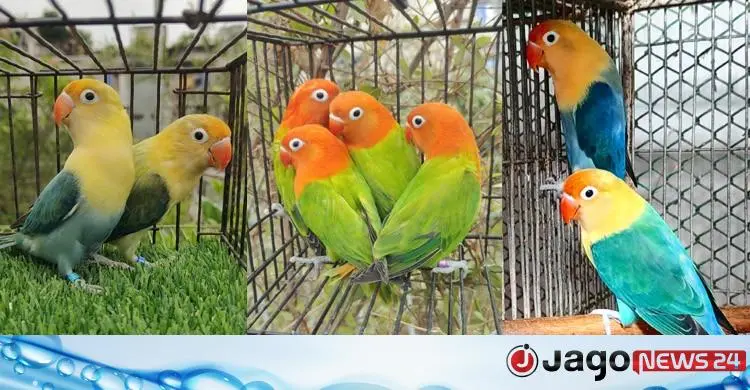
Lovebirds are small, brightly coloured, lively birds, writes Muhammad Shafiqur Rahman. Their original home is Africa and Madagascar, and their genus name is Agapornis. They usually weigh 60-70 grams and are 5-7 inches (13-17 cm) long, with a tail of 1-1.5 inches. A lovebird lives for about 20 years and rarely falls ill. They lay eggs and raise chicks readily in cages, and their varied and charming lives attract people. For these reasons the lovebird is now one of everyone's favourite birds.
Here are the details of keeping and caring for lovebirds, which matter for keeping these beautiful birds healthy and long-lived.
The cage and where to keep it
Lovebirds are called cage birds because they like living in cages, including eating, laying eggs and raising chicks there. The ideal cage measures 36x24x24 inches, though 24x24x24 or 18x18x24 inches is also fine. Do not use a rusty cage: lovebirds often grip the cage bars with their striking beaks.
You can keep lovebirds in a cage on a veranda or roof, or even in a corner of your room; people abroad also keep them indoors. But choose a spot with good light and air, and avoid shady, damp places.
Feeding
The lovebird's main food is a seed mix, made by combining suitable amounts of millet, foxtail millet, sunflower seeds, safflower seeds, paddy, linseed, wheat, niger seed and so on. There are various ratios; one is 3 kg millet, 1.5 kg foxtail millet, 250 g sunflower seeds, 1.5 kg aromatic (polao) paddy, 1 kg canary seed, 200 g niger seed and 200 g hemp seed. Alongside the seed mix it is good to give water spinach, spinach, red amaranth, carrot, sweet pumpkin, green chilli, moringa leaves, coriander leaves, yard-long beans, cabbage, cauliflower, boiled broken maize and, occasionally, boiled split chickpeas. In winter it is best to add a little more sunflower seed to the mix. Honey and apple cider vinegar mixed into the drinking water boost the birds' immunity, and aloe vera in the bathing water reduces insect attacks. Dry egg food, bought or made at home, keeps the birds healthy and strong.
To make egg food, boil one egg (a local hen's egg is better) and mix it with washed, finely chopped greens or vegetables such as pumpkin, pointed gourd, ridge gourd, beans or hog plum. Raw greens are better, as boiling reduces their nutritional value. Chocolate, salt, mushrooms, onions and apple seeds must not be given to lovebirds.
Breeding
It is best to breed lovebirds once they are a year old. They can raise chicks two or three times a year and rest the rest of the time. Sometimes a bird lays eggs that do not hatch. Possible reasons include calcium deficiency, a badly matched pair, birds too young, two females, lack of humidity, poor care of the eggs, the birds feeling unsafe, a shaky cage, fright, or improper mating at laying time. A breeding box should be 8 inches long, 6 inches wide and 6 inches high. For nest building, provide a broom made of date palm leaves.
Cleaning and health
The cage should be cleaned once a week, as a dirty cage breeds disease. Wash the water pot every night and give fresh water in the morning. Remove home-made egg food before it spoils; dry egg food can stay in the cage for a long time. Keep water in a bowl in the cage and the birds will bathe on their own.
Lovebirds are generally hardy and do not suffer much disease. Occasionally they may have indigestion or diarrhoea, and mites can also attack. For a cold you can give honey, ginger, tulsi (holy basil) leaves, mint leaves or unrefined apple cider vinegar. If a bird is injured, apply aloe vera gel to the wound, which reduces pain and speeds healing. For any problem, posting a photo in a bird group on Facebook brings free advice from experienced keepers.
Where to buy
Lovebirds are available at any bird shop, at markets and in places such as Katabon. You can also buy directly from breeders, who can be found in Facebook bird groups. Make sure you buy locally bred lovebirds, not imported ones: imported birds may carry various diseases and should not be bought even if they are cheap. Find out about the breeder before buying, and buy with DNA papers.
Source: Jagonews24. First published in Bengali on The Agro News.


Comments
(0)