
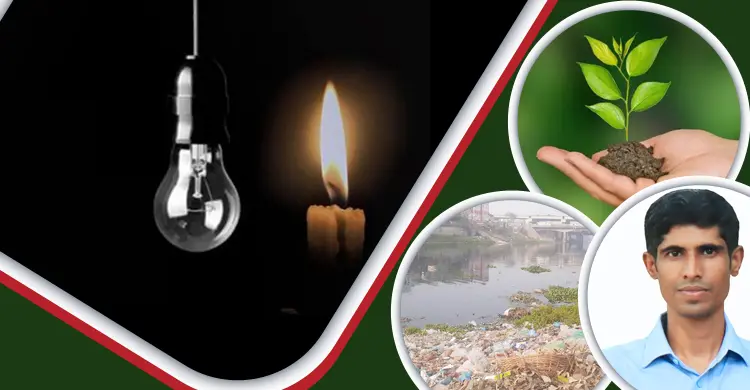
Load-shedding in the country has grown somewhat worse recently, and the intense heatwave has made the situation almost unbearable. Electricity is one of the main drivers of a country's overall economic development, and in both power generation and management Bangladesh still lags well behind other countries. Since the current government came to power, however, the power problem had been on its way to being largely solved through short-, medium- and long-term plans. But as a result of the recent Russia-Ukraine war, Bangladesh, like many other countries, has fallen into a power crisis. The government is trying to solve the problem quickly, especially by importing coal to keep power generation normal. So we must be patient until generation returns to normal.
We must remember that electricity is not a consumer product that can be stored. It is a continuous system: it has to be generated to match demand, so when generation falls, load-shedding is unavoidable. When you leave a light, fan or air conditioner running needlessly, remember that someone else has to sit in the dark or swelter in the heat because of that luxury. Our extravagance in using electricity can therefore be named as one cause of the current crisis. Here one recalls the lines of the poet Krishnachandra Majumdar: "He who in the day, in careless delight, burns a wax candle, will soon find no lamp glowing in his home at night."
Citizens' responsibility
As citizens, we are always indifferent to our duties and to awareness. When a crisis comes, we are busy placing all the blame on the government and keeping ourselves free of it. Just as we have the right as citizens to criticise the government constructively, we must also admit our failure to fulfil our civic duties. The most important subject for discussion now should be the problems caused by climate change. Of rising temperatures and rising load-shedding, the load-shedding problem will be solved when power supply increases, but the problems of rising temperatures are long-term and so is their impact. That makes it the most important issue of our time.
Rivers and trees under threat
In Bangladesh, river encroachment and tree felling, along with environmental pollution, have become routine, and they are among the main causes of rising temperatures. The first blow to Bangladesh's river system came from faulty river management in the British era. Then harmful embankments built in the 1960s in the name of the green revolution, and the World Bank's flood-control embankments in the 1980s, did the rivers more harm than good. Over the past two decades, rivers have been encroached upon and polluted on a large scale to expand industry and trade. Twenty-seven ministries and departments are involved in keeping river flows healthy, keeping rivers free of pollution and preventing encroachment, and there is also a National River Conservation Commission to stop illegal encroachment and pollution. Still, the rivers are not being saved. From villages to cities, we dump all our waste in rivers. Industrial waste ends up in rivers, and silt coming down from upstream settles in them. Waste threatens aquatic life on the one hand and fills up the rivers on the other.
Trees are also immensely important for keeping the country's environment and biodiversity in balance. They absorb excess heat and keep the environment clean, taking in carbon dioxide, a gas harmful to the environment, and releasing oxygen, the essential element for animal life. But under population pressure, trees are being felled day by day. As a result the amount of carbon dioxide in the air is rising and the weather is being damaged. Because of tree felling it is not raining, and the lack of rain is disrupting our daily lives. Tree felling is also costing the environment its balance, destroying biodiversity and breaking down ecosystems.
To keep the environment in balance, any country needs forest on 25% of its land. By that measure, Bangladesh does not have enough forest because of tree felling. Last year, the UN Food and Agriculture Organization (FAO) said in a forestry report that forest covers 13.5 per cent of Bangladesh's total land area. The Ministry of Environment and Forests, however, does not accept this figure; it claims forest covers 17 per cent of the country's total area. Even this figure falls short of what is needed.
A man-made change
We call the present change in climate "man-made", because past climate changes were natural. The situation has reached a point where, if the rate of temperature rise cannot be controlled, our beautiful earth will become unfit to live on in the near future. Rising surface temperatures will increase the water-holding capacity of the upper and lower layers of the atmosphere, so humid regions will become more humid and dry regions drier, making human life, or survival itself, difficult.
Research shows that variability in temperature and rainfall in the country's coastal and inland regions is very large, which is deeply worrying. Over the past 50 years (1968-2018), warmth during both day and night has increased in the country, while cool days and nights have declined sharply. Over the past five decades, the number of warm days has risen by an average of 0.394 days a year in coastal regions and 0.15 days a year inland. In addition, warm spells in coastal regions are growing by 0.507 days every year. Rainfall indices have changed relatively less than temperature.
The adverse effects of climate change over the past 50 years are being felt deeply in Bangladesh. Although the 2015 Paris Agreement set a goal of keeping warming below 2 degrees Celsius, research says that unless surface temperatures are kept even lower, Bangladesh will face ever new challenges from irregularities and abnormalities in weather elements such as temperature, rainfall and wind speed. Because of population density and poverty, changes in temperature and rainfall could take a terrible form, and a lack of capacity will make the situation very fragile.
What we must do
Finally, as citizens we have an important role in keeping the environment pleasant and bearable. We must plant trees through social forestry or on our own initiative, stop polluting the environment and treat our rivers well. This is part of our civic duty. The relevant government ministries and law enforcement agencies must adopt a zero-tolerance policy to keep the environment clean. We must work to ensure a liveable environment for future generations.
I hope that, with the government's sincerity, the load-shedding problem will be solved quickly. But how long it takes to solve the long-term climate problem depends on our actions. I therefore believe that fulfilling our civic duties and raising public awareness will play an important role in tackling the climate crisis.
The writer is a fiction writer and columnist.
Source: Jagonews24. First published in Bengali on The Agro News.

Comments
(0)