
By Dr Forkan Ali
In the drive to change our days, employment is essential. To bring the share of people living below the poverty line down to 15%, incomes must rise and unemployment must end. The livestock sector alone could create new jobs for one crore people in the next six months.
According to BBS and the Department of Agricultural Extension (DAE), Bangladesh has 1 crore 50 lakh 89 thousand farm households and 2 crore 29 lakh 31 thousand people working in agriculture. Some of them face seasonal or partial unemployment: sometimes there is work, sometimes there is not. Bangladesh has 4,488 unions and 87,623 villages large and small. If an average of 120 beneficiaries were selected from each village, a total of 1 crore 5 lakh 14 thousand 760 beneficiaries could be chosen.
120 beneficiaries per village
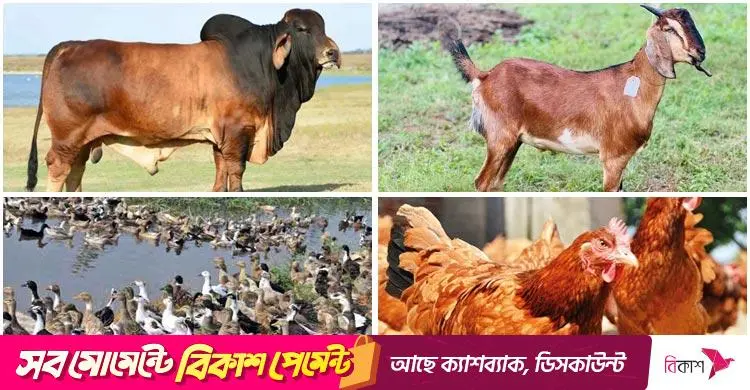
New jobs could be created for them through the livestock sector alone. The 120 beneficiaries would include unemployed young men and women, widows, abandoned wives, educated unemployed youth and keen farmers. In each village, 30 would receive training in dairy cow rearing, 30 in cattle fattening, 30 in goat rearing and 30 in bio-secure poultry farming, and bank loans at low or zero interest should be arranged for them.
The nearest commercial bank would lend to them and recover the loans, with the local livestock office supervising. For this, a "livestock extension programme" should be launched through the upazila livestock offices, along the lines of the Department of Agricultural Extension. Energetic, hardworking and tireless beneficiaries should be chosen from every village in the upazila, motivated, and given the necessary advice, technical knowledge and proper hands-on training. Each farm should be inspected regularly and any problem solved as soon as it appears.
Vaccines should be given to prevent disease, and farmers must be made to understand how to set up healthy, bio-secure farms. They should be taught about animal nutrition so they can feed nutritious rations. If farm managers understand management, housing, lighting, temperature, relative humidity, disease prevention and treatment, feed management and drainage, every farm will be profitable. The government should arrange special "interest-free" or "low-interest" loans for entrepreneurs through a commercial bank.
Why livestock
The country's small, marginal and landless farmers cannot be given more land for crops, because land is limited, and not every farmer has land for a pond. But anyone with at least a homestead can keep a cow, two goats and a few ducks and chickens. So the livestock sector offers ample scope to increase farmers' employment and income.
Shortfalls in milk, meat and eggs
According to the Department of Livestock Services, national milk demand was 13.01 million tonnes against production of 2.65 million tonnes, a shortfall of 10.36 million tonnes. Per capita demand is 250 ml a day, but availability was only 51 ml. Annual meat demand was 6.26 million tonnes against production of only 1.04 million tonnes, a shortfall of 5.32 million tonnes. Per capita demand is 120 grams a day, but availability was only 19.98 grams.
Egg demand was 14,828 million against production of only 5,654 million, a shortfall of 9,174 million. Per capita demand is 104 eggs a year, but availability was only 39. This shows how urgent it is to start a livestock extension programme. Although livestock is a sector of huge potential, its annual growth rate in the national economy was only 2.41 per cent, and its contribution to the national economy only 2.79 per cent a year, which could be raised much further.
Leather alone earned 4.31 per cent of foreign currency a year, which could also be increased. Cow dung and poultry droppings are excellent organic fertiliser, yet in the fiscal year only 80 million tonnes of organic fertiliser was produced from them, a figure that could be raised a great deal.
The people of this country have energy, enthusiasm, dreams and ambition, and a history of winning victory with their blood. With a little patronage, motivation and extension work, the livestock sector could create jobs on a large scale, and we ourselves would contribute to the country's economic development.
The writer is a researcher and former principal of Rupsha College.
Source: Jagonews24. First published in Bengali on The Agro News.


Comments
(0)