
By Istiak Ahmed
After much wandering, this time I set off on a trip to India. Our vehicle was Shyamoli Paribahan's SP section bus from Dhaka to Siliguri. We left Arambagh at 6pm and reached Burimari, the familiar border crossing in the north of the country, at 7am. Immigration at the Burimari-Changrabandha border opens only at 9am, so with plenty of time in hand we freshened up and had breakfast.
Travel tax and border formalities
Those who want to travel to India by road can pay the travel tax in Dhaka, at Sonali Bank or online. The travel tax is currently Tk 1,000 for adults and Tk 500 for children aged 5 to 12; children under 5 are exempt.
Those who arrive without paying the travel tax can still pay it at the port. For those not travelling on a through bus, some agencies are available to help, and with their help you can complete immigration easily.
On the way out, on the Bangladesh side it is immigration first and then the customs check; on the Indian side it is customs first and then immigration. Those in employment must remember to carry a no-objection certificate (NOC). Photocopies of your passport and visa are needed both going and coming back, so take plenty of copies.
The border was quite busy, so by the time we had finished immigration, exchanged taka for rupees and boarded the bus, it was nearly noon. Next came the roughly 78 km from Changrabandha to Siliguri. Changrabandha is in Cooch Behar district, while Siliguri is part of Darjeeling district, so anyone who says on reaching Siliguri that they have arrived in Darjeeling is not wrong.
The Shyamoli SP section bus's last stop is at Mallaguri Mor. The NR section uses Hyundai buses, but in terms of border and counter service the SP section has always been excellent. We had barely rested after getting off the bus when our car arrived.
Choosing an offbeat destination
Most Bangladeshis visiting India go to Darjeeling or to Gangtok in Sikkim, so these two most common tourist spots are busy almost all year. Since it is now the peak season, we set out with a plan to relax somewhere a little different.
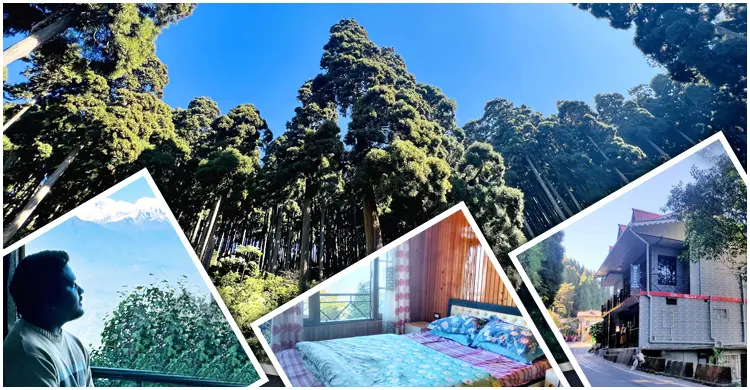
So we chose the offbeat destination of Lamahatta, where our homestay had been booked in advance. Pine forest on one side and a view of the great Kanchenjunga on the other: where the two meet is Lamahatta. Via Mallaguri Mor and the Sevoke road, it is about 65 km away.
Siliguri today is not what it used to be; there are traffic jams at every junction. We set off at 3pm, and as we sped through the Sevoke forest beyond the town, the cool air of the woods after the heat of the city refreshed both mind and body.
Not long ago, a cloudburst caused about 100 hectares of Sikkim's Lhonak lake to vanish. The lake's water came down the Teesta as a flash flood, and the Teesta destroyed everything in its path, including a hydroelectric power plant, river embankments and roads.
The evidence is still there along the Teesta: broken roads and landslide rocks all along the way. The familiar greenish Teesta is now just layers of sand, a reminder of the power of nature.
Evening falls early in the hills, and night came soon after we set off. Via Kalimpong, we then climbed and descended the hill roads through the tea gardens of Tribeni and Peshok. Having left home the previous evening, we reached our homestay after a journey of about 26 hours, a little after 7pm.
The homestay
Green View Homestay is one of the best homestays in the offbeat destination of Lamahatta. Two rooms on the third floor had been reserved for us. The homestay has four rooms in all, two on the third floor and two on the first floor, with the dining room and kitchen on the second floor. Although it is a homestay, you have the place to yourself: unless you come down at mealtimes, you will not see anyone.
Every room at Green View is very pretty and clean, furnished with excellent eco-friendly fittings. Each has a double bed, two divans, a dressing table and a wardrobe. The walls and floors are covered in wood so the cold is felt less. Each room has a clean, spacious bathroom with hot water. Lamahatta is quite cold: when we arrived the temperature had dropped to about 11 degrees, and as the night wore on it fell to 8 degrees.
Every room has plenty of quilts, blankets and comforters, and a balcony. Step out onto it and you will see thousands of fireflies. Not fireflies, in fact, but the electric lights of Darjeeling to the west and the towns of Sikkim to the east, and a sky full of countless stars.
As soon as we arrived, hot water was brought, and a little later steaming tea with pakoras. After tea and a wash, it was time to go out and see the town at night. Next to our homestay is a viewpoint from which you can see from Darjeeling to Namchi, the whole of South Sikkim.
Many people sit along the road selling organic vegetables. We walked around the town at night and returned to our room. We had wanted to walk to a Bengali cafe a little way off for a late coffee, but local dadas warned us against it, saying it was the time when leopards come out.
Leopards are said to move through the pine forest here. With luck, you may also see deer at the homestay itself, and quite large flying foxes can be seen there. As soon as evening falls, everything goes silent.
The nights in Lamahatta are even more secluded. There is no noise, as if you were alone in an uninhabited land surrounded by nature. At night nothing can be heard except the steady calls of some unfamiliar insects.
Peshok Road, the main road from Darjeeling to Sikkim or Kalimpong, runs right in front of the homestay. Red, blue, purple and yellow wildflowers bloom along the roadside all the time. If you want to visit Lamahatta, remember that the best time is October to December.
Food, people and the view
Next came dinner: hot rice, papad, dal, vegetables, mashed potato and chicken. If you tell them in advance, the aunty arranges halal chicken. Essentially, all the homestays in Lamahatta belong to one family: the homestays and shops are owned by brothers and sisters of the same family. A number of Muslim residents also live here, and halal meat is mainly supplied by them. Even the woman who sometimes helps the aunty who owns our homestay with the cooking is Bengali and Muslim.
After dinner, we waited for morning. The homestay's uncle told us at the outset to get up by 5:40am, because sunrise was at 5:46 and can be seen from our room's balcony, and we should not miss it. When the first light of dawn falls on Kanchenjunga, the peak changes colour moment by moment, from pale pink to orange and yellow, right before your eyes.
Bangladeshis long so much to see Kanchenjunga, and here it can be seen from the bed in this homestay. In season, the homestay charges 1,500 rupees per person. That covers the night's stay along with breakfast, lunch, evening snacks and dinner, plus unlimited Kanchenjunga.
To escape the bustle of everyday life, you can visit Lamahatta (locally pronounced Lamatta), a Sherpa village far from the glitter of Darjeeling. At an altitude of 5,700 feet, the village is home to Tamang, Bhutia, Drukpa and other hill communities.
The Indian government arranged for Tibetan lamas to settle here, which is how the place got the name Lamahatta. It is a treasure of varied beauty, where pine forest, hills, sky, silence and the simplicity of the villagers blend into one.
Useful information
- Bus fare from Dhaka to Siliguri: Tk 2,000
- Shyamoli Paribahan Siliguri bus counter: +91 9153037970
- Car driver Sanjoy da: +91 7029283482
- Green View Homestay, Lamahatta: +91 8972195314
For more details about travelling to Lamahatta, you can watch a four-part vlog series on YouTube called Letter From North, which sets out all the costs, contact numbers and ways to get there.
Source: Jagonews24. First published in Bengali on The Agro News.
Comments
(0)